Ghafouri Moghaddam Mostafa, Butcher Buntika A
Integrative Ecology Laboratory, Department of Biology, Faculty of Science, Chulalongkorn University, Phayathai Road, Pathumwan, Bangkok 10330, Thailand.
Insects. 2023 Mar 30;14(4):338. doi: 10.3390/insects14040338.
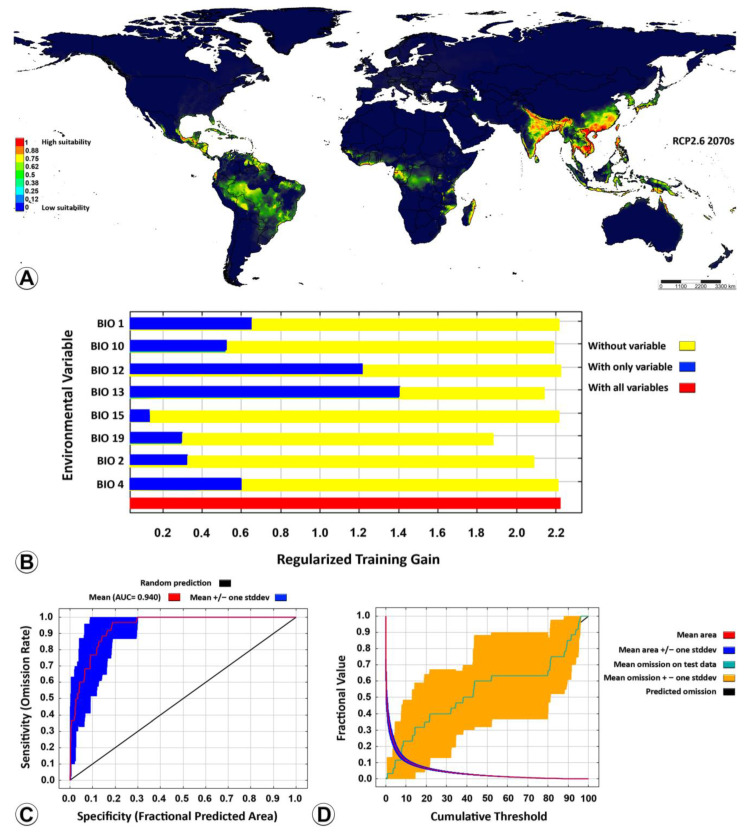
The parasitoid wasp Ashmead (Braconidae: Microgastrinae) is an important natural enemy of caterpillars and of a range of noctuids, including pest species of armyworms ( spp.). Here, the wasp is redescribed and, for the first time, illustrated based on the holotype. An updated list of all the species attacking the noctuid spp. along with a discussion on host-parasitoid-food plant associations is offered. Based on information about the actual distribution of and a set of bioclimatic variables, the maximum entropy (MaxEnt) niche model and the quantum geographic information system (QGIS) were explored to predict the potential distribution of this wasp in a global context. The worldwide geographical distribution of potential climatic suitability of at present and in three different periods in the future was simulated. The relative percent contribution score of environmental factors and the Jackknife test were combined to identify dominant bioclimatic variables and their appropriate values influencing the potential distribution of . The results showed that under current climate conditions, the prediction of the maximum entropy model highly matches the actual distribution, and that the obtained value of simulation accuracy was very high. Likewise, the distribution of was mainly affected by five bioclimatic variables, listed in order of importance as follows: precipitation during the wettest month (BIO13), annual precipitation (BIO12), annual mean temperature (BIO1), temperature seasonality (BIO4), and mean temperature during the warmest quarter (BIO10). In a global context, the suitable habitat of would be mainly in tropical and subtropical countries. Furthermore, under the four greenhouse gas concentration scenarios (representative concentration pathways: RCP2.6, RCP4.5, RCP6.0, and RCP8.5) in the future period of the 2070s, the areas with high, medium, and low suitability showed varying degrees of change from current conditions and are expected to expand in the future. This work provides theoretical backing for studies associated with the safeguarding of the environment and pest management.
寄生黄蜂阿什米德(茧蜂科:小腹茧蜂亚科)是毛虫以及包括害虫种类粘虫(夜蛾科物种)在内的一系列夜蛾科昆虫的重要天敌。在此,对该黄蜂进行了重新描述,并首次基于正模标本进行了绘图。提供了所有攻击夜蛾科物种的阿什米德黄蜂物种的最新列表,以及关于寄主 - 寄生蜂 - 食物植物关联的讨论。基于阿什米德黄蜂的实际分布信息和一组生物气候变量,探索了最大熵(MaxEnt)生态位模型和量子地理信息系统(QGIS),以预测该黄蜂在全球范围内的潜在分布。模拟了阿什米德黄蜂目前以及未来三个不同时期潜在气候适宜性的全球地理分布。结合环境因素的相对贡献百分比得分和刀切法检验,以确定影响阿什米德黄蜂潜在分布的主要生物气候变量及其适宜值。结果表明,在当前气候条件下,最大熵模型的预测与实际分布高度匹配,且模拟精度值非常高。同样,阿什米德黄蜂的分布主要受五个生物气候变量影响,按重要性顺序排列如下:最湿月降水量(BIO13)、年降水量(BIO12)、年平均温度(BIO1)、温度季节性(BIO4)和最暖季平均温度(BIO10)。在全球范围内,阿什米德黄蜂的适宜栖息地主要位于热带和亚热带国家。此外,在2070年代未来时期的四种温室气体浓度情景(代表性浓度路径:RCP2.6、RCP4.5、RCP6.0和RCP8.5)下,高、中、低适宜性区域与当前状况相比显示出不同程度的变化,预计未来会扩大。这项工作为与环境保护和害虫管理相关的研究提供了理论支持。