US Army Institute of Surgical Research, Fort Sam Houston, San Antonio, TX 78234, USA.
The Geneva Foundation, Tacoma, WA 98402, USA.
Int J Mol Sci. 2023 Apr 19;24(8):7494. doi: 10.3390/ijms24087494.
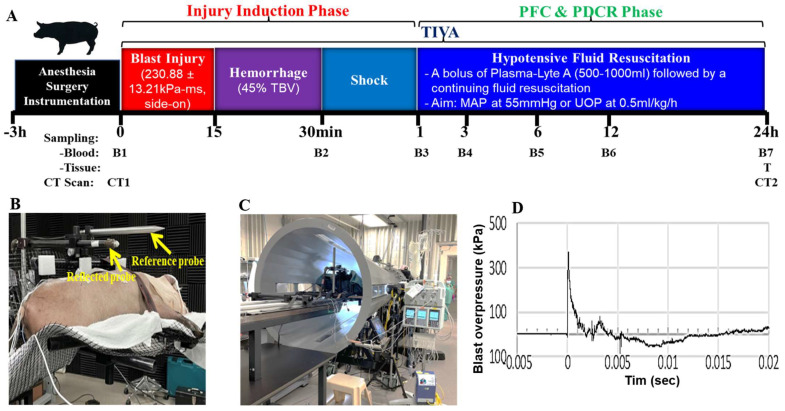
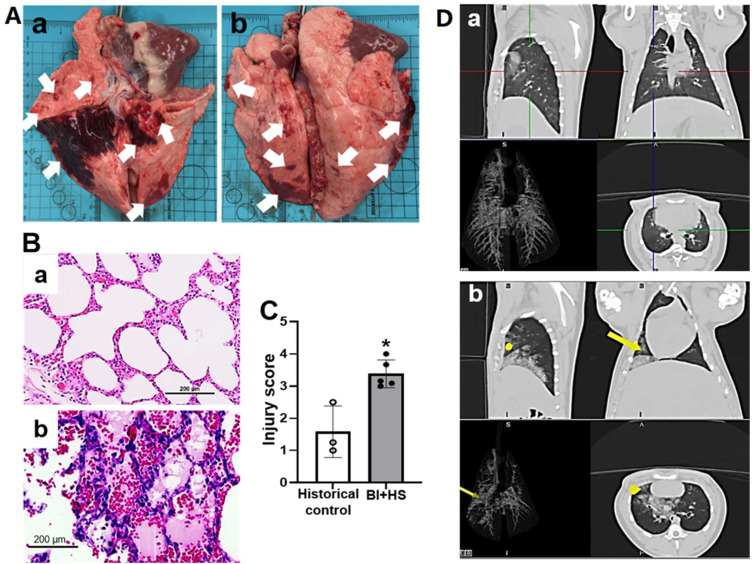
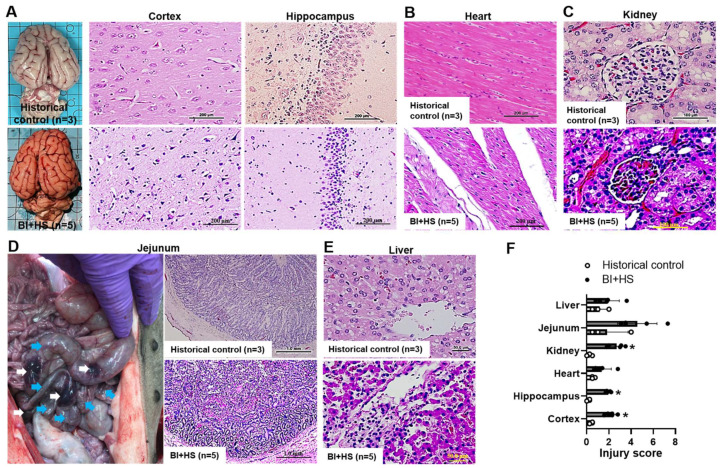
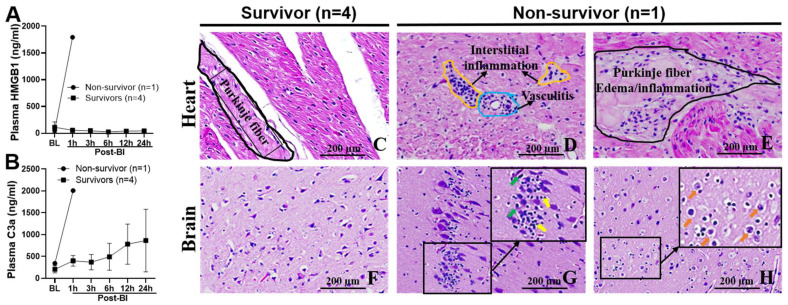
Trauma-related hemorrhagic shock (HS) remains a leading cause of death among military and civilian trauma patients. We have previously shown that administration of complement and HMGB1 inhibitors attenuate morbidity and mortality 24 h after injury in a rat model of blast injury (BI) and HS. To further validate these results, this study aimed to develop a swine model and evaluate BI+HS-induced pathophysiology. Anesthetized Yucatan minipigs underwent combined BI and volume-controlled hemorrhage. After 30 min of shock, animals received an intravenous bolus of PlasmaLyte A and a continuous PlasmaLyte A infusion. The survival rate was 80% (4/5), and the non-survivor expired 72 min post-BI. Circulating organ-functional biomarkers, inflammatory biomarkers, histopathological evaluation, and CT scans indicated evidence of multiple-organ damage, systemic innate immunological activation, and local tissue inflammation in the injured animals. Interestingly, a rapid and dramatic increase in plasma levels of HMGB1 and C3a and markedly early myocarditis and encephalitis were associated with early death post-BI+HS. This study suggests that this model reflects the immunopathological alterations of polytrauma in humans during shock and prolonged damage control resuscitation. This experimental protocol could be helpful in the assessment of immunological damage control resuscitation approaches during the prolonged care of warfighters.
创伤相关失血性休克(HS)仍然是军事和平民创伤患者死亡的主要原因。我们之前已经表明,在爆炸伤(BI)和 HS 的大鼠模型中,给予补体和 HMGB1 抑制剂可减轻损伤后 24 小时的发病率和死亡率。为了进一步验证这些结果,本研究旨在开发猪模型并评估 BI+HS 引起的病理生理学变化。麻醉的尤卡坦小型猪接受了联合 BI 和容量控制出血。在休克 30 分钟后,动物接受了 PlasmaLyte A 静脉推注和持续 PlasmaLyte A 输注。存活率为 80%(4/5),非幸存者在 BI 后 72 分钟死亡。循环器官功能生物标志物、炎症生物标志物、组织病理学评估和 CT 扫描表明,受伤动物存在多器官损伤、全身固有免疫激活和局部组织炎症的证据。有趣的是,HMGB1 和 C3a 血浆水平的快速和显著增加以及早期心肌炎和脑炎与 BI+HS 后的早期死亡有关。本研究表明,该模型反映了休克和长时间损伤控制性复苏期间人类多发伤的免疫病理变化。该实验方案有助于评估在长时间对战士进行护理期间免疫性损伤控制性复苏方法。