Wetwittayakhlang Panu, Gonczi Lorant, Golovics Petra A, Kurti Zsuzsanna, Pandur Tunde, David Gyula, Erdelyi Zsuzsanna, Szita Istvan, Lakatos Laszlo, Lakatos Peter L
Division of Gastroenterology and Hepatology, McGill University Health Centre, Montreal, QC H3G 1A4, Canada.
Gastroenterology and Hepatology Unit, Division of Internal Medicine, Faculty of Medicine, Prince of Songkla University, Hat Yai 90110, Thailand.
J Clin Med. 2023 Apr 21;12(8):3026. doi: 10.3390/jcm12083026.
Data from population-based studies investigating trends in environmental factors associated with inflammatory bowel disease (IBD) is lacking. We aimed to assess long-term time trends of environmental and socioeconomic factors in IBD patients from a well-defined population-based cohort from Veszprem, Hungary.
Patients were included between 1 January 1977, and 31 December 2020. Trends of environmental and socioeconomic factors were evaluated in three periods based on the decade of diagnosis, representing different therapeutic eras: cohort-A,1977-1995; cohort-B,1996-2008 (immunomodulator era); and cohort-C, 2009-2020 (biological era).
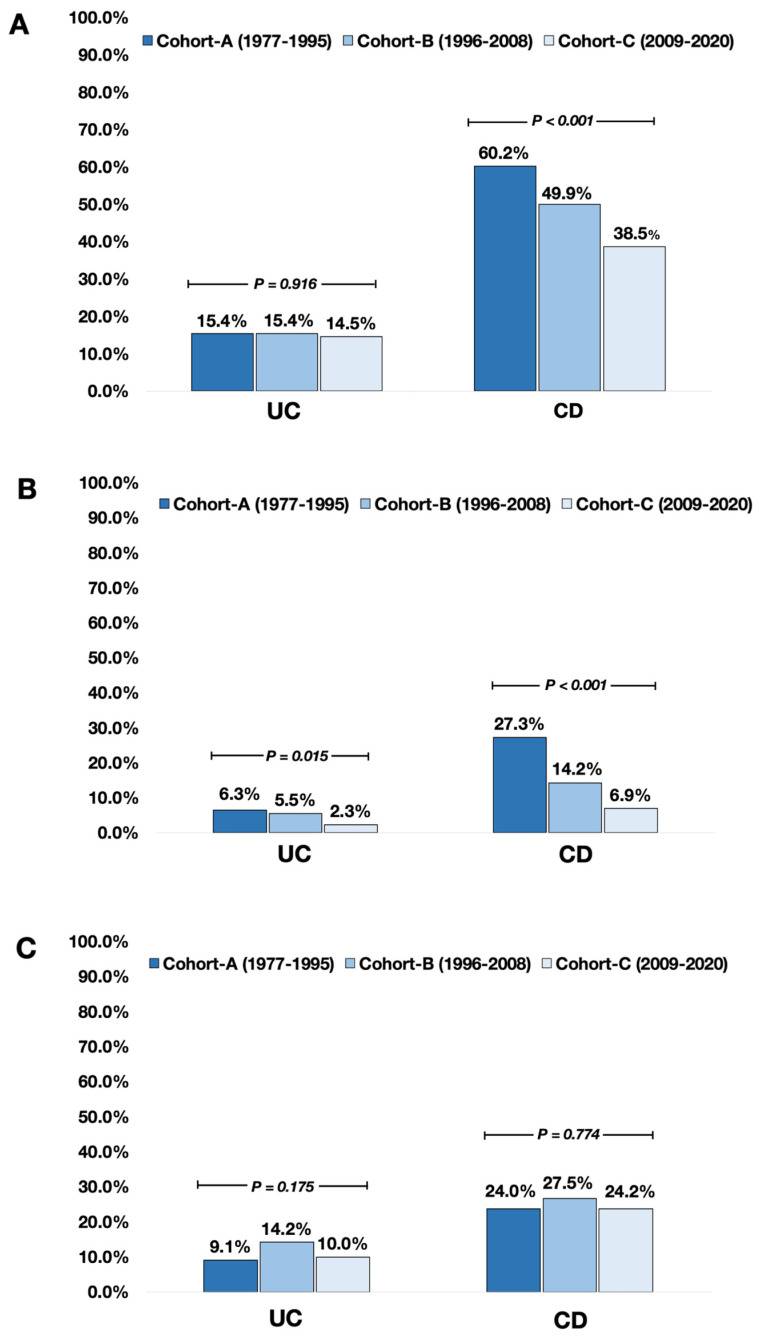
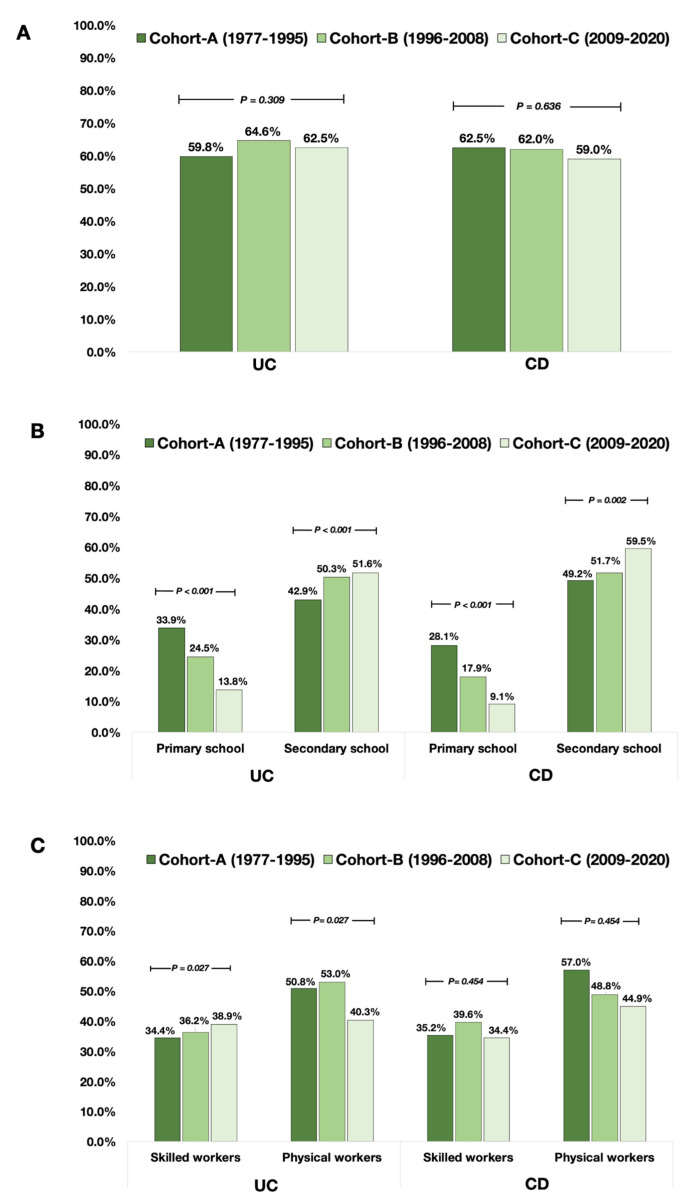
A total of 2240 incident patients with IBD were included (ulcerative colitis (UC) 61.2%, male 51.2%, median age at diagnosis: 35 years (IQR 29-49)). Rates of active smoking significantly decreased over time in Crohn's disease (CD): 60.2%, 49.9%, and 38.6% in cohorts A/B/C ( < 0.001). In UC, the rates were low and stable: 15.4%, 15.4%, and 14.5% in cohorts A/B/C ( = 0.981). Oral contraceptive use was more common in CD compared to UC (25.0% vs. 11.6%, < 0.001). In UC, prevalence of appendectomy before diagnosis decreased over time: 6.4%, 5.5%, and 2.3% in cohorts A/B/C ( = 0.013). No significant changes were found in the socio-geographic characteristics of the IBD population (urban living: UC, 59.8%/64.8%/ 62.5% ( = 0.309) and CD, 62.5%/ 62.0%/ 59.0% ( = 0.636), in cohorts A/B/C). A greater percentage of patients had completed secondary school as the highest education level in later cohorts in both UC (42.9%/50.2%/51.6%, < 0.001) and CD (49.2%/51.7%/59.5%, = 0.002). A higher percentage of skilled workers (34.4%/36.2%/38.9%, = 0.027) was found in UC, but not in CD ( = 0.454).
The association between trends of known environmental factors and IBD is complex. Smoking has become less prevalent in CD, but no other major changes occurred in socioeconomic factors over the last four decades that could explain the sharp increase in IBD incidence.
缺乏基于人群的研究数据来调查与炎症性肠病(IBD)相关的环境因素趋势。我们旨在评估来自匈牙利维斯普雷姆一个明确的基于人群队列的IBD患者的环境和社会经济因素的长期时间趋势。
纳入1977年1月1日至2020年12月31日期间的患者。根据诊断年代将环境和社会经济因素的趋势分为三个时期,代表不同的治疗时代:队列A,1977 - 1995年;队列B,1996 - 2008年(免疫调节剂时代);队列C,2009 - 2020年(生物制剂时代)。
共纳入2240例IBD新发病例(溃疡性结肠炎(UC)占61.2%,男性占51.2%,诊断时的中位年龄:35岁(四分位间距29 - 49岁))。克罗恩病(CD)患者中主动吸烟率随时间显著下降:队列A/B/C中分别为60.2%、49.9%和38.6%(P < 0.001)。在UC中,吸烟率较低且稳定:队列A/B/C中分别为15.4%、15.4%和14.5%(P = 0.981)。与UC相比,CD患者中口服避孕药的使用更为常见(25.0%对11.6%,P < 0.001)。在UC中,诊断前阑尾切除术的患病率随时间下降:队列A/B/C中分别为6.4%、5.5%和2.3%(P = 0.013)。IBD患者的社会地理特征无显著变化(城市居住:UC,队列A/B/C中分别为59.8%/64.8%/62.5%(P = 0.309);CD,队列A/B/C中分别为62.5%/62.0%/59.0%(P = 0.636))。在UC(42.9%/50.2%/51.6%,P < 0.001)和CD(49.2%/51.7%/59.5%,P = 0.002)中,后一个队列中完成中学教育作为最高教育水平的患者比例更高。在UC中发现熟练工人的比例更高(34.4%/36.2%/38.9%,P = 0.027),但在CD中未发现显著变化(P = 0.454)。
已知环境因素趋势与IBD之间的关联很复杂。吸烟在CD中变得不那么普遍,但在过去四十年中社会经济因素没有其他重大变化可以解释IBD发病率的急剧上升。