Adolph Ramona S, Beck Eileen, Schweimer Kristian, Di Fonzo Andrea, Weyand Michael, Rösch Paul, Wöhrl Birgitta M, Steegborn Clemens
Department of Biochemistry, University of Bayreuth, 95440 Bayreuth, Germany.
Department of Biopolymers, University of Bayreuth, 95440 Bayreuth, Germany.
Life (Basel). 2023 Apr 4;13(4):949. doi: 10.3390/life13040949.
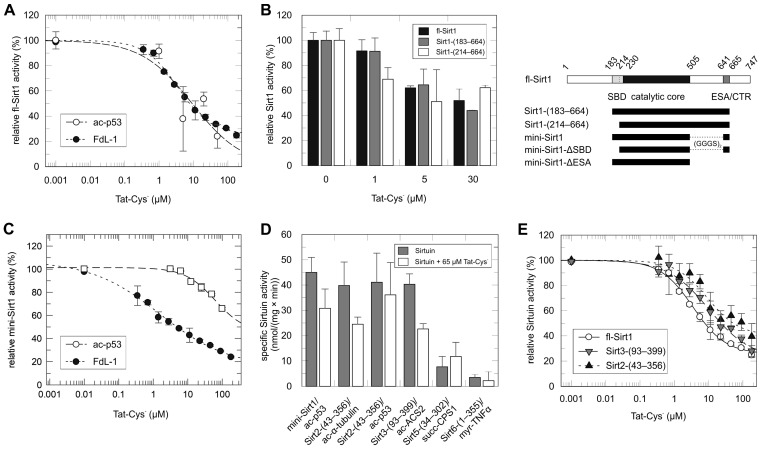
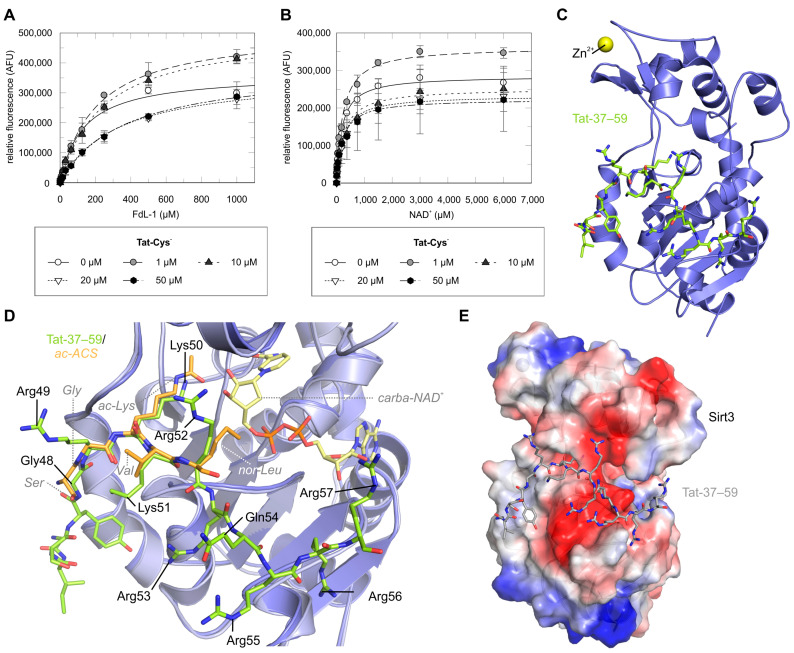
Sirtuins are NAD-dependent protein lysine deacylases implicated in metabolic regulation and aging-related dysfunctions. The nuclear isoform Sirt1 deacetylates histones and transcription factors and contributes, e.g., to brain and immune cell functions. Upon infection by human immunodeficiency virus 1 (HIV1), Sirt1 deacetylates the viral transactivator of transcription (Tat) protein to promote the expression of the viral genome. Tat, in turn, inhibits Sirt1, leading to the T cell hyperactivation associated with HIV infection. Here, we describe the molecular mechanism of Tat-dependent sirtuin inhibition. Using Tat-derived peptides and recombinant Tat protein, we mapped the inhibitory activity to Tat residues 34-59, comprising Tat core and basic regions and including the Sirt1 deacetylation site Lys50. Tat binds to the sirtuin catalytic core and inhibits Sirt1, Sirt2, and Sirt3 with comparable potencies. Biochemical data and crystal structures of sirtuin complexes with Tat peptides reveal that Tat exploits its intrinsically extended basic region for binding to the sirtuin substrate binding cleft through substrate-like β-strand interactions, supported by charge complementarity. Tat Lys50 is positioned in the sirtuin substrate lysine pocket, although binding and inhibition do not require prior acetylation and rely on subtle differences to the binding of regular substrates. Our results provide mechanistic insights into sirtuin regulation by Tat, improving our understanding of physiological sirtuin regulation and the role of this interaction during HIV1 infection.
沉默调节蛋白是依赖烟酰胺腺嘌呤二核苷酸(NAD)的蛋白质赖氨酸脱酰基酶,与代谢调节和衰老相关功能障碍有关。核异构体Sirt1使组蛋白和转录因子脱乙酰化,并例如对大脑和免疫细胞功能有贡献。在被人类免疫缺陷病毒1(HIV1)感染后,Sirt1使病毒转录激活因子(Tat)蛋白脱乙酰化,以促进病毒基因组的表达。反过来,Tat抑制Sirt1,导致与HIV感染相关的T细胞过度激活。在这里,我们描述了Tat依赖性沉默调节蛋白抑制的分子机制。使用Tat衍生肽和重组Tat蛋白,我们将抑制活性定位到Tat的34 - 59位残基,包括Tat核心区和碱性区,其中包括Sirt1脱乙酰化位点赖氨酸50。Tat与沉默调节蛋白催化核心结合,并以相当的效力抑制Sirt1、Sirt2和Sirt3。沉默调节蛋白与Tat肽复合物的生化数据和晶体结构表明,Tat利用其固有的延伸碱性区域,通过类似底物的β链相互作用结合到沉默调节蛋白底物结合裂隙,电荷互补性对此有支持作用。Tat赖氨酸50位于沉默调节蛋白底物赖氨酸口袋中,尽管结合和抑制不需要预先乙酰化,并且依赖于与常规底物结合的细微差异。我们的结果为Tat对沉默调节蛋白的调控提供了机制性见解,增进了我们对生理性沉默调节蛋白调控以及这种相互作用在HIV1感染过程中作用的理解。