
运动疗法联合肌内效贴治疗髌股疼痛综合征的效果。
Effect of Adding Kinesio Taping to Exercise Therapy in the Treatment of Patellofemoral Pain Syndrome.
机构信息
Department of Sports Medical Center, Anam Hospital, Korea University College of Medicine, Seoul 02841, Republic of Korea.
Department of Physical Medicine and Rehabilitation, Harvard Medical School/Spaulding Rehabilitation Hospital, Boston, MA 02115, USA.
出版信息
Medicina (Kaunas). 2023 Apr 12;59(4):754. doi: 10.3390/medicina59040754.
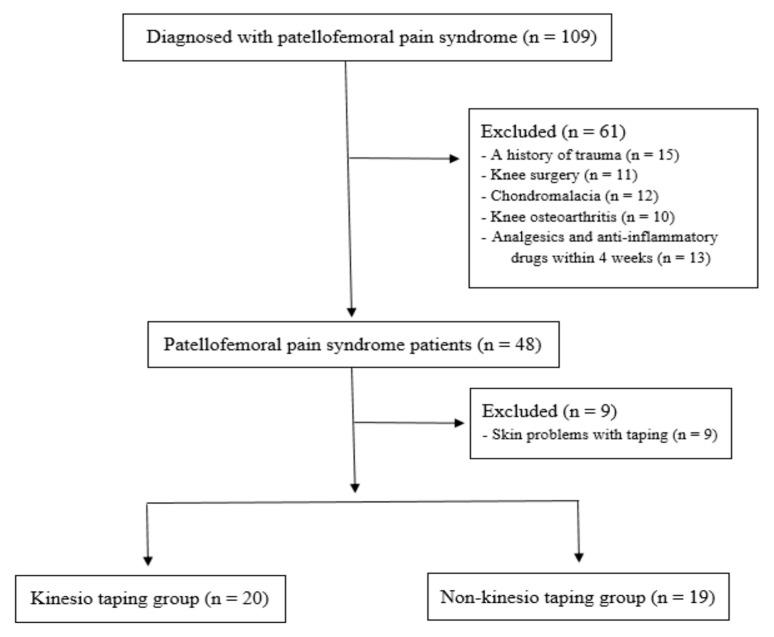
Patellar taping has been widely used for the primary or adjunctive treatment of patellofemoral pain syndrome (PFPS); however, there are limited data in terms of functional outcomes. This study aimed to investigate whether there is any beneficial effect of adding Kinesio Taping (KT) to exercise therapy in the treatment of PFPS. Twenty patients (27.5 ± 5.4 years) with PFPS who applied KT and 19 patients (27.3 ± 7.4 years) who did not were included in this study. Quadriceps muscle strength and acceleration time (AT) were assessed using an isokinetic device. Patient-reported outcomes were evaluated using the Kujala anterior knee pain scale (AKPS). Both groups underwent one-month exercise therapy. There was no significant difference in quadriceps strength, AT, and AKPS at baseline and at 1 month between the taping and non-taping groups ( > 0.05). However, for quadriceps muscle strength, the effect of time*group interaction was statistically significant (F(1.37) = 4.543, < 0.05, partial eta squared 0.109), showing that improvement in the quadriceps strength was higher in the non-taping group than that in the taping group. Adding KT to exercise therapy did not elicit extra benefits in quadriceps muscle strength and AT, and AKPS among PFPS with abnormal patellar tracking at one month.
髌腱贴扎在髌股疼痛综合征(PFPS)的主要或辅助治疗中被广泛应用;然而,其在功能结果方面的数据有限。本研究旨在探讨在 PFPS 的治疗中,添加运动疗法的肌内效贴布(KT)是否有任何有益效果。
本研究纳入了 20 名(27.5±5.4 岁)接受 KT 治疗和 19 名(27.3±7.4 岁)未接受 KT 治疗的 PFPS 患者。使用等速设备评估股四头肌力量和加速时间(AT)。采用 Kujala 膝关节前痛量表(AKPS)评估患者报告的结果。两组均接受为期 1 个月的运动疗法。
在基线和 1 个月时,贴扎组和非贴扎组之间的股四头肌力量、AT 和 AKPS 均无显著差异(>0.05)。然而,对于股四头肌力量,时间*组交互作用的效果具有统计学意义(F(1.37)=4.543,<0.05,偏 eta 平方 0.109),表明非贴扎组的股四头肌力量改善程度高于贴扎组。
在 1 个月时,对于存在髌股轨迹异常的 PFPS 患者,添加 KT 到运动疗法并未在股四头肌力量、AT 和 AKPS 方面产生额外的益处。

 Zotero 插件