Hirai Hana, Hong Jing, Fujii Wataru, Sanjoba Chizu, Goto Yasuyuki
Laboratory of Molecular Immunology, Graduate School of Agricultural and Life Sciences, The University of Tokyo, Tokyo 113-8657, Japan.
Laboratory of Biomedical Science, Graduate School of Agricultural and Life Sciences, The University of Tokyo, Tokyo 113-8657, Japan.
Pathogens. 2023 Apr 13;12(4):593. doi: 10.3390/pathogens12040593.
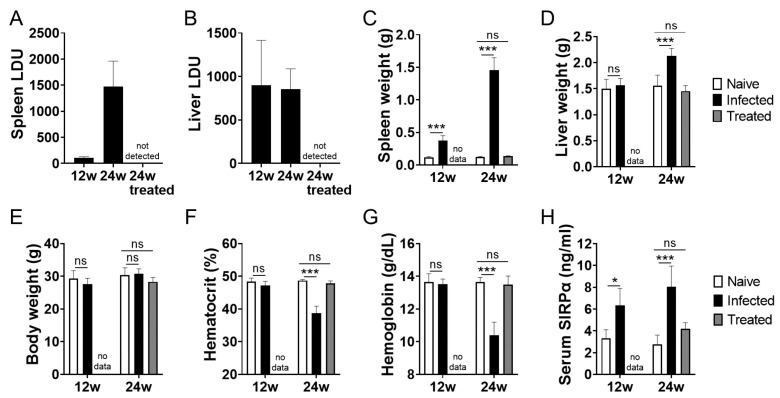
The shedding of cell surface receptors may bring synergistic outcomes through the loss of receptor-mediated cell signaling and competitive binding of the shed soluble receptor to its ligand. Thus, soluble receptors have both biological importance and diagnostic importance as biomarkers in immunological disorders. Signal regulatory protein α (SIRPα), one of the receptors responsible for the 'don't-eat-me' signal, is expressed by myeloid cells where its expression and function are in part regulated by proteolytic cleavage. However, reports on soluble SIRPα as a biomarker are limited. We previously reported that mice with experimental visceral leishmaniasis (VL) manifest anemia and enhanced hemophagocytosis in the spleen accompanied with decreased SIRPα expression. Here, we report increased serum levels of soluble SIRPα in mice infected with , a causative agent of VL. Increased soluble SIRPα was also detected in a culture supernatant of macrophages infected with in vitro, suggesting the parasite infection promotes ectodomain shedding of SIRPα on macrophages. The release of soluble SIRPα was partially inhibited by an ADAM proteinase inhibitor in both LPS stimulation and infection, suggesting a shared mechanism for cleavage of SIRPα in both cases. In addition to the ectodomain shedding of SIRPα, both LPS stimulation and infection induced the loss of the cytoplasmic region of SIRPα. Although the effects of these proteolytic processes or changes in SIRPα still remain unclear, these proteolytic regulations on SIRPα during infection may explain hemophagocytosis and anemia induced by infection, and serum soluble SIRPα may serve as a biomarker for hemophagocytosis and anemia in VL and the other inflammatory disorders.
细胞表面受体的脱落可能通过受体介导的细胞信号传导丧失以及脱落的可溶性受体与其配体的竞争性结合带来协同效应。因此,可溶性受体作为免疫紊乱中的生物标志物具有生物学重要性和诊断重要性。信号调节蛋白α(SIRPα)是负责“别吃我”信号的受体之一,由髓样细胞表达,其表达和功能部分受蛋白水解切割调节。然而,关于可溶性SIRPα作为生物标志物的报道有限。我们之前报道过,患有实验性内脏利什曼病(VL)的小鼠表现出贫血,脾脏中的噬血细胞增多增强,同时伴有SIRPα表达降低。在这里,我们报道感染VL病原体的小鼠血清中可溶性SIRPα水平升高。在体外感染该病原体的巨噬细胞培养上清液中也检测到可溶性SIRPα增加,这表明寄生虫感染促进了巨噬细胞上SIRPα的胞外域脱落。在LPS刺激和该病原体感染中,ADAM蛋白酶抑制剂都部分抑制了可溶性SIRPα的释放,这表明在这两种情况下SIRPα切割存在共同机制。除了SIRPα的胞外域脱落,LPS刺激和该病原体感染都诱导了SIRPα细胞质区域的丧失。尽管这些蛋白水解过程或SIRPα变化的影响仍不清楚,但在该病原体感染期间对SIRPα的这些蛋白水解调节可能解释了感染诱导的噬血细胞增多和贫血,血清可溶性SIRPα可能作为VL和其他炎症性疾病中噬血细胞增多和贫血的生物标志物。