Department of Vegetal Biology and Soil Sciences, Faculty of Sciences, University of Vigo, 32004 Ourense, Spain.
Department of Agroecology, Flakkebjerg Research Center, Aarhus University, Forsøgsvej 1, 4200 Aarhus, Denmark.
Sensors (Basel). 2023 Apr 8;23(8):3818. doi: 10.3390/s23083818.
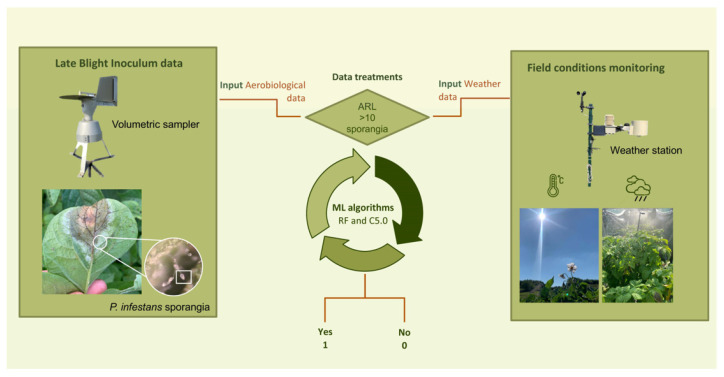
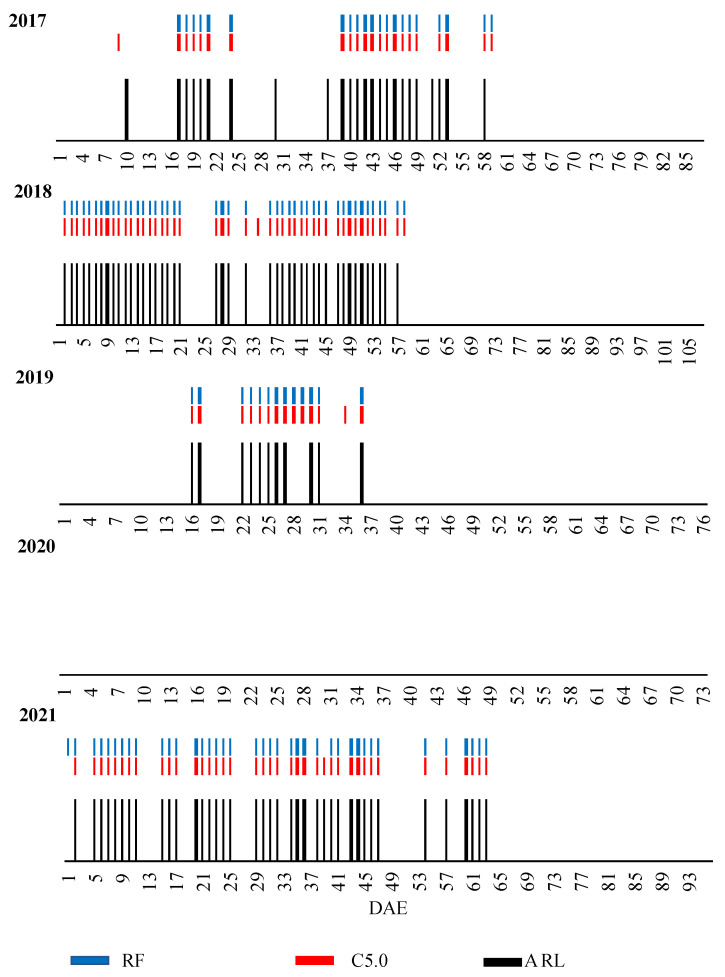
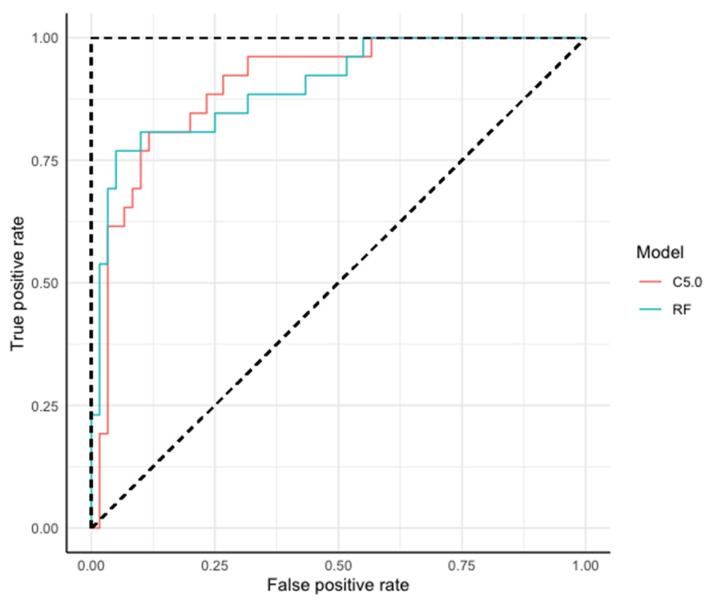
Late blight, caused by , is a major disease of the potato crop with a strong negative impact on tuber yield and tuber quality. The control of late blight in conventional potato production systems is often through weekly application of prophylactic fungicides, moving away from a sustainable production system. In support of integrated pest management practices, machine learning algorithms were proposed as tools to forecast aerobiological risk level (ARL) of (>10 sporangia/m) as inoculum to new infections. For this, meteorological and aerobiological data were monitored during five potato crop seasons in Galicia (northwest Spain). Mild temperatures (T) and high relative humidity (RH) were predominant during the foliar development (FD), coinciding with higher presence of sporangia in this phenological stage. The infection pressure (IP), wind, escape or leaf wetness (LW) of the same day also were significantly correlated with sporangia according to Spearman's correlation test. ML algorithms such as random forest (RF) and C5.0 decision tree (C5.0) were successfully used to predict daily sporangia levels, with an accuracy of the models of 87% and 85%, respectively. Currently, existing late blight forecasting systems assume a constant presence of critical inoculum. Therefore, ML algorithms offer the possibility of predicting critical levels of concentration. The inclusion of this type of information in forecasting systems would increase the exactitude in the estimation of the sporangia of this potato pathogen.
晚疫病由 引起,是马铃薯作物的主要病害,对块茎产量和块茎质量有很强的负面影响。在常规马铃薯生产系统中,晚疫病的防治通常是通过每周应用预防性杀菌剂来实现的,这使得生产系统难以持续。为了支持综合虫害管理实践,机器学习算法被提议作为预测气传病原(>10 个游动孢子/米)作为新感染接种体的空气生物学风险水平(ARL)的工具。为此,在加利西亚(西班牙西北部)的五个马铃薯作物季节期间监测了气象和空气生物学数据。在叶片发育(FD)期间,温度(T)温和相对湿度(RH)较高,与该物候阶段游动孢子的更高存在相一致。同一天的感染压力(IP)、风、逃逸或叶片湿润度(LW)与游动孢子也根据 Spearman 相关检验显著相关。机器学习算法,如随机森林(RF)和 C5.0 决策树(C5.0),成功地用于预测每日游动孢子水平,模型的准确性分别为 87%和 85%。目前,现有的晚疫病预测系统假设存在恒定的临界接种体。因此,机器学习算法提供了预测 浓度临界水平的可能性。在预测系统中纳入此类信息将提高对这种马铃薯病原体游动孢子的估计的准确性。