Xiao Yanhui, Guo Xue, Zhang Min, Chen Yaping, Zhang Yanyang, Yu Xiaoqing, Luo Linyun, Chen Haiping, Xu Weichai, Liu Haibo, Wu Lixia, Hou Renwu, Ma Yong, Long Lin, Ruan Jiewei, Chen Wei, Yang Xiaoming
Medical Affairs Department, China National Biotec Group Company Limited, No. 2, Shuangqiao Street, Chaoyang District, Beijing 100024, China.
Medical Affairs Department, Changchun Institute of Biological Products Company Limited, Changchun 130012, China.
Vaccines (Basel). 2023 Apr 18;11(4):862. doi: 10.3390/vaccines11040862.
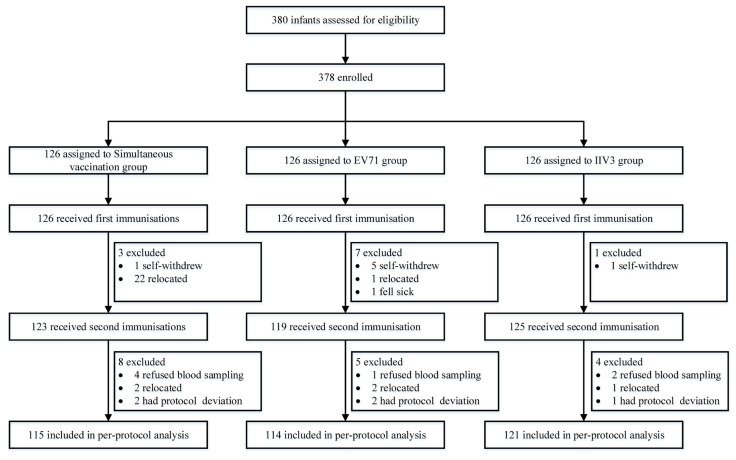
: To assess the immunogenicity and safety of the enterovirus 71 vaccine (Vero cell) (EV71 vaccine) and trivalent split-virion influenza vaccine (IIV3). : Healthy infants aged 6-7 months were recruited from Zhejiang Province, Henan Province, and Guizhou Province and randomly assigned to the simultaneous vaccination group, EV71 group, and IIV3 group at a ratio of 1:1:1. Then, 3 mL blood samples were collected before vaccination and 28 days after the second dose of vaccine. Cytopathic effect inhibition assay was used to detect EV71 neutralization antibody, and cytopathic effect inhibition assay was used to detect influenza virus antibody. : A total of 378 infants were enrolled and received the first dose of vaccine and were included in the safety analysis, and 350 infants were involved in the immunogenicity analysis. The adverse events rates were 31.75%, 28.57%, and 34.13% in the simultaneous vaccination group, EV71 group, and IIV3 group ( > 0.05), respectively. No vaccine-related serious adverse events were reported. After two doses of EV71 vaccine, the seroconversion rates of EV71 neutralizing antibody were 98.26% and 97.37% in the simultaneous vaccination group and the EV71 group, respectively. After two doses of IIV3, the simultaneous vaccination group and the IIV3 group, respectively, had seroconversion rates of 80.00% and 86.78% for H1N1 antibody, 99.13% and 98.35% for H3N2 antibody, and 76.52% and 80.99% for B antibody. There was no statistically significant difference in the seroconversion rates of influenza virus antibodies between groups ( > 0.05). : The coadministration of EV71 vaccine and IIV3 has good safety and immunogenicity in infants aged 6-7 months.
评估肠道病毒71型疫苗(Vero细胞)(EV71疫苗)和三价裂解流感病毒疫苗(IIV3)的免疫原性和安全性。:从浙江省、河南省和贵州省招募6至7个月大的健康婴儿,并按1:1:1的比例随机分配至联合疫苗接种组、EV71组和IIV3组。然后,在接种疫苗前和第二剂疫苗接种后28天采集3mL血液样本。采用细胞病变效应抑制试验检测EV71中和抗体,采用细胞病变效应抑制试验检测流感病毒抗体。:共有378名婴儿入组并接种了第一剂疫苗,纳入安全性分析,350名婴儿参与免疫原性分析。联合疫苗接种组、EV71组和IIV3组的不良事件发生率分别为31.75%、28.57%和34.13%(P>0.05)。未报告与疫苗相关的严重不良事件。两剂EV71疫苗接种后,联合疫苗接种组和EV71组的EV71中和抗体血清转化率分别为98.26%和97.37%。两剂IIV3接种后,联合疫苗接种组和IIV3组的H1N1抗体血清转化率分别为80.00%和86.78%,H3N2抗体血清转化率分别为99.13%和98.35%,B抗体血清转化率分别为76.52%和80.99%。各组流感病毒抗体血清转化率差异无统计学意义(P>0.05)。:EV71疫苗和IIV3联合接种在6至7个月大的婴儿中具有良好的安全性和免疫原性。