Xu Yong-Xia, Liu Guo-Ying, Ji Zhang-Zhang, Li Yue-Yun, Wang Yan-Li, Wu Xue-Yan, Liu Jun-Lin, Ma Dan-Xia, Zhong Ming-Kui, Gao Chao-Bing, Xu Qi
Department of Geriatric Endocrinology, Anhui Geriatric Institute, The First Affiliated Hospital of Anhui Medical University, Hefei, Anhui, China.
Department of Physiology, School of Basic Medical Sciences, Anhui Medical University, Hefei, Anhui, China.
Front Psychiatry. 2023 Apr 12;14:1090420. doi: 10.3389/fpsyt.2023.1090420. eCollection 2023.
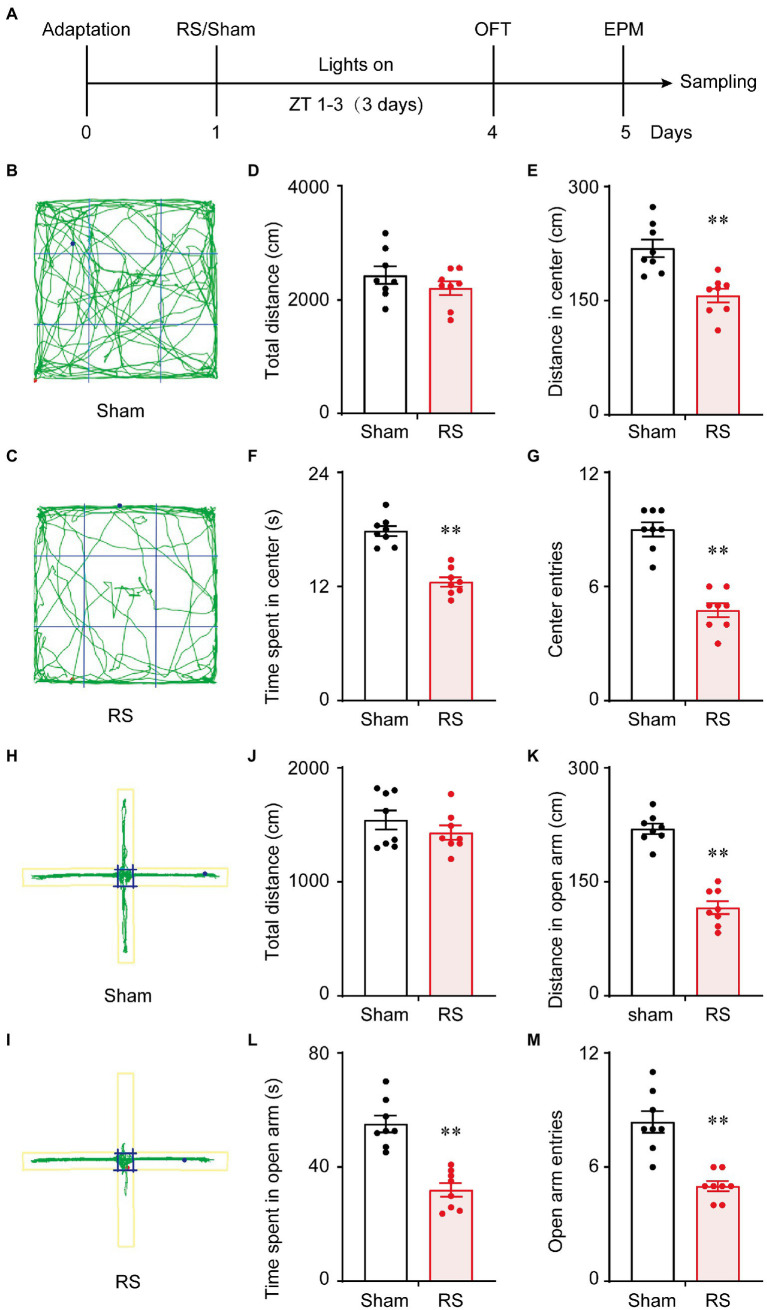
In humans and animals, exposure to changes in internal or external environments causes acute stress, which changes sleep and enhances neurochemical, neuroendocrine, and sympathetic activities. Repeated stress responses play an essential role in the pathogenesis of psychiatric diseases and sleep disorders. However, the underlying mechanism of sleep changes and anxiety disorders in response to acute stress is not well established. In the current study, the effects of restraint stress (RS) on anxiety and sleep-wake cycles in mice were investigated. We found that after RS, the mice showed anxiety-like behavior after RS manipulation and increased the amounts of both non-rapid eye movement (NREM) and rapid eye movement (REM) sleep in the dark period. The increase in sleep time was mainly due to the increased number of episodes of NREM and REM sleep during the dark period. In addition, the mice showed an elevation of the EEG power spectrum of both NREM and REM sleep 2 h after RS manipulation. There was a significant reduction in the EEG power spectrum of both NREM and REM sleep during the darkperiod in the RS condition. The expression of the c-Fos protein was significantly increased in the parabrachial nucleus, bed nucleus of the stria terminalis, central amygdala, and paraventricular hypothalamus by RS manipulation. Altogether, the findings from the present study indicated that neural circuits from the parabrachial nucleus might regulate anxiety and sleep responses to acute stress, and suggest a potential therapeutic target for RS induced anxiety and sleep alterations.
在人类和动物中,暴露于内部或外部环境变化会引发急性应激,这会改变睡眠并增强神经化学、神经内分泌和交感神经活动。反复的应激反应在精神疾病和睡眠障碍的发病机制中起着至关重要的作用。然而,急性应激反应引起睡眠变化和焦虑症的潜在机制尚未完全明确。在本研究中,我们调查了束缚应激(RS)对小鼠焦虑和睡眠-觉醒周期的影响。我们发现,RS处理后,小鼠在RS操作后表现出焦虑样行为,并且在黑暗期非快速眼动(NREM)睡眠和快速眼动(REM)睡眠的时长均增加。睡眠时间的增加主要是由于黑暗期NREM和REM睡眠发作次数的增加。此外,RS操作后2小时,小鼠NREM和REM睡眠的脑电图功率谱均升高。在RS条件下,黑暗期NREM和REM睡眠的脑电图功率谱均显著降低。RS操作使臂旁核、终纹床核、中央杏仁核和室旁下丘脑中的c-Fos蛋白表达显著增加。总之,本研究结果表明,来自臂旁核的神经回路可能调节对急性应激的焦虑和睡眠反应,并提示了一个针对RS诱导的焦虑和睡眠改变的潜在治疗靶点。