Lee Guk Jin, Kim Hyunho, Cho Sung Shim, Park Hyung Soon, An Ho Jung, Woo In Sook, Byun Jae Ho, Hong Ji Hyung, Ko Yoon Ho, Sun Der Sheng, Won Hye Sung, Jin Jong Youl, Park Ji Chan, Kim In-Ho, Roh Sang Young, Shim Byoung Yong
Division of Medical Oncology, Department of Internal Medicine, Bucheon St. Mary's Hospital, College of Medicine, The Catholic University of Korea, Seoul, Korea.
Division of Medical Oncology, Department of Internal Medicine, St. Vincent's Hospital, College of Medicine, The Catholic University of Korea, Seoul, Korea.
J Gastric Cancer. 2023 Apr;23(2):315-327. doi: 10.5230/jgc.2023.23.e16.
Oxaliplatin, a component of the capecitabine plus oxaliplatin (XELOX) regimen, has a more favorable toxicity profile than cisplatin in patients with advanced gastric cancer (GC). However, oxaliplatin can induce sensory neuropathy and cumulative, dose-related toxicities. Thus, the capecitabine maintenance regimen may achieve the maximum treatment effect while reducing the cumulative neurotoxicity of oxaliplatin. This study aimed to compare the survival of patients with advanced GC between capecitabine maintenance and observation after 1st line XELOX chemotherapy.
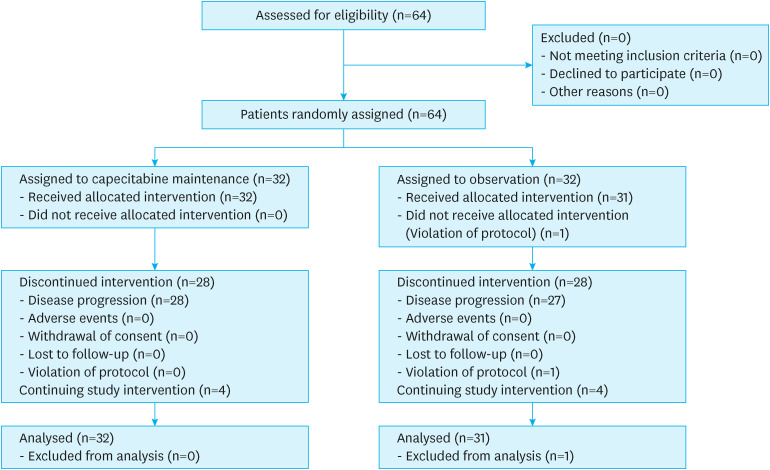
Sixty-three patients treated with six cycles of XELOX for advanced GC in six hospitals of the Catholic University of Korea were randomized 1:1 to receive capecitabine maintenance or observation. The primary endpoint was progression-free survival (PFS), analyzed using a two-sided log-rank test stratified at a 5% significance level.
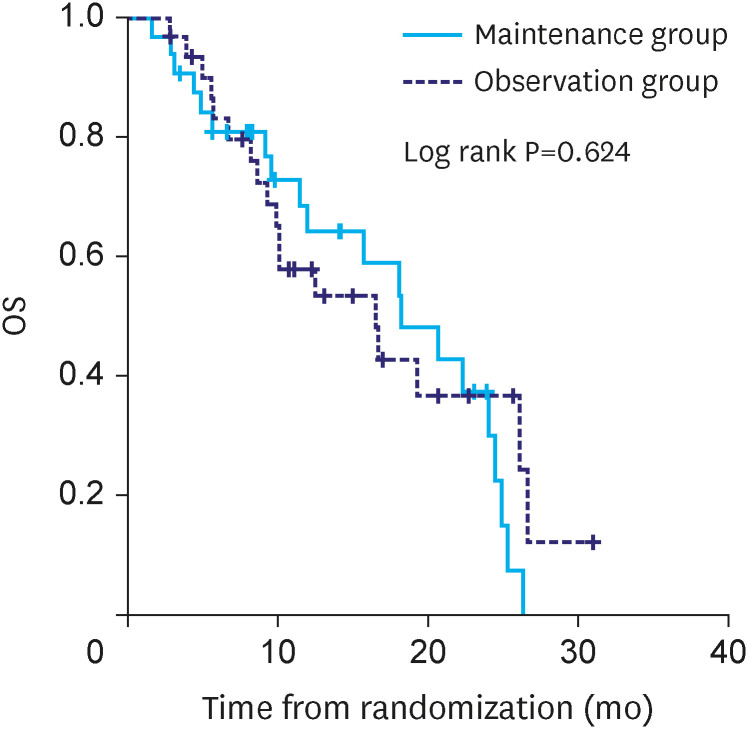
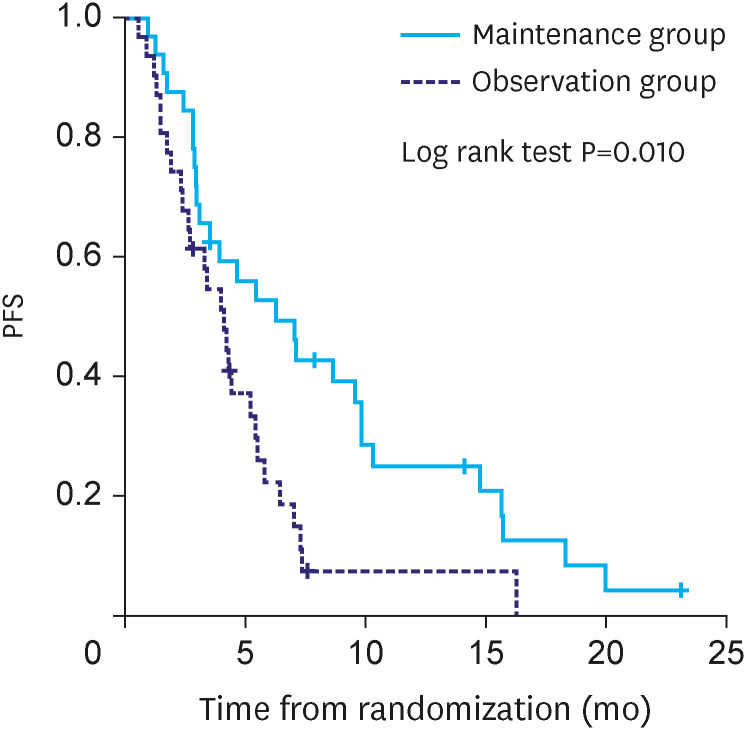
Between 2015 and 2020, 32 and 31 patients were randomized into the maintenance and observation groups, respectively. After randomization, the median number of capecitabine maintenance cycles was 6. The PFS was significantly higher in the maintenance group than the observation group (6.3 vs. 4.1 months, P=0.010). Overall survival was not significantly different between the 2 groups (18.2 vs. 16.5 months, P=0.624). Toxicities, such as hand-foot syndrome, were reported in some maintenance group patients. Maintenance treatment was a significant factor associated with PFS in multivariate analysis (hazard ratio, 0.472; 95% confidence interval, 0.250-0.890; P=0.020).
After 6 cycles of XELOX chemotherapy, capecitabine maintenance significantly prolonged PFS compared with observation, and toxicity was manageable. Maintenance treatment was a significant prognostic factor associated with PFS.
ClinicalTrials.gov Identifier: NCT02289547.
奥沙利铂是卡培他滨联合奥沙利铂(XELOX)方案的组成部分,在晚期胃癌(GC)患者中,其毒性特征比顺铂更有利。然而,奥沙利铂可诱发感觉神经病变以及累积性、剂量相关毒性。因此,卡培他滨维持治疗方案可能在降低奥沙利铂累积神经毒性的同时实现最大治疗效果。本研究旨在比较晚期GC患者在一线XELOX化疗后接受卡培他滨维持治疗与观察等待的生存情况。
韩国天主教大学六家医院中接受六个周期XELOX治疗的63例晚期GC患者按1:1随机分组,分别接受卡培他滨维持治疗或观察等待。主要终点为无进展生存期(PFS),采用双侧对数秩检验进行分析,分层显著性水平为5%。
2015年至2020年期间,分别有32例和31例患者被随机分入维持治疗组和观察等待组。随机分组后,卡培他滨维持治疗周期的中位数为6个。维持治疗组的PFS显著高于观察等待组(6.3个月对4.1个月,P = 0.010)。两组的总生存期无显著差异(18.2个月对16.5个月,P = 0.624)。一些维持治疗组患者报告出现了手足综合征等毒性反应。在多因素分析中,维持治疗是与PFS相关的显著因素(风险比,0.472;95%置信区间,0.250 - 0.890;P = 0.020)。
在六个周期的XELOX化疗后,与观察等待相比,卡培他滨维持治疗显著延长了PFS,且毒性反应可控。维持治疗是与PFS相关的显著预后因素。
ClinicalTrials.gov标识符:NCT02289547。