Faria Murilo Henrique, Simieli Lucas, Rietdyk Shirley, Penedo Tiago, Santinelli Felipe Balistieri, Barbieri Fabio Augusto
Human Movement Research Laboratory (MOVI-LAB), School of Sciences, Department of Physical Education, São Paulo State University (Unesp), Bauru, São Paulo, Brazil.
Department of Health and Kinesiology, Purdue University, West Lafayette, IN, United States.
Front Aging Neurosci. 2023 Apr 17;15:1142540. doi: 10.3389/fnagi.2023.1142540. eCollection 2023.
Gait asymmetry and deficits in gait initiation (GI) are among the most disabling symptoms in people with Parkinson's disease (PwPD). Understanding if PwPD with reduced asymmetry during GI have higher asymmetry in cortical activity may provide support for an adaptive mechanism to improve GI, particularly in the presence of an obstacle.
This study quantified the asymmetry of anticipatory postural adjustments (APAs), stepping parameters and cortical activity during GI, and tested if the presence of an obstacle regulates asymmetry in PwPD.
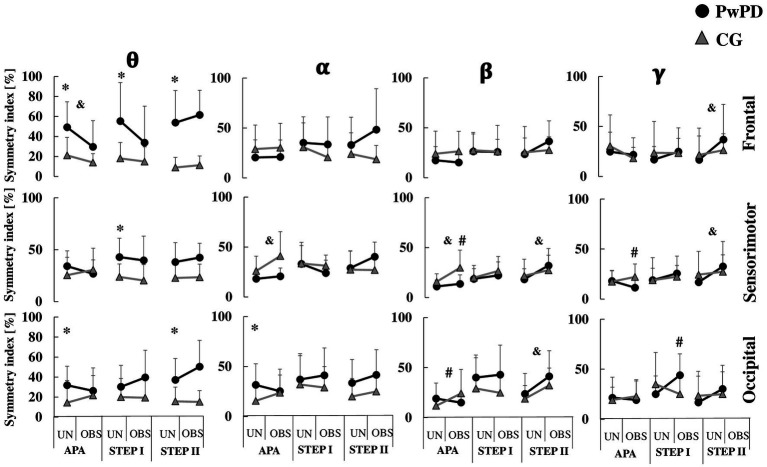
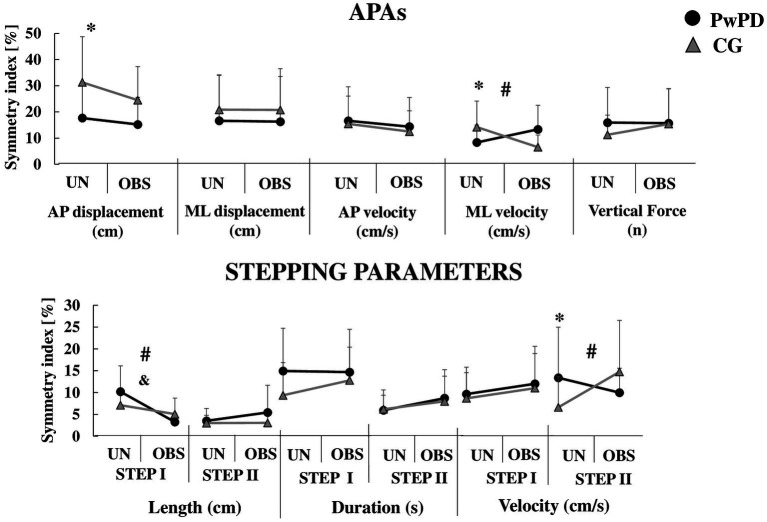
Sixteen PwPD and 16 control group (CG) performed 20-trials in two conditions: unobstructed and obstructed GI with right and left limbs. We measured, through symmetry index, (i) motor parameters: APAs and stepping, and (ii) cortical activity: the PSD of the frontal, sensorimotor and occipital areas during APA, STEP-I (moment of heel-off of the leading foot in the GI until the heel contact of the same foot); and STEP-II (moment of the heel-off of the trailing foot in the GI until the heel contact of the same foot) phases.
Parkinson's disease showed higher asymmetry in cortical activity during APA, STEP-I and STEP-II phases and step velocity (STEP-II phase) during unobstructed GI than CG. However, unexpectedly, PwPD reduced the level of asymmetry of anterior-posterior displacement ( < 0.01) and medial-lateral velocity ( < 0.05) of the APAs. Also, when an obstacle was in place, PwPD showed higher APAs asymmetry (medial-lateral velocity: < 0.002), with reduced and increased asymmetry of the cortical activity during APA and STEP-I phases, respectively.
Parkinson's disease were not motor asymmetric during GI, indicating that higher cortical activity asymmetry can be interpreted as an adaptive behavior to reduce motor asymmetry. In addition, the presence of obstacle did not regulate motor asymmetry during GI in PwPD.
步态不对称和步态起始(GI)缺陷是帕金森病患者(PwPD)中最致残的症状之一。了解在GI过程中不对称性降低的PwPD患者在皮质活动中是否具有更高的不对称性,可能为改善GI的适应性机制提供支持,尤其是在存在障碍物的情况下。
本研究量化了GI过程中预期姿势调整(APA)、步行动作参数和皮质活动的不对称性,并测试了障碍物的存在是否会调节PwPD患者的不对称性。
16名PwPD患者和16名对照组(CG)在两种条件下进行了20次试验:无阻碍和有阻碍的GI,分别使用右肢和左肢。我们通过对称性指数测量了:(i)运动参数:APA和步行动作;(ii)皮质活动:在APA、STEP-I(GI中前脚脚跟离地至同一只脚脚跟接触的时刻)和STEP-II(GI中后脚脚跟离地至同一只脚脚跟接触的时刻)阶段,额叶、感觉运动区和枕叶区域的功率谱密度。
与CG相比,帕金森病患者在无阻碍GI期间的APA、STEP-I和STEP-II阶段以及步速(STEP-II阶段)的皮质活动中表现出更高的不对称性。然而,出乎意料的是,PwPD患者的APA前后位移(<0.01)和内外侧速度(<0.05)的不对称水平降低。此外,当有障碍物时,PwPD患者表现出更高的APA不对称性(内外侧速度:<0.002),在APA和STEP-I阶段皮质活动的不对称性分别降低和增加。
帕金森病患者在GI期间并非运动不对称,这表明更高的皮质活动不对称性可被解释为减少运动不对称的适应性行为。此外,障碍物的存在并未调节PwPD患者在GI期间的运动不对称性。