
母体免疫激活以性别特异性方式改变胎盘组蛋白-3赖氨酸-9三甲基化、后代感觉运动处理以及下丘脑转座元件表达。
Maternal immune activation alters placental histone-3 lysine-9 tri-methylation, offspring sensorimotor processing, and hypothalamic transposable element expression in a sex-specific manner.
作者信息
DeRosa Holly, Smith Arianna, Geist Laurel, Cheng Ada, Hunter Richard G, Kentner Amanda C
机构信息
University of Massachusetts Boston, Department of Psychology, Developmental and Brain Sciences Program, Boston, Massachusetts, USA.
School of Arts & Sciences, Health Psychology Program, Massachusetts College of Pharmacy and Health Sciences, Boston, MA, USA.
出版信息
Neurobiol Stress. 2023 Apr 12;24:100538. doi: 10.1016/j.ynstr.2023.100538. eCollection 2023 May.
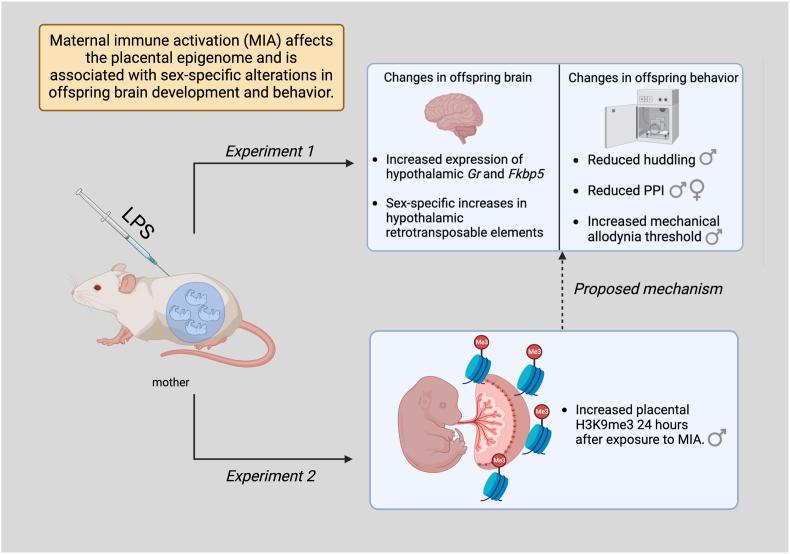
Animal models of maternal immune activation (MIA) are central to identifying the biological mechanisms that underly the association between prenatal infection and neuropsychiatric disorder susceptibility. Many studies, however, have limited their scope to protein coding genes and their role in mediating this inherent risk, while much less attention has been directed towards exploring the roles of the epigenome and transposable elements (TEs). In Experiment 1, we demonstrate the ability of MIA to alter the chromatin landscape of the placenta. We induced MIA by injecting 200 μg/kg (i.p.) of lipopolysaccharide (LPS) on gestational day 15 in Sprague-Dawley rats. We found a sex-specific rearrangement of heterochromatin 24-h after exposure to MIA, as evidenced by an increase in histone-3 lysine-9 trimethylation (H3K9me3). In Experiment 2, MIA was associated with long-term sensorimotor processing deficits as indicated by reduced prepulse inhibition (PPI) of the acoustic startle reflex in adult male and female offspring and an increased mechanical allodynia threshold in males. Analyses of gene expression within the hypothalamus-chosen for its involvement in the sex-specific pathogenesis of schizophrenia and the stress response-revealed significantly higher levels of the stress-sensitive genes and . Deleterious TE expression is often a hallmark of neuropsychiatric disease and we found sex-specific increases in the expression of several TEs including IAP, B2 SINE, and LINE-1 ORF1. The data from this study warrant the future consideration of chromatin stability and TEs as part of the mechanism that drives MIA-associated changes in the brain and behavior.
母体免疫激活(MIA)的动物模型对于确定产前感染与神经精神疾病易感性之间关联的生物学机制至关重要。然而,许多研究将范围局限于蛋白质编码基因及其在介导这种内在风险中的作用,而对表观基因组和转座元件(TEs)作用的探索则少得多。在实验1中,我们证明了MIA改变胎盘染色质景观的能力。我们通过在妊娠第15天给斯普拉格-道利大鼠腹腔注射200μg/kg脂多糖(LPS)来诱导MIA。我们发现暴露于MIA后24小时异染色质发生了性别特异性重排,组蛋白-3赖氨酸-9三甲基化(H3K9me3)增加证明了这一点。在实验2中,MIA与长期感觉运动处理缺陷有关,表现为成年雄性和雌性后代听觉惊吓反射的前脉冲抑制(PPI)降低以及雄性机械性异常性疼痛阈值增加。对下丘脑内基因表达的分析(选择下丘脑是因为其参与精神分裂症的性别特异性发病机制和应激反应)显示应激敏感基因和的水平显著升高。有害的TE表达通常是神经精神疾病的一个标志,我们发现包括IAP、B2 SINE和LINE-1 ORF1在内的几种TE的表达存在性别特异性增加。这项研究的数据值得未来将染色质稳定性和TEs作为驱动与MIA相关的大脑和行为变化机制的一部分加以考虑。


 Zotero 插件