Department of Medical Microbiology and Infectious Diseases, University of Manitoba, Winnipeg, Manitoba, Canada.
Institute for Global Public Health (IGPH), University of Manitoba, Winnipeg, Manitoba, Canada.
Cancer Med. 2023 Jun;12(12):13745-13757. doi: 10.1002/cam4.6008. Epub 2023 May 4.
Human papillomavirus (HPV) infection is associated with anal cancers and is more prevalent in gay, bisexual, and men who have sex with men (gbMSM), partly due to their vulnerability to HIV infection. Baseline HPV genotype distributions and risk factors can inform the design of next-generation HPV vaccines to prevent anal cancer.
A cross-sectional study was conducted among gbMSM receiving care at a HIV/STI clinic in Nairobi, Kenya. Anal swabs were genotyped using a Luminex microsphere array. Multiple logistic regression methods were used to identify risk factors for four HPV outcomes (any HPV, any HR-HPV, and 4- and 9-valent vaccine-preventable HPVs).
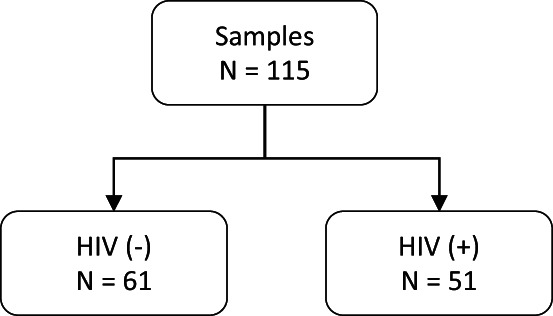
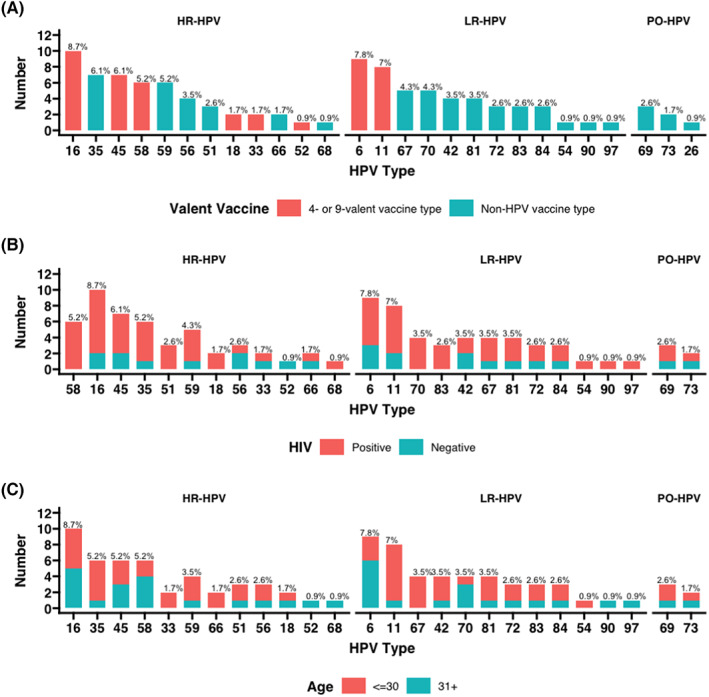
Among 115 gbMSM, 51 (44.3%) were HIV-infected. Overall HPV prevalence was 51.3%; 84.3% among gbMSM living with HIV and 24.6% among gbMSM without HIV (p < 0.001). One-third (32.2%) had HR-HPV and the most prevalent vaccine-preventable HR-HPV genotypes were 16, 35, 45, and 58. HPV-18 was uncommon (n = 2). The 9-valent Gardasil vaccine would have prevented 61.0% of HPV types observed in this population. In multivariate analyses, HIV status was the only significant risk factor for any HPV (adjusted odds ratio [aOR]:23.0, 95% confidence interval [95% CI]: 7.3-86.0, p < 0.001) and for HR-HPV (aOR: 8.9, 95% CI: 2.8-36.0, p < 0.001). Similar findings were obtained for vaccine-preventable HPVs. Being married to a woman significantly increased the odds of having HR-HPV infections (aOR: 8.1, 95% CI: 1.6-52.0, p = 0.016).
GbMSM living with HIV in Kenya are at higher risk of anal HPV infections including genotypes that are preventable with available vaccines. Our findings support the need for a targeted HPV vaccination campaign in this population.
人乳头瘤病毒(HPV)感染与肛门癌有关,在男同性恋、双性恋和与男性发生性关系的男性(gbMSM)中更为普遍,部分原因是他们易感染艾滋病毒。基线 HPV 基因型分布和危险因素可以为预防肛门癌的下一代 HPV 疫苗的设计提供信息。
在肯尼亚内罗毕的一家艾滋病毒/性传播感染诊所,对接受治疗的 gbMSM 进行了一项横断面研究。使用 Luminex 微球阵列对肛门拭子进行基因分型。多变量逻辑回归方法用于确定四个 HPV 结果(任何 HPV、任何高危型 HPV 以及 4 价和 9 价疫苗可预防 HPV)的危险因素。
在 115 名 gbMSM 中,51 名(44.3%)感染了 HIV。总体 HPV 流行率为 51.3%;HIV 感染者中为 84.3%,HIV 阴性者中为 24.6%(p<0.001)。三分之一(32.2%)有高危型 HPV,最常见的疫苗可预防高危型 HPV 基因型为 16、35、45 和 58。HPV-18 很少见(n=2)。九价 Gardasil 疫苗本可以预防该人群中观察到的 61.0%的 HPV 类型。在多变量分析中,HIV 状况是任何 HPV(调整后的优势比[aOR]:23.0,95%置信区间[95%CI]:7.3-86.0,p<0.001)和高危型 HPV(aOR:8.9,95%CI:2.8-36.0,p<0.001)的唯一显著危险因素。对于疫苗可预防的 HPV 也有类似的发现。与女性结婚会显著增加感染高危型 HPV 的几率(aOR:8.1,95%CI:1.6-52.0,p=0.016)。
肯尼亚感染 HIV 的 gbMSM 肛门 HPV 感染风险更高,包括可通过现有疫苗预防的基因型。我们的研究结果支持在该人群中开展有针对性的 HPV 疫苗接种活动。