
通过网版印刷研究活性基团化学与杂化反应性染料印花性能的关系。
Relationship between reactive group chemistry and printing properties of heterofunctional reactive dyes via screen printing.
机构信息
Department of Chemistry, University of Jhang, Jhang, 3500, Pakistan.
Department of Chemistry, University of Agriculture, Faisalabad, 38040, Pakistan.
出版信息
Sci Rep. 2023 May 4;13(1):7259. doi: 10.1038/s41598-023-33819-3.
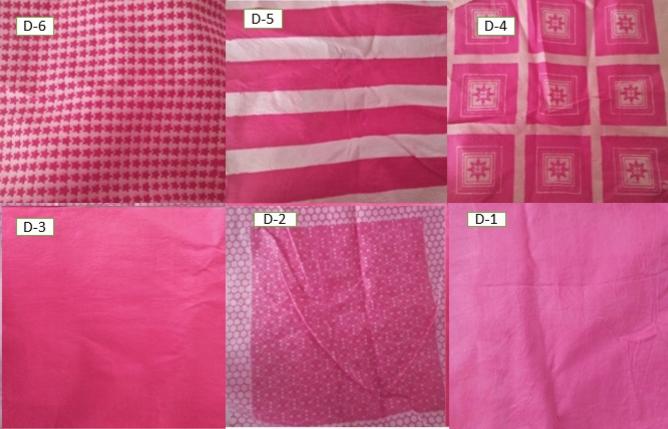
Screen printing of cotton fabric using newly synthesized azo reactive dyes was carried out in the present study. Functional group chemistry and its effect on the printing properties of cotton fabric by varying the nature, number and position of reactive groups of synthesized azo reactive dyes (D1-D6) was studied. Different printing parameters (Temperature, alkali and urea) and their effect was explored on the physicochemical printing properties e.g., fixation, color yield, and penetration of the dyed cotton fabric. Data revealed that dyes with more reactive groups and having linear and planar structures (D-6) showed enhanced printing properties. Spectraflash spectrophotometer was used to evaluate the colorimetric properties of screen-printed cotton fabric and results showed superb color buildup. Printed cotton samples displayed excellent to very good ultraviolet protection factor (UPF). Presence of sulphonate groups and excellent fastness properties may entitle these reactive dyes as commercially viable for urea free printing of cotton fabric.
本研究采用新合成的偶氮反应性染料对棉织物进行了筛网印花。研究了功能基化学及其对棉织物印花性能的影响,通过改变合成偶氮反应性染料(D1-D6)的反应基团的性质、数量和位置。研究了不同的印花参数(温度、碱和尿素)及其对染色棉织物的物理化学印花性能的影响,如固着率、色得率和渗透性。数据表明,具有更多反应基团和线性和平坦结构的染料(D-6)显示出增强的印花性能。Spectraflash 分光光度计用于评估筛网印花棉织物的色度特性,结果表明颜色堆积良好。印花棉样显示出优异到非常好的紫外线防护因子(UPF)。磺酸基团的存在和良好的牢度性能可能使这些反应性染料具有商业上的可行性,可用于无尿素印花棉织物。


 Zotero 插件