Centre for Health Management and Policy Research, School of Public Health, Cheeloo. College of Medicine, Shandong University, Jinan, China.
Jinan Medical Emergency Center, Jinan, China.
Front Public Health. 2023 Apr 18;11:1050256. doi: 10.3389/fpubh.2023.1050256. eCollection 2023.
Previous studies have shown that carbon monoxide (CO) poisoning occurs mostly in winter and is associated with severe cold weather (e.g., ice storms, temperature drops). However, according to previous studies, the impact of low temperature on health has a delayed effect, and the existing research cannot fully reveal the delayed effect of cold waves on CO poisoning.
The purpose of this study is to analyze the temporal distribution of CO poisoning in Jinan and to explore the acute effect of cold waves on CO poisoning.
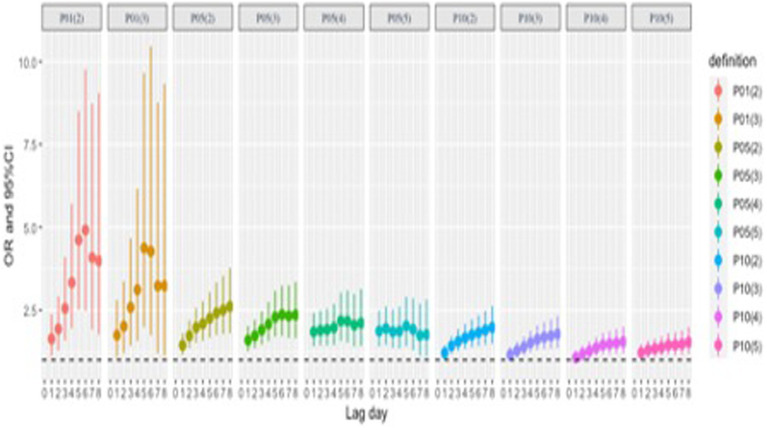
We collected emergency call data for CO poisoning in Jinan from 2013 to 2020 and used a time-stratified case-crossover design combined with a conditional logistic regression model to evaluate the impact of the cold wave day and lag 0-8 days on CO poisoning. In addition, 10 definitions of a cold wave were considered to evaluate the impact of different temperature thresholds and durations.
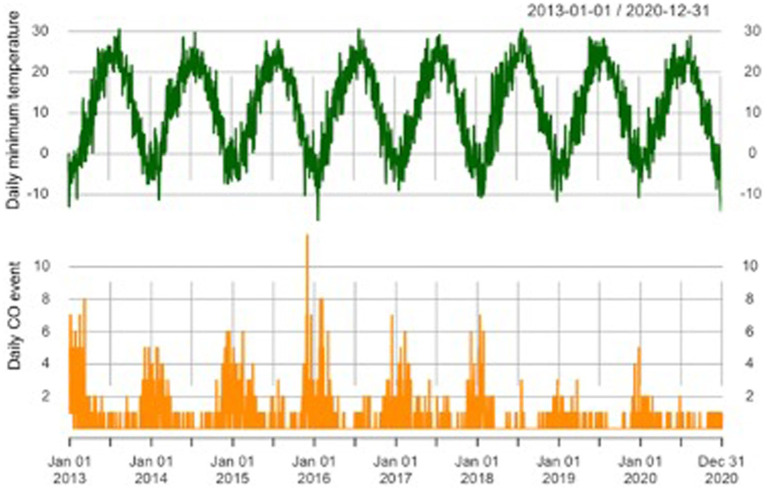
During the study period, a total of 1,387 cases of CO poisoning in Jinan used the emergency call system, and more than 85% occurred in cold months. Our findings suggest that cold waves are associated with an increased risk of CO poisoning in Jinan. When P01, P05, and P10 (P01, P05, and P10 refer to the 1st, 5th, and 10th percentiles of the lowest temperature, respectively) were used as temperature thresholds for cold waves, the most significant effects (the maximum OR value, which refers to the risk of CO poisoning on cold wave days compared to other days) were 2.53 (95% CI:1.54, 4.16), 2.06 (95% CI:1.57, 2.7), and 1.49 (95% CI:1.27, 1.74), respectively.
Cold waves are associated with an increased risk of CO poisoning, and the risk increases with lower temperature thresholds and longer cold wave durations. Cold wave warnings should be issued and corresponding protective policies should be formulated to reduce the potential risk of CO poisoning.
先前的研究表明,一氧化碳(CO)中毒多发生于冬季,与严寒天气(如冰暴、气温骤降)有关。然而,根据先前的研究,低温对健康的影响具有滞后效应,现有研究无法充分揭示寒潮对 CO 中毒的滞后影响。
本研究旨在分析济南 CO 中毒的时间分布,并探讨寒潮对 CO 中毒的急性影响。
我们收集了 2013 年至 2020 年济南的 CO 中毒急救电话数据,采用时间分层病例交叉设计结合条件 logistic 回归模型,评估寒潮日及滞后 0-8 天对 CO 中毒的影响。此外,我们考虑了 10 种寒潮定义,以评估不同温度阈值和持续时间对 CO 中毒的影响。
研究期间,济南共有 1387 例 CO 中毒患者使用急救电话系统,其中超过 85%发生在寒冷月份。我们的研究结果表明,寒潮与济南 CO 中毒风险增加有关。当 P01、P05 和 P10(P01、P05 和 P10 分别表示最低温度的第 1、5 和 10 百分位数)用作寒潮的温度阈值时,影响最大(最大 OR 值,即与其他天数相比,寒潮日发生 CO 中毒的风险)分别为 2.53(95%CI:1.54,4.16)、2.06(95%CI:1.57,2.7)和 1.49(95%CI:1.27,1.74)。
寒潮与 CO 中毒风险增加有关,且风险随温度阈值降低和寒潮持续时间延长而增加。应发布寒潮预警,并制定相应的保护政策,以降低 CO 中毒的潜在风险。