
迈向包容绿色增长:数字经济重要吗?
Towards inclusive green growth: does digital economy matter?
机构信息
School of Management, China University of Mining and Technology-Beijing, Beijing, 100083, China.
Center for Economic Research, Shandong University, Jinan, 250100, China.
出版信息
Environ Sci Pollut Res Int. 2023 Jun;30(27):70348-70370. doi: 10.1007/s11356-023-27357-8. Epub 2023 May 6.
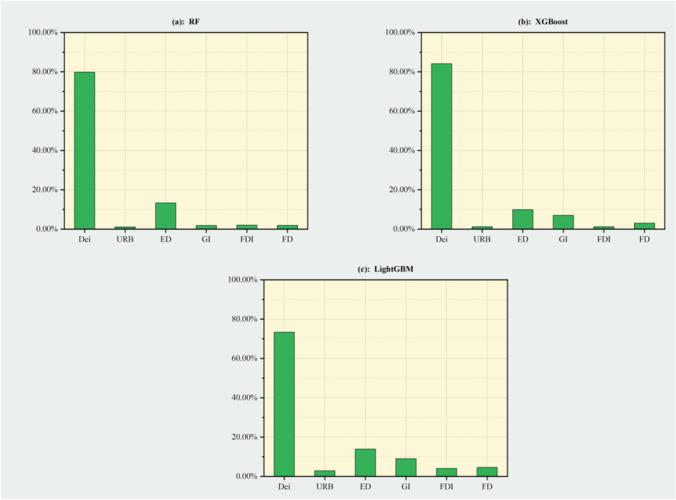
In this decade, China has been pursuing an inclusive green growth strategy. Concurrently, the digital economy, which relies on the Internet of Things, big data, and artificial intelligence, has experienced explosive growth in China. The digital economy's capacity to optimize resource allocation and reduce energy consumption potentially makes it a conducive channel towards sustainability. Using the panel data of 281 cities in China from 2011 to 2020, we theoretically and empirically explore the impact of the digital economy on inclusive green growth. Firstly, we theoretically analyze the potential impact of the digital economy on inclusive green growth using two hypotheses: accelerating green innovation and promoting the industrial upgrading effect. Subsequently, we measure the digital economy and inclusive green growth of Chinese cities using Entropy-TOPSIS and DEA approaches, respectively. Then, we apply traditional econometric estimation models and machine learning algorithms to our empirical analysis. The results show that China's high-powered digital economy significantly promotes inclusive green growth. Moreover, we analyze the internal mechanisms behind this impact. We find that innovation and industrial upgrading are two plausible channels that explain this effect. Additionally, we document a nonlinear feature of diminishing marginal effects between the digital economy and inclusive green growth. The heterogeneity analysis shows that the contribution weight of the digital economy to inclusive green growth is more remarkable in eastern region cities, large and medium-sized cities, and cities with high marketization. Overall, these findings shed more light on the digital economy-inclusive green growth nexus and provide new insights into understanding the real effects of the digital economy on sustainable development.
在这十年中,中国一直在追求包容的绿色增长战略。与此同时,中国的数字经济,依托物联网、大数据和人工智能,也经历了爆炸式的增长。数字经济优化资源配置和降低能源消耗的能力使其成为可持续发展的一个有利渠道。利用 2011 年至 2020 年中国 281 个城市的面板数据,我们从理论和实证两个方面探讨了数字经济对包容绿色增长的影响。首先,我们从两个假设的角度对数字经济对包容绿色增长的潜在影响进行了理论分析:加速绿色创新和促进产业升级效应。随后,我们分别使用熵权-TOPSIS 和 DEA 方法衡量中国城市的数字经济和包容绿色增长。然后,我们采用传统的计量经济学估计模型和机器学习算法进行实证分析。结果表明,中国强大的数字经济显著促进了包容的绿色增长。此外,我们还分析了这一影响背后的内在机制。我们发现创新和产业升级是解释这一效应的两个合理途径。此外,我们还记录了数字经济和包容绿色增长之间的边际效应递减的非线性特征。异质性分析表明,数字经济对包容绿色增长的贡献权重在东部地区城市、大中城市和市场化程度较高的城市更为显著。总的来说,这些发现为数字经济-包容绿色增长关系提供了更多的启示,并为理解数字经济对可持续发展的实际影响提供了新的视角。




 Zotero 插件