He Tingyan, Xia Yu, Luo Ying, Yang Jun
Department of Rheumatology and Immunology, Shenzhen Children's Hospital, Shenzhen, China.
Front Pediatr. 2023 Apr 20;11:1134312. doi: 10.3389/fped.2023.1134312. eCollection 2023.
Systemic juvenile idiopathic arthritis (SJIA) is characterized by excessive and inappropriate production of proinflammatory cytokines. Janus kinase inhibitors (JAKi) can block the downstream pathway of many cytokines. The use of JAKi in SJIA or macrophage activation syndrome (MAS) has only been described in a limited number of case reports. In this study, we aimed to assess the efficacy and potential adverse effects of JAKi in SJIA patients.
Patients with SJIA who received JAKi and underwent at least one assessment of efficacy and safety after JAKi initiation were eligible for this study. Data were collected retrospectively from inpatient or outpatient medical records at JAKi initiation, at 1, 3, 6, 9, and 12 months, after disease flare, after JAKi discontinuation, or at the last follow-up.
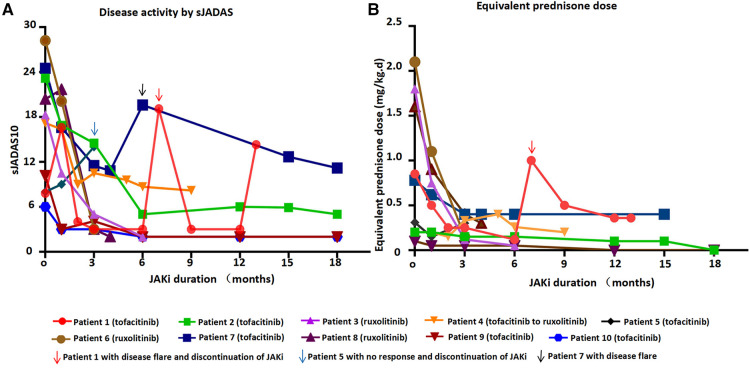
Ten patients with SJIA were included in the study. At the start of JAKi treatment, all patients presented with active disease; five showed variable adverse effects secondary to glucocorticoids. Seven patients received tofacitinib (one later switched to ruxolitinib). Of these, only two patients showed a complete response of persistent arthritis associated with tocilizumab; tofacitinib was used without a biological DMARD only in two patients, together with MTX, showing a partial response; three patients were nonresponders. Four patients with SJIA-related MAS or persistent hyperferritinemia were treated with ruxolitinib. Ruxolitinib allowed a good response on MAS parameters in three of them. All these four patients required an adjunction or switch to canakinumab later. The median decrease in the daily glucocorticoid dose between JAKi initiation and the last follow-up was 90.6% in patients with complete remission and 77.4% in other patients. Three patients discontinued glucocorticoid treatment after the introduction of JAKi. Severe adverse events, notably serious infection or thrombosis, were not observed during JAKi treatment.
JAKi may be an alternative or adjuvant agent for SJIA patients, especially in those with persistently active disease, glucocorticoid-related adverse reactions, or SJIA-MAS.
全身型幼年特发性关节炎(SJIA)的特征是促炎细胞因子过度且不适当产生。Janus激酶抑制剂(JAKi)可阻断多种细胞因子的下游通路。JAKi在SJIA或巨噬细胞活化综合征(MAS)中的应用仅在少数病例报告中有描述。在本研究中,我们旨在评估JAKi在SJIA患者中的疗效和潜在不良反应。
接受JAKi治疗且在开始使用JAKi后至少进行过一次疗效和安全性评估的SJIA患者符合本研究条件。数据从住院或门诊病历中回顾性收集,收集时间为开始使用JAKi时、1、3、6、9和12个月时、疾病复发后、停用JAKi后或最后一次随访时。
10例SJIA患者纳入本研究。在开始JAKi治疗时,所有患者均表现为疾病活动;5例出现糖皮质激素继发的各种不良反应。7例患者接受托法替布治疗(1例后来换用鲁索替尼)。其中,仅2例患者对托珠单抗相关的持续性关节炎表现出完全缓解;仅2例患者在未使用生物性改善病情抗风湿药(bDMARD)的情况下使用托法替布,联合甲氨蝶呤(MTX),表现出部分缓解;3例患者无反应。4例与SJIA相关的MAS或持续性高铁蛋白血症患者接受鲁索替尼治疗。鲁索替尼使其中3例患者的MAS参数得到良好反应。所有这4例患者后来均需要加用或换用卡那单抗。完全缓解患者从开始使用JAKi到最后一次随访时每日糖皮质激素剂量的中位数下降90.6%,其他患者为77.4%。3例患者在引入JAKi后停用糖皮质激素治疗。在JAKi治疗期间未观察到严重不良事件,尤其是严重感染或血栓形成。
JAKi可能是SJIA患者的一种替代或辅助药物,尤其是对于那些疾病持续活动、有糖皮质激素相关不良反应或SJIA-MAS的患者。