• 文献检索
  • 文档翻译
  • 深度研究
  • 学术资讯
  • Suppr Zotero 插件Zotero 插件
  • 邀请有礼
  • 套餐&价格
  • 历史记录
应用&插件
Suppr Zotero 插件Zotero 插件浏览器插件Mac 客户端Windows 客户端微信小程序
定价
高级版会员购买积分包购买API积分包
服务
文献检索文档翻译深度研究API 文档MCP 服务
关于我们
关于 Suppr公司介绍联系我们用户协议隐私条款
关注我们

Suppr 超能文献

核心技术专利:CN118964589B侵权必究
粤ICP备2023148730 号-1Suppr @ 2026

文献检索

告别复杂PubMed语法,用中文像聊天一样搜索,搜遍4000万医学文献。AI智能推荐,让科研检索更轻松。

立即免费搜索

文件翻译

保留排版,准确专业,支持PDF/Word/PPT等文件格式,支持 12+语言互译。

免费翻译文档

深度研究

AI帮你快速写综述,25分钟生成高质量综述,智能提取关键信息,辅助科研写作。

立即免费体验

团结讲西班牙语的儿科内分泌学界:中美洲和南美洲低收入和中等收入国家首次虚拟儿科内分泌会议。

Bringing the Pediatric Endocrine Spanish Speaking Community Together: First Virtual Pediatric Endocrine Meeting in Low- and Middle-Income Countries in Central and South America.

作者信息

Bogarin Roberto, Elizondo Luis, Kalaitzoglou Evangelia, Popovic Jadranka, Rogol Alan, Richmond Erick, Chanoine Jean-Pierre, Lopez-Pedrosa Jose M, Ruiz Salazar Francis, Vuguin Patricia

机构信息

Costa Rica National Children´s Hospital, San Jose, Costa Rica.

Hospital Calderon Guardia, San Jose, Costa Rica.

出版信息

Interact J Med Res. 2023 May 8;12:e41353. doi: 10.2196/41353.

DOI:10.2196/41353
PMID:37155229
原文链接:https://pmc.ncbi.nlm.nih.gov/articles/PMC10203921/
Abstract

BACKGROUND

Pediatric endocrinology is a specialty that is struggling worldwide to maintain adequately trained professionals. Pediatric endocrine care in Central America and Caribbean countries is often performed by pediatricians or adult endocrinologists due to the limited number of pediatric endocrinologists. These health care providers are seldom members of endocrine societies and frequently lack formal training in the field.

OBJECTIVE

In this study, we describe the scope of a virtual conference in pediatric endocrinology and diabetes targeted to low- and middle-income countries to provide equal opportunities for access to medical education for health care professionals.

METHODS

The virtual conference was sponsored by the Pediatric Endocrine Society (North America), Asociación Costarricense de Endocrinología (previously, Asociación Nacional Pro Estudio de la Diabetes, Endocrinología y Metabolismo), and Asociacion Centroamericana y del Caribe de Endocrinologia Pediátrica. The conference was free to participants and comprised 23 sessions that were either synchronous with ability for real-time interactive sessions or asynchronous sessions, where content was available online to access at their convenience. Topics included idiopathic short stature, polycystic ovarian syndrome, diabetes mellitus, telemedicine, Turner syndrome, congenital adrenal hyperplasia, obesity, central precocious puberty, and subclinical hypothyroidism. The participants were asked to evaluate the conference after its completion with a questionnaire.

RESULTS

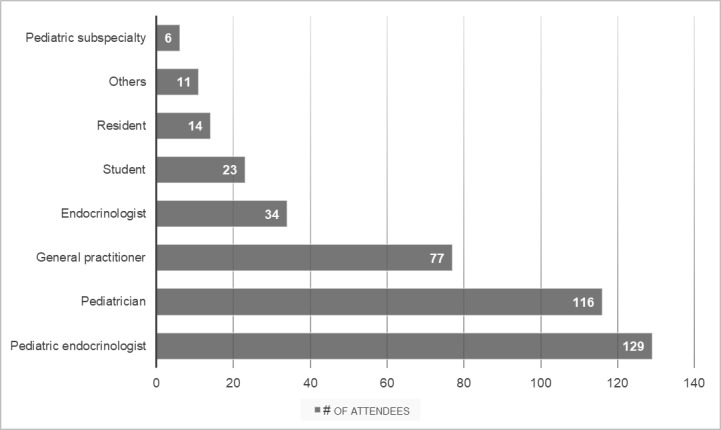
A total of 8 speakers from Spain, Canada, Costa Rica, and the United States delivered the virtual event to 668 health care professionals from Guatemala, Venezuela, Dominican Republic, Costa Rica, Ecuador, Peru, Uruguay, Mexico, Honduras, Argentina, the United States, Bolivia, Chile, Panama, El Salvador, Nicaragua, Paraguay, Belize, Spain, and Colombia. Name, profession, and country were fully disclosed by 410 (61.4%) of the 668 health care professionals. The profession or level of training of participants were as follows: pediatric endocrinologists (n=129, 19.3%), pediatricians (n=116, 17.4%), general practitioners (n=77, 11.5%), adult endocrinologists (n=34, 5.1%), medical students (n=23, 3.4%), residents in various specialties (n=14, 2.1%), and others (n=17, 2.6%). A total of 23 sessions were offered, most of which were bilingual (Spanish and English). Feedback from the evaluation questionnaire indicated that the content of the conference was very relevant to the participants' professional practice. Additionally, the participants reported that they were very satisfied with the organization, the web-based platform, and the sessions of the conference.

CONCLUSIONS

Lack of accessibility to the latest and cutting-edge medical education in pediatric endocrinology and diabetes for medical professionals from low- and middle-income countries can be overcome with a virtual conference. Online availability, low cost, and easy-to-use technology were well received from the participants, who were overall very satisfied by the quality and the relevance of the sessions to their professional practice.

摘要

背景

儿科内分泌学作为一门专业学科,在全球范围内都面临着专业人才储备不足的问题。由于儿科内分泌专家数量有限,中美洲和加勒比地区国家的儿科内分泌护理工作通常由儿科医生或成人内分泌科医生承担。这些医疗服务提供者很少是内分泌学会的成员,并且常常缺乏该领域的正规培训。

目的

在本研究中,我们描述了一场面向低收入和中等收入国家的儿科内分泌学与糖尿病虚拟会议的情况,旨在为医疗专业人员提供平等的医学教育机会。

方法

该虚拟会议由北美儿科内分泌学会、哥斯达黎加内分泌协会(前身为全国糖尿病、内分泌学与代谢研究协会)以及中美洲和加勒比地区儿科内分泌协会联合主办。会议对参与者免费开放,共包含23场会议,其中一些为实时互动的同步会议,另一些为异步会议,参会者可根据自身方便随时在线获取会议内容。主题包括特发性身材矮小、多囊卵巢综合征、糖尿病、远程医疗、特纳综合征、先天性肾上腺皮质增生症、肥胖症、中枢性性早熟以及亚临床甲状腺功能减退症。会议结束后,要求参与者通过问卷对会议进行评估。

结果

来自西班牙、加拿大、哥斯达黎加和美国的8位演讲者为来自危地马拉、委内瑞拉、多米尼加共和国、哥斯达黎加、厄瓜多尔、秘鲁、乌拉圭、墨西哥、洪都拉斯、阿根廷、美国、玻利维亚、智利、巴拿马、萨尔瓦多、尼加拉瓜、巴拉圭、伯利兹、西班牙和哥伦比亚的668名医疗专业人员举办了此次虚拟会议。668名医疗专业人员中的410名(61.4%)完全披露了自己的姓名、职业和国家。参与者的职业或培训水平如下:儿科内分泌专家(n = 129,19.3%)、儿科医生(n = 116,17.4%)、全科医生(n = 77,11.5%)、成人内分泌科医生(n = 34,5.1%)、医学生(n = 23,3.4%)、各专业住院医师(n = 14,2.1%)以及其他人员(n = 17,2.6%)。会议共提供了23场会议,其中大部分为双语(西班牙语和英语)。评估问卷的反馈表明,会议内容与参与者的专业实践高度相关。此外,参与者报告称他们对会议的组织、网络平台以及会议场次非常满意。

结论

通过虚拟会议,可以克服低收入和中等收入国家医疗专业人员难以获取儿科内分泌学与糖尿病领域最新前沿医学教育的问题。在线获取、低成本以及易于使用的技术受到了参与者的广泛好评,他们总体上对会议的质量以及会议内容与专业实践的相关性非常满意。
https://cdn.ncbi.nlm.nih.gov/pmc/blobs/06ac/10203921/9b309fb032e7/ijmr_v12i1e41353_fig3.jpg
https://cdn.ncbi.nlm.nih.gov/pmc/blobs/06ac/10203921/8226bdac9b5c/ijmr_v12i1e41353_fig1.jpg
https://cdn.ncbi.nlm.nih.gov/pmc/blobs/06ac/10203921/2f6db22273d7/ijmr_v12i1e41353_fig2.jpg
https://cdn.ncbi.nlm.nih.gov/pmc/blobs/06ac/10203921/9b309fb032e7/ijmr_v12i1e41353_fig3.jpg
https://cdn.ncbi.nlm.nih.gov/pmc/blobs/06ac/10203921/8226bdac9b5c/ijmr_v12i1e41353_fig1.jpg
https://cdn.ncbi.nlm.nih.gov/pmc/blobs/06ac/10203921/2f6db22273d7/ijmr_v12i1e41353_fig2.jpg
https://cdn.ncbi.nlm.nih.gov/pmc/blobs/06ac/10203921/9b309fb032e7/ijmr_v12i1e41353_fig3.jpg

相似文献

1
Bringing the Pediatric Endocrine Spanish Speaking Community Together: First Virtual Pediatric Endocrine Meeting in Low- and Middle-Income Countries in Central and South America.团结讲西班牙语的儿科内分泌学界:中美洲和南美洲低收入和中等收入国家首次虚拟儿科内分泌会议。
Interact J Med Res. 2023 May 8;12:e41353. doi: 10.2196/41353.
2
Infant and child mortality in Latin America.拉丁美洲的婴幼儿死亡率
Notas Poblacion. 1978 Apr;6(16):23-44.
3
Community interventions and strategies for caries control in Latin American and Caribbean countries.拉丁美洲和加勒比国家的龋齿控制社区干预措施和策略。
Braz Oral Res. 2021 May 28;35(suppl 01):e054. doi: 10.1590/1807-3107bor-2021.vol35.0054. eCollection 2021.
4
Prevalence of Anemia in Latin America and the Caribbean.拉丁美洲和加勒比地区贫血症的患病率。
Food Nutr Bull. 2015 Jun;36(2 Suppl):S119-28. doi: 10.1177/0379572115585775.
5
Planning for the next generation.为下一代做规划。
People Planet. 1992;1(3):24-5.
6
Nuptiality of unmarried women in Latin America.拉丁美洲未婚女性的婚姻状况
Notas Poblacion. 1978 Dec;6(18):9-75.
7
Latin American Dialysis and Renal Transplant Registry: 2008 report (data 2006).拉丁美洲透析与肾移植登记处:2008年报告(2006年数据)
Clin Nephrol. 2010 Nov;74 Suppl 1:S3-8.
8
[Prenatal care in Latin America].[拉丁美洲的产前护理]
Salud Publica Mex. 1990 Nov-Dec;32(6):673-84.
9
[Demographic policy in Latin America].[拉丁美洲的人口政策]
Courr Unesco. 1974 Jul-Aug;27:62-3.
10
[The Latin American Psychiatrist: profile and degree of satisfaction with the specialty].[拉丁美洲精神科医生:专业简介与满意度]
Actas Esp Psiquiatr. 2009 Jan-Feb;37(1):9-16.

引用本文的文献

1
Pediatric Endocrinology Education Among Trainees: A Scoping Review.实习生的儿科内分泌学教育:一项范围综述
Clin Teach. 2025 Feb;22(1):e70011. doi: 10.1111/tct.70011.

本文引用的文献

1
Ten-Year Experience of a Global and Freely Accessible e-Learning Website for Pediatric Endocrinology and Diabetes.全球免费小儿内分泌与糖尿病电子学习网站十年经验
Horm Res Paediatr. 2023;96(4):366-375. doi: 10.1159/000527984. Epub 2022 Nov 8.
2
Global incidence, prevalence, and mortality of type 1 diabetes in 2021 with projection to 2040: a modelling study.2021 年全球 1 型糖尿病发病率、患病率和死亡率,并预测至 2040 年:一项建模研究。
Lancet Diabetes Endocrinol. 2022 Oct;10(10):741-760. doi: 10.1016/S2213-8587(22)00218-2. Epub 2022 Sep 13.
3
Establishing paediatric endocrinology services in a limited resource country: experience from Sudan.
在资源有限的国家建立儿科内分泌服务:来自苏丹的经验。
Sudan J Paediatr. 2021;21(2):116-122. doi: 10.24911/SJP.106-1610648000.
4
Multilingual Global E-Learning Pediatric Endocrinology and Diabetes Curriculum for Front Line Health Care Providers in Resource-Limited Countries: Development Study.面向资源有限国家一线医疗服务提供者的多语言全球电子学习儿科内分泌学与糖尿病课程:开发研究
JMIR Form Res. 2020 Nov 5;4(11):e18555. doi: 10.2196/18555.
5
Virtual conferences raise standards for accessibility and interactions.虚拟会议提高了可及性和互动的标准。
Elife. 2020 Nov 4;9:e62668. doi: 10.7554/eLife.62668.
6
Sustaining the Pediatric Endocrinology Workforce: Recommendations from the Pediatric Endocrine Society Workforce Task Force.维持儿科内分泌专业人才队伍:儿科内分泌学会人才队伍特别工作组的建议
J Pediatr. 2021 Jun;233:4-7. doi: 10.1016/j.jpeds.2020.10.063. Epub 2020 Oct 31.
7
The Impact and Successes of a Paediatric Endocrinology Fellowship Program in Africa.非洲一项儿科内分泌学 fellowship 项目的影响与成就
Int J Endocrinol. 2016;2016:1560248. doi: 10.1155/2016/1560248. Epub 2016 Jan 20.
8
Prevalence of type 1 and type 2 diabetes among children and adolescents from 2001 to 2009.2001 年至 2009 年期间儿童和青少年 1 型和 2 型糖尿病的患病率。
JAMA. 2014 May 7;311(17):1778-86. doi: 10.1001/jama.2014.3201.
9
Promoting excellence in the care of pediatric endocrine diseases in the developing world.促进发展中国家儿科内分泌疾病护理的卓越水平。
Pediatrics. 2013 Feb;131(2):e573-8. doi: 10.1542/peds.2012-0848. Epub 2013 Jan 21.
10
Changes, trends and challenges of medical education in Latin America.拉丁美洲医学教育的变革、趋势与挑战。
Med Teach. 2006 Feb;28(1):24-9. doi: 10.1080/01421590500441869.