
杂合 Rab10 敲除小鼠的行为和转录组特征分析。
Behavioral and Transcriptome Profiling of Heterozygous Rab10 Knock-Out Mice.
机构信息
Department of Physical Therapy, East Carolina University, Greenville, NC 27834.
Max Planck Florida Institute for Neuroscience, Jupiter, FL 33458.
出版信息
eNeuro. 2023 May 22;10(5). doi: 10.1523/ENEURO.0459-22.2023. Print 2023 May.
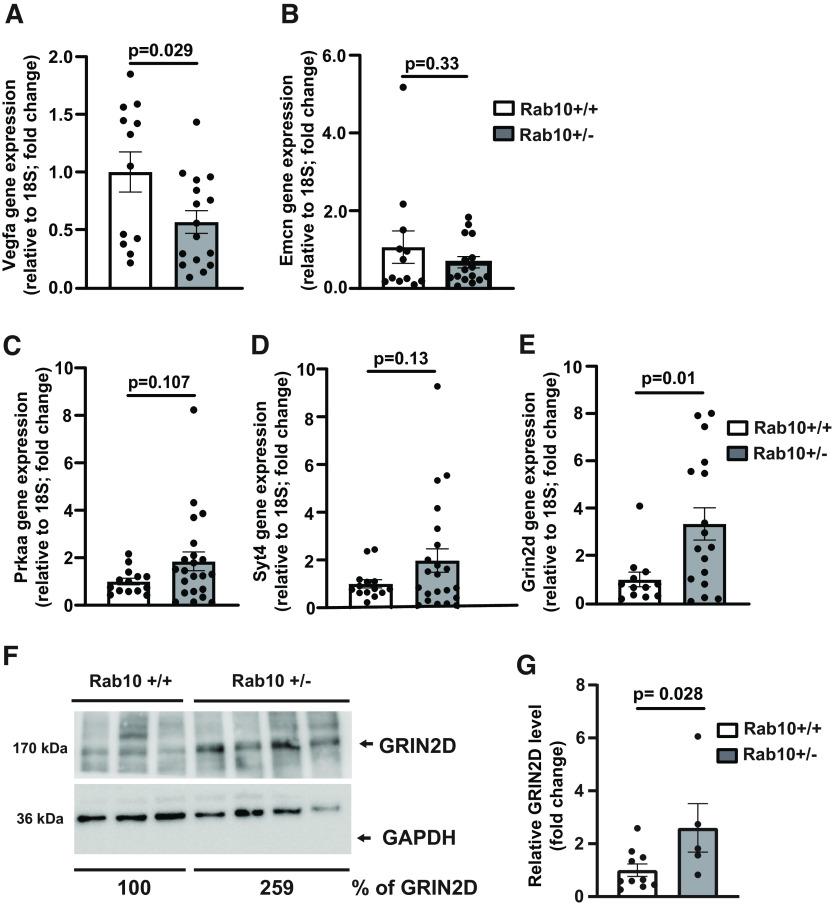
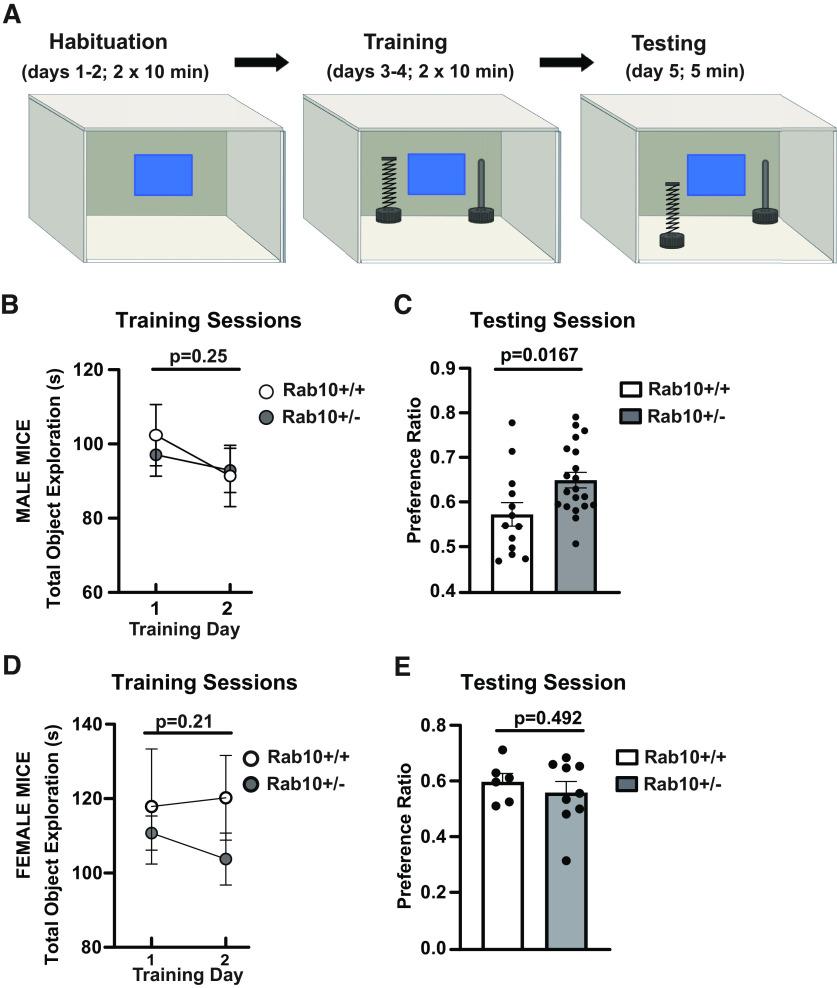
A central question in the field of aging research is to identify the cellular and molecular basis of neuroresilience. One potential candidate is the small GTPase, Rab10. Here, we used Rab10 mice to investigate the molecular mechanisms underlying Rab10-mediated neuroresilience. Brain expression analysis of 880 genes involved in neurodegeneration showed that Rab10 mice have increased activation of pathways associated with neuronal metabolism, structural integrity, neurotransmission, and neuroplasticity compared with their Rab10 littermates. Lower activation was observed for pathways involved in neuroinflammation and aging. We identified and validated several differentially expressed genes (DEGs), including Stx2, Stx1b, Vegfa, and Lrrc25 (downregulated) and Prkaa2, Syt4, and Grin2d (upregulated). Behavioral testing showed that Rab10 mice perform better in a hippocampal-dependent spatial task (object in place test), while their performance in a classical conditioning task (trace eyeblink classical conditioning, TECC) was significantly impaired. Therefore, our findings indicate that Rab10 differentially controls the brain circuitry of hippocampal-dependent spatial memory and higher-order behavior that requires intact cortex-hippocampal circuitry. Transcriptome and biochemical characterization of these mice suggest that glutamate ionotropic receptor NMDA type subunit 2D (GRIN2D or GluN2D) is affected by Rab10 signaling. Further work is needed to evaluate whether GRIN2D mediates the behavioral phenotypes of the Rab10 mice. We conclude that Rab10 mice described here can be a valuable tool to study the mechanisms of resilience in Alzheimer's disease (AD) model mice and to identify novel therapeutical targets to prevent cognitive decline associated with normal and pathologic aging.
衰老研究领域的一个核心问题是确定神经弹性的细胞和分子基础。一种潜在的候选者是小 GTPase Rab10。在这里,我们使用 Rab10 小鼠来研究 Rab10 介导的神经弹性的分子机制。对涉及神经退行性变的 880 个基因的脑表达分析表明,与 Rab10 同窝仔相比,Rab10 小鼠的神经元代谢、结构完整性、神经递质传递和神经可塑性相关途径的激活增加。观察到神经炎症和衰老相关途径的激活降低。我们鉴定并验证了几个差异表达基因(DEGs),包括 Stx2、Stx1b、Vegfa 和 Lrrc25(下调)以及 Prkaa2、Syt4 和 Grin2d(上调)。行为测试表明,Rab10 小鼠在海马依赖性空间任务(物体位置测试)中表现更好,而它们在经典条件反射任务(痕迹眨眼经典条件反射,TECC)中的表现则明显受损。因此,我们的研究结果表明,Rab10 差异控制了海马依赖性空间记忆和需要完整皮层-海马回路的高级行为的大脑回路。对这些小鼠的转录组和生化特征的研究表明,谷氨酸离子型受体 NMDA 型亚基 2D(GRIN2D 或 GluN2D)受 Rab10 信号的影响。需要进一步的工作来评估 GRIN2D 是否介导 Rab10 小鼠的行为表型。我们得出结论,这里描述的 Rab10 小鼠可以成为研究阿尔茨海默病(AD)模型小鼠中弹性机制以及鉴定预防与正常和病理性衰老相关认知能力下降的新治疗靶点的有价值的工具。




 Zotero 插件