Homma Yuta, Hiragi Shu, Fukuda Mitsunori
Laboratory of Membrane Trafficking Mechanisms, Department of Integrative Life Sciences, Graduate School of Life Sciences, Tohoku University, Sendai, Japan.
FEBS J. 2021 Jan;288(1):36-55. doi: 10.1111/febs.15453. Epub 2020 Jul 1.
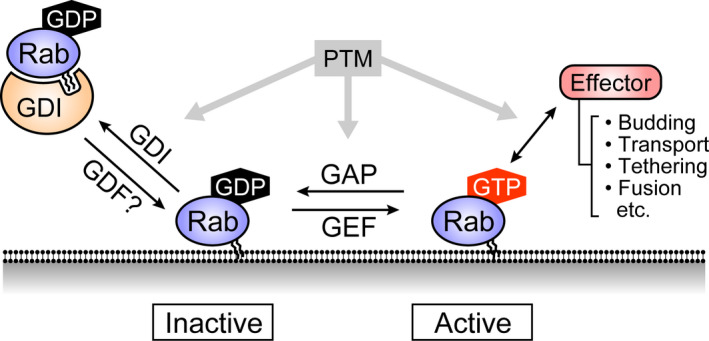
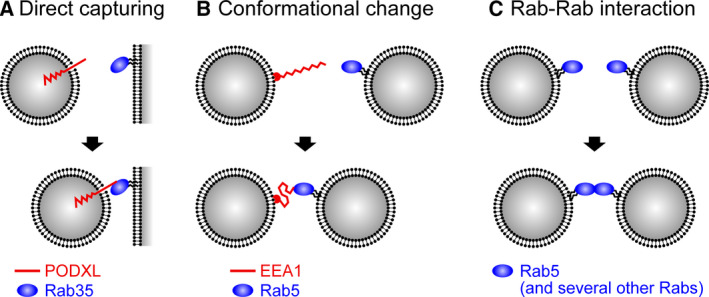
The Rab family of small GTPases regulates intracellular membrane trafficking by orchestrating the biogenesis, transport, tethering, and fusion of membrane-bound organelles and vesicles. Like other small GTPases, Rabs cycle between two states, an active (GTP-loaded) state and an inactive (GDP-loaded) state, and their cycling is catalyzed by guanine nucleotide exchange factors (GEFs) and GTPase-activating proteins (GAPs). Because an active form of each Rab localizes on a specific organelle (or vesicle) and recruits various effector proteins to facilitate each step of membrane trafficking, knowing when and where Rabs are activated and what effectors Rabs recruit is crucial to understand their functions. Since the discovery of Rabs, they have been regarded as one of the central hubs for membrane trafficking, and numerous biochemical and genetic studies have revealed the mechanisms of Rab functions in recent years. The results of these studies have included the identification and characterization of novel GEFs, GAPs, and effectors, as well as post-translational modifications, for example, phosphorylation, of Rabs. Rab functions beyond the simple effector-recruiting model are also emerging. Furthermore, the recently developed CRISPR/Cas technology has enabled acceleration of knockout analyses in both animals and cultured cells and revealed previously unknown physiological roles of many Rabs. In this review article, we provide the most up-to-date and comprehensive lists of GEFs, GAPs, effectors, and knockout phenotypes of mammalian Rabs and discuss recent findings in regard to their regulation and functions.
小GTP酶的Rab家族通过协调膜结合细胞器和囊泡的生物发生、运输、拴系和融合来调节细胞内膜运输。与其他小GTP酶一样,Rabs在两种状态之间循环,即活性(结合GTP)状态和非活性(结合GDP)状态,它们的循环由鸟嘌呤核苷酸交换因子(GEFs)和GTP酶激活蛋白(GAPs)催化。由于每种Rab的活性形式定位于特定的细胞器(或囊泡)并招募各种效应蛋白以促进膜运输的每个步骤,因此了解Rabs何时何地被激活以及Rabs招募了哪些效应蛋白对于理解它们的功能至关重要。自发现Rabs以来,它们一直被视为膜运输的核心枢纽之一,近年来大量的生化和遗传学研究揭示了Rab功能的机制。这些研究结果包括新型GEFs、GAPs和效应蛋白的鉴定和表征,以及Rabs的翻译后修饰,例如磷酸化。超出简单效应蛋白招募模型的Rab功能也正在出现。此外,最近开发的CRISPR/Cas技术加快了动物和培养细胞中的敲除分析,并揭示了许多Rabs以前未知的生理作用。在这篇综述文章中,我们提供了哺乳动物Rabs的GEFs、GAPs、效应蛋白和敲除表型的最新和最全面的列表,并讨论了关于它们的调节和功能的最新发现。