Department of Medical Education, Taipei Veterans General Hospital, Taipei, Taiwan.
School of Medicine, College of Medicine, Taipei Medical University, Taipei, Taiwan.
Sci Rep. 2023 May 10;13(1):7597. doi: 10.1038/s41598-023-34128-5.
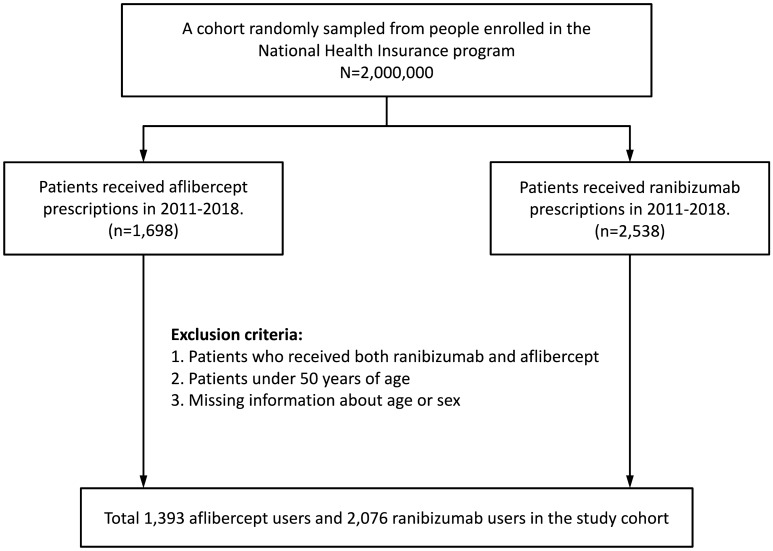
Intravitreal anti-vascular endothelial growth factor (anti-VEGF) agents have been increasingly applied in the treatment of retinal neovascular diseases. Concerns have arisen that these intravitreal agents may be associated with a potential risk of arterial thromboembolic (ATE) events. We conducted a retrospective, nationwide population-based cohort study to analyze the risks for ATE events in patients receiving intravitreal ranibizumab (IVR) or intravitreal aflibercept (IVA). Data (2011-2018) were obtained from Taiwan's National Health Insurance Research Database. Cox proportional-hazards model was used to identify the risk factors for ATEs. Of the total 3,469 patients, 1393 and 2076 patients received IVR and IVA, respectively. In our result, 38 ATEs occurred within 6 months after IVR or IVA. The risk of ATEs was lower in patients receiving IVR than in those receiving IVA (adjusted hazard ratio [aHR], 0.27; 95% confidence interval [CI], 0.11-0.66). Patients with coronary artery disease (CAD) exhibited a higher risk of ATEs than did those without CAD (aHR, 3.47; 95% CI, 1.41-8.53). The risk of ATEs was higher in patients with an event of acute myocardial infarction (AMI) or ischemic stroke (IS) within 6 months prior to index IVI than in those without recent AMI/IS events (aHR, 23.8; 95% CI, 7.35-77.2 and IS: aHR, 290.2; 95% CI, 103.1-816.4). In conclusion, compared with IVA, IVR was associated with a lower risk of ATEs. When strategies for anti-VEGF agents are devised, risk factors, such as CAD and a history of AMI or IS within 6 months should be considered. Further large-scale studies are warranted to elucidate the safety of anti-VEGF injections.
玻璃体内抗血管内皮生长因子(anti-VEGF)药物已越来越多地应用于治疗视网膜新生血管疾病。人们担心这些玻璃体内药物可能与动脉血栓栓塞(ATE)事件的潜在风险有关。我们进行了一项回顾性、全国性基于人群的队列研究,以分析接受玻璃体内雷珠单抗(IVR)或玻璃体内阿柏西普(IVA)治疗的患者发生 ATE 事件的风险。数据(2011-2018 年)来自台湾全民健康保险研究数据库。Cox 比例风险模型用于确定 ATE 的风险因素。在总共 3469 名患者中,1393 名和 2076 名患者分别接受了 IVR 和 IVA。我们的结果显示,38 例 ATE 发生在 IVR 或 IVA 后 6 个月内。与接受 IVA 的患者相比,接受 IVR 的患者发生 ATE 的风险较低(调整后的危险比[aHR],0.27;95%置信区间[CI],0.11-0.66)。患有冠状动脉疾病(CAD)的患者发生 ATE 的风险高于无 CAD 的患者(aHR,3.47;95%CI,1.41-8.53)。与没有近期 AMI/IS 事件的患者相比,在索引 IVI 前 6 个月内发生急性心肌梗死(AMI)或缺血性卒中(IS)事件的患者发生 ATE 的风险更高(aHR,23.8;95%CI,7.35-77.2 和 IS:aHR,290.2;95%CI,103.1-816.4)。总之,与 IVA 相比,IVR 与较低的 ATE 风险相关。当制定抗 VEGF 药物策略时,应考虑 CAD 等风险因素,以及 6 个月内发生的 AMI 或 IS 病史。需要进一步的大规模研究来阐明抗 VEGF 注射的安全性。