Coe Dorothy, Newell Natasha, Jones Mark, Robb Matthew, Clark Natalie, Reaich David, Wroe Caroline
Newcastle-upon-Tyne Hospitals NHS Foundation Trust, Newcastle upon Tyne, UK.
Newcastle University, Newcastle upon Tyne, UK.
Arch Public Health. 2023 May 10;81(1):88. doi: 10.1186/s13690-023-01099-y.
In Spring 2020 there was a change in organ donation legislation in England (UK). Much is known about public opinions to organ donation and the change in legislation, however, there is little evidence about the opinions of the NHS workforce. This study set out to understand the levels of awareness, support and action of NHS staff to this change and explore the impact of respondent demographics, place and type of work on awareness, support and action.
An online survey was offered to all NHS organisations in North Thames and the North East and North Cumbria through the NIHR Clinical Research Network between July and December 2020. Participating organisations were provided with an information package and promoted the survey via email and internal staff communications. Associations were compared univariately using chi-square tests and logistic regression was used for multivariable analysis to compare findings with NHS Blood and Transplant public Kantar survey data.
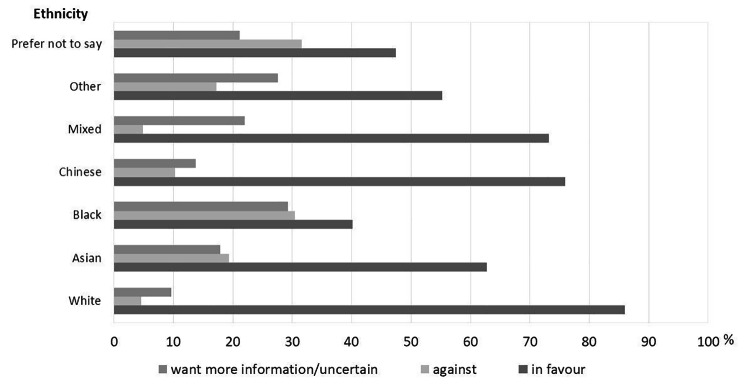
A total of 5789 staff participated in the survey. They were more aware, more supportive, more likely to have discussed their organ donation choices with family and more likely to be on the organ donor register than the public. This increased awareness and support was found across minority ethnic and religious groups. Those working in a transplanting centre were most aware and supportive and those working in the ambulance service were most likely to 'opt-in' following the change in legislation.
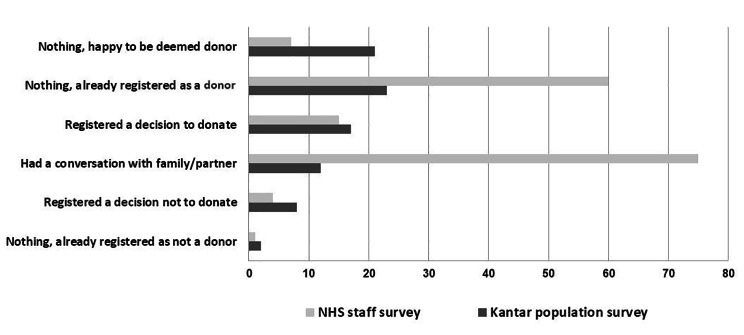
NHS staff in England were well informed about the change in organ donation legislation and levels of support were high. NHS staff were six times more likely than the public to have a conversation with their family about their organ donation choices. The size and ethnic diversity of the NHS workforce offers an opportunity to enable and support NHS staff to be advocates for organ donation and raise awareness of the change in legislation amongst their communities.
2020年春季,英国英格兰的器官捐赠立法发生了变化。关于公众对器官捐赠及立法变化的看法,我们了解很多,然而,关于国民保健服务体系(NHS)工作人员的看法,几乎没有证据。本研究旨在了解NHS工作人员对这一变化的知晓程度、支持程度及行动情况,并探讨受访者的人口统计学特征、工作地点和工作类型对知晓程度、支持程度及行动的影响。
2020年7月至12月期间,通过国家卫生研究院临床研究网络,向北泰晤士、东北部和北坎布里亚的所有NHS机构提供了一项在线调查。参与的机构收到了一份信息包,并通过电子邮件和内部员工沟通来推广该调查。使用卡方检验对各协会进行单变量比较,并使用逻辑回归进行多变量分析,以将研究结果与NHS血液与移植组织的康德公众调查数据进行比较。
共有5789名工作人员参与了调查。与公众相比,他们对器官捐赠的知晓程度更高、支持程度更高,更有可能与家人讨论自己的器官捐赠选择,也更有可能登记成为器官捐赠者。在少数族裔和宗教群体中也发现了这种知晓程度和支持程度的提高。在移植中心工作的人员知晓程度和支持程度最高,而在救护服务部门工作的人员在立法变化后最有可能“选择加入”。
英格兰的NHS工作人员对器官捐赠立法的变化了解充分,支持程度很高。NHS工作人员与家人谈论自己器官捐赠选择的可能性是公众的六倍。NHS工作人员队伍的规模和种族多样性为促使和支持NHS工作人员成为器官捐赠的倡导者,并提高其所在社区对立法变化的认识提供了机会。