Hahn Steffen, Briedis Martins, Barboutis Christos, Schmid Raffaella, Schulze Martin, Seifert Nina, Szép Tibor, Emmenegger Tamara
Department Bird Migration, Swiss Ornithological Institute, Seerose 1, CH-6204, Sempach, Switzerland.
Lab of Ornithology, Institute of Biology, University of Latvia, Salaspils, Latvia.
BMC Zool. 2021 Apr 20;6(1):6. doi: 10.1186/s40850-021-00071-z.
Populations of long-distance migratory birds experience different environments and are consequently exposed to different parasites throughout their annual cycles. Though, specific whereabouts and accompanied host-parasite interactions remain unknown for most migratory passerines. Collared sand martins (Riparia riparia) breeding in the western Palaearctic spend the nonbreeding period in Africa, but it is not yet clear whether specific populations differ in overwintering locations and whether these also result in varying infections with vector-transmitted endoparasites.
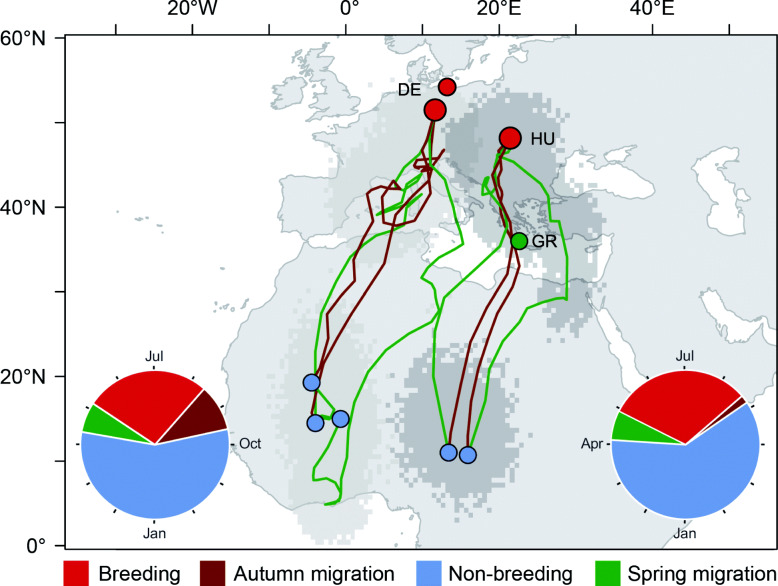
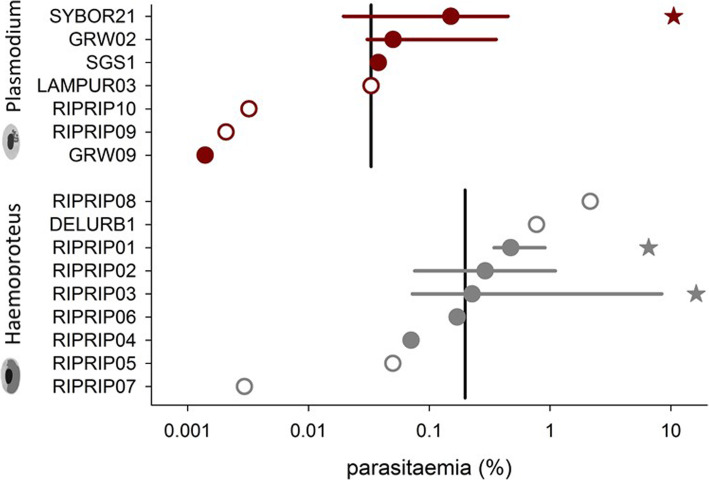
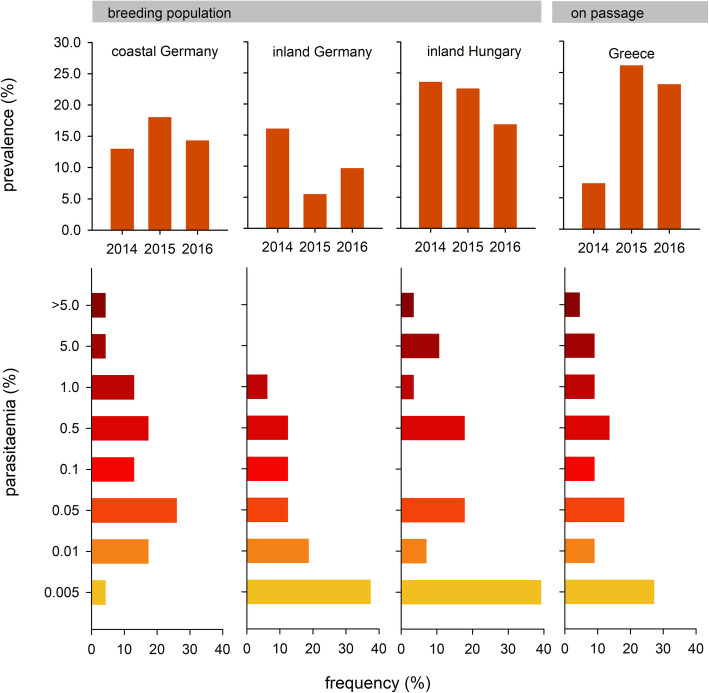
Geolocator tracking revealed that collared sand martins from northern-central and central-eastern Europe migrate to distant nonbreeding sites in West Africa and the Lake Chad basin in central Africa, respectively. While the ranges of these populations were clearly separated throughout the year, they consistently spent up to 60% of the annual cycle in Africa. Ambient light recorded by geolocators further indicated unsheltered roosting during the nonbreeding season in Africa compared to the breeding season in Europe. We found 5-26% prevalence of haemosporidian parasites in three breeding populations and one migratory passage population that was only sampled but not tracked. In total, we identified seven Plasmodium and nine Haemoproteus lineages (incl. two and seven new lineages, respectively), the latter presumably typical for swallows (Hirundinae) hosts. 99.5% of infections had a low intensity, typical for chronic infection stages, whereas three individuals (0.5%) showed high parasitaemia typical for acute infections during spring migration and breeding.
Our study shows that blood parasite infections are common in several western Palaearctic breeding populations of collared sand martins who spent the nonbreeding season in West Africa and the lake Chad region. Due to long residency at the nonbreeding grounds blood parasite transmissions may mainly occur at host population-specific residences sites in Europe and Africa; the latter being likely facilitated by unsheltered roosting and thus high vulnerability to hematophagous insects. The rare cases of high parasitaemia during spring migration and breeding further indicates either relapses of chronic infection or primary infections which occurred shortly before migration and during breeding.
长途候鸟种群会经历不同的环境,因此在其年度周期中会接触到不同的寄生虫。然而,对于大多数迁徙雀形目鸟类来说,其具体行踪以及伴随的宿主 - 寄生虫相互作用仍不为人所知。在古北界西部繁殖的领燕(Riparia riparia)在非洲度过非繁殖期,但尚不清楚特定种群在越冬地点是否存在差异,以及这些差异是否也会导致媒介传播的体内寄生虫感染情况不同。
地理定位跟踪显示,来自欧洲中北部和中东地区的领燕分别迁徙到西非和中非乍得湖盆地的遥远非繁殖地。虽然这些种群的活动范围在全年都明显分开,但它们在非洲全年周期中始终有高达60%的时间。地理定位器记录的环境光进一步表明,与在欧洲繁殖季节相比,在非洲非繁殖季节领燕栖息时没有遮蔽。我们在三个繁殖种群和一个仅采样但未跟踪的迁徙过境种群中发现血孢子虫寄生虫的感染率为5% - 26%。总共,我们鉴定出7种疟原虫和9种血变原虫谱系(分别包括2种和7种新谱系),后者可能是燕子(燕亚科)宿主所特有的。99.5%的感染强度较低,这是慢性感染阶段的典型特征,而有三只个体(0.5%)在春季迁徙和繁殖期间表现出急性感染典型的高寄生虫血症。
我们的研究表明,血寄生虫感染在几个在西非和乍得湖地区度过非繁殖季节的古北界西部领燕繁殖种群中很常见。由于在非繁殖地长期停留,血寄生虫传播可能主要发生在欧洲和非洲宿主种群特定的居住地点;后者可能由于栖息时没有遮蔽,因此极易受到吸血昆虫的侵害而得以促进。春季迁徙和繁殖期间罕见的高寄生虫血症病例进一步表明,要么是慢性感染复发,要么是在迁徙前不久和繁殖期间发生的初次感染。