
强化物价值调节产前酒精暴露对学习和逆转的影响。
Reinforcer value moderates the effects of prenatal alcohol exposure on learning and reversal.
作者信息
Chandrasekaran Jayapriya, Jacquez Belkis, Wilson Jennifer, Brigman Jonathan L
机构信息
Department of Neurosciences, University of New Mexico School of Medicine, Albuquerque, NM, United States.
New Mexico Alcohol Research Center, UNM Health Sciences Center, Albuquerque, NM, United States.
出版信息
Front Neurosci. 2023 Apr 25;17:1147536. doi: 10.3389/fnins.2023.1147536. eCollection 2023.
INTRODUCTION
Fetal Alcohol Spectrum Disorders (FASD) are the leading cause of preventable developmental disability and are commonly characterized by alterations in executive function. Reversal learning tasks are reliable, cross-species methods for testing a frequently impaired aspect of executive control, behavioral flexibility. Pre-clinical studies commonly require the use of reinforcers to motivate animals to learn and perform the task. While there are several reinforcers available, the most commonly employed are solid (food pellets) and liquid (sweetened milk) rewards. Previous studies have examined the effects of different solid rewards or liquid dietary content on learning in instrumental responding and found that rodents on liquid reward with higher caloric content performed better with increased response and task acquisition rate. The influence of reinforcer type on reversal learning and how this interacts with developmental insults such as prenatal alcohol exposure (PAE) has not been explored.
METHODS
We tested whether reinforcer type during learning or reversal would impact an established deficit in PAE mice.
RESULTS
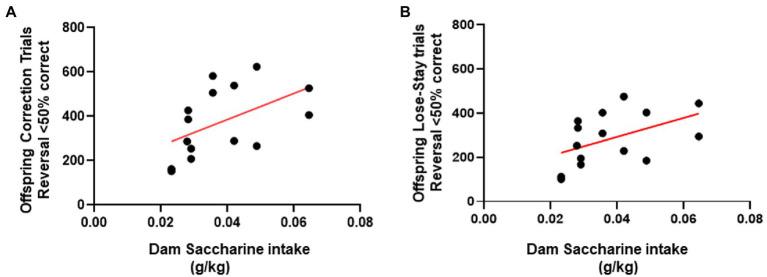
We found that all male and female mice on liquid reward, regardless of prenatal exposure were better motivated to learn task behaviors during pre-training. Consistent with previous findings, both male and female PAE mice and Saccharine control mice were able to learn the initial stimulus reward associations irrespective of the reinforcer type. During the initial reversal phase, male PAE mice that received pellet rewards exhibited maladaptive perseverative responding whereas male mice that received liquid rewards performed comparable to their control counterparts. Female PAE mice that received either reinforcer types did not exhibit any deficits on behavioral flexibility. Female saccharine control mice that received liquid, but not pellet, rewards showed increased perseverative responding during the early reversal phase.
DISCUSSION
These data suggest that reinforcer type can have a major impact on motivation, and therefore performance, during reversal learning. Highly motivating rewards may mask behavioral deficits seen with more moderately sought rewards and gestational exposure to the non-caloric sweetener, saccharine, can impact behavior motivated by those reinforcers in a sex-dependent manner.
引言
胎儿酒精谱系障碍(FASD)是可预防的发育障碍的主要原因,其常见特征是执行功能改变。反转学习任务是测试执行控制中经常受损的一个方面——行为灵活性的可靠的跨物种方法。临床前研究通常需要使用强化物来激励动物学习和执行任务。虽然有几种强化物可供使用,但最常用的是固体(食物颗粒)和液体(加糖牛奶)奖励。先前的研究已经考察了不同固体奖励或液体饮食成分对工具性反应学习的影响,发现高热量含量的液体奖励的啮齿动物在反应增加和任务习得率方面表现更好。强化物类型对反转学习的影响以及它如何与发育性损伤(如产前酒精暴露(PAE))相互作用尚未得到探索。
方法
我们测试了学习或反转过程中的强化物类型是否会影响PAE小鼠已有的缺陷。
结果
我们发现,所有接受液体奖励的雄性和雌性小鼠,无论产前暴露情况如何,在预训练期间学习任务行为的积极性都更高。与先前的研究结果一致,雄性和雌性PAE小鼠以及糖精对照小鼠都能够学习初始刺激-奖励关联,而与强化物类型无关。在初始反转阶段,接受颗粒奖励的雄性PAE小鼠表现出适应不良的持续性反应,而接受液体奖励的雄性小鼠表现与对照小鼠相当。接受任何一种强化物类型的雌性PAE小鼠在行为灵活性方面均未表现出任何缺陷。接受液体而非颗粒奖励的雌性糖精对照小鼠在早期反转阶段表现出增加的持续性反应。
讨论
这些数据表明,强化物类型在反转学习过程中可能对动机以及因此对表现产生重大影响。高度激励性的奖励可能掩盖使用更适度寻求的奖励时出现的行为缺陷,并且孕期接触非热量甜味剂糖精会以性别依赖的方式影响由这些强化物激发的行为。


 Zotero 插件