Department of Radiology, CJ Gorter MRI Center, Leiden University Medical Center, Leiden, The Netherlands.
Department of Neurology, Leiden University Medical Center, Leiden, The Netherlands.
J Neuromuscul Dis. 2023;10(5):869-883. doi: 10.3233/JND-230023.
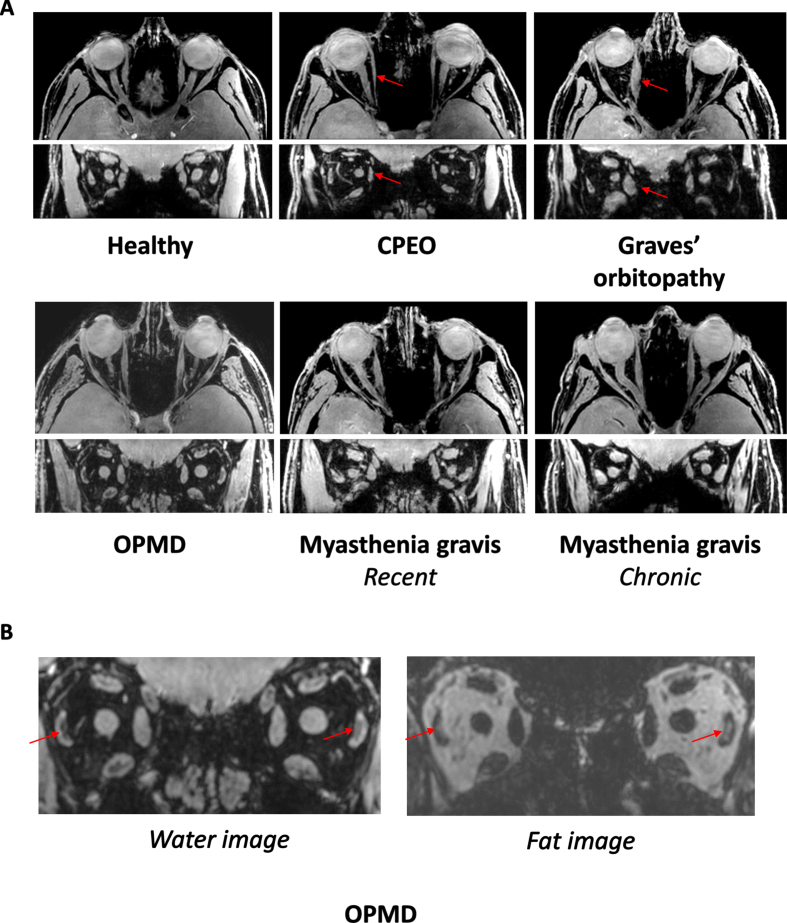
MRI of extra-ocular muscles (EOM) in patients with myasthenia gravis (MG) could aid in diagnosis and provide insights in therapy-resistant ophthalmoplegia. We used quantitative MRI to study the EOM in MG, healthy and disease controls, including Graves' ophthalmopathy (GO), oculopharyngeal muscular dystrophy (OPMD) and chronic progressive external ophthalmoplegia (CPEO).
Twenty recently diagnosed MG (59±19yrs), nineteen chronic MG (51±16yrs), fourteen seronegative MG (57±9yrs) and sixteen healthy controls (54±13yrs) were included. Six CPEO (49±14yrs), OPMD (62±10yrs) and GO patients (44±12yrs) served as disease controls. We quantified muscle fat fraction (FF), T2water and volume. Eye ductions and gaze deviations were assessed by synoptophore and Hess-charting.
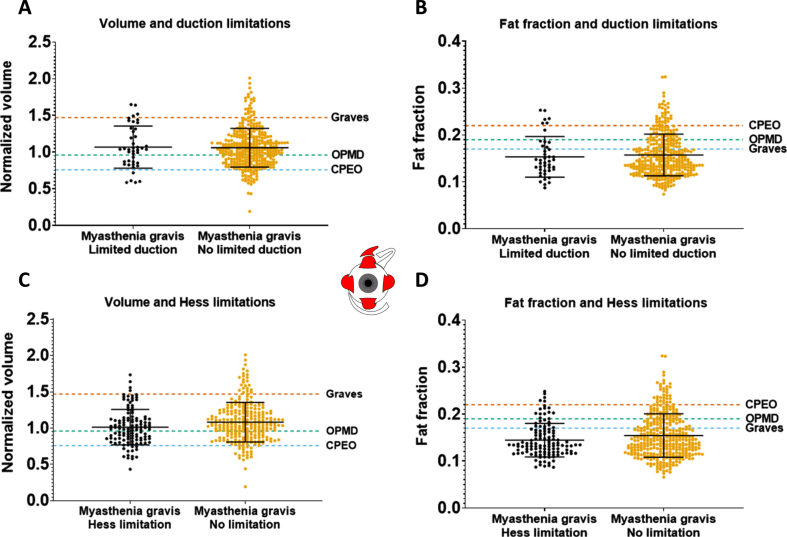
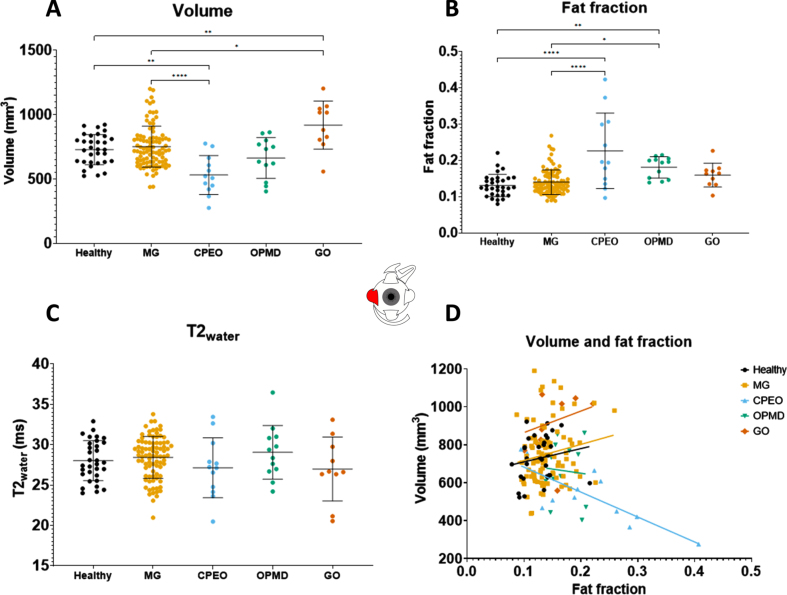
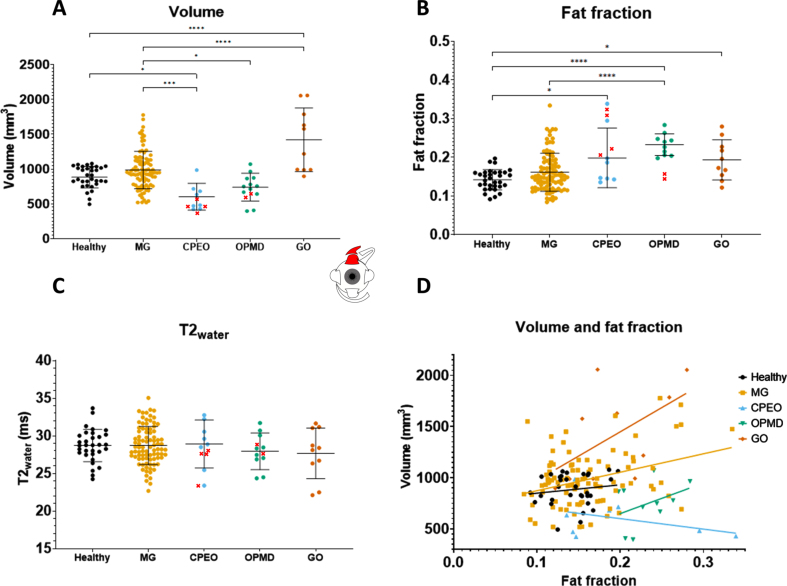
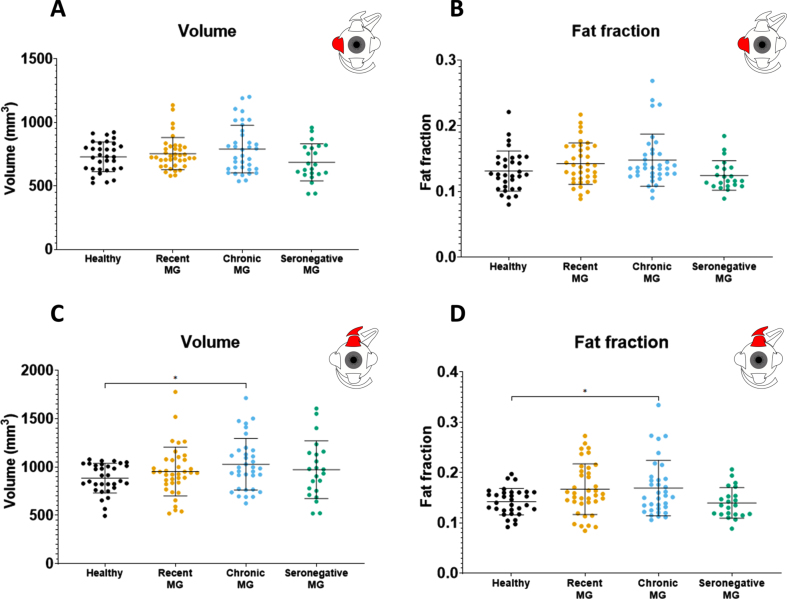
Chronic, but not recent onset, MG patients showed volume increases (e.g. superior rectus and levator palpebrae [SR+LPS] 985±155 mm3 compared to 884±269 mm3 for healthy controls, p < 0.05). As expected, in CPEO volume was decreased (e.g. SR+LPS 602±193 mm3, p < 0.0001), and in GO volume was increased (e.g. SR+LPS 1419±457 mm3, p < 0.0001). FF was increased in chronic MG (e.g. medial rectus increased 0.017, p < 0.05). In CPEO and OPMD the FF was more severely increased. The severity of ophthalmoplegia did not correlate with EOM volume in MG, but did in CPEO and OPMD. No differences in T2water were found.
We observed small increases in EOM volume and FF in chronic MG compared to healthy controls. Surprisingly, we found no atrophy in MG, even in patients with long-term ophthalmoplegia. This implies that even long-term ophthalmoplegia in MG does not lead to secondary structural myopathic changes precluding functional recovery.
对重症肌无力(MG)患者的眼外肌(EOM)进行 MRI 检查有助于诊断,并为治疗抵抗性眼肌麻痹提供深入了解。我们使用定量 MRI 研究了 MG、健康对照者和疾病对照组(包括格雷夫斯眼病(GO)、眼咽肌营养不良(OPMD)和慢性进行性眼外肌麻痹(CPEO))的 EOM。
共纳入 20 例新近诊断的 MG(59±19 岁)、19 例慢性 MG(51±16 岁)、14 例血清阴性 MG(57±9 岁)和 16 例健康对照者(54±13 岁)。6 例 CPEO(49±14 岁)、6 例 OPMD(62±10 岁)和 6 例 GO 患者(44±12 岁)作为疾病对照组。我们定量了肌肉脂肪分数(FF)、T2 水和体积。使用同视机和 Hess 图表评估眼球运动和凝视偏差。
慢性但非近期发病的 MG 患者显示出体积增加(例如,上直肌和提上睑肌[SR+LPS]为 985±155mm3,而健康对照组为 884±269mm3,p<0.05)。如预期的那样,CPEO 患者的体积减少(例如,SR+LPS 为 602±193mm3,p<0.0001),GO 患者的体积增加(例如,SR+LPS 为 1419±457mm3,p<0.0001)。慢性 MG 患者的 FF 增加(例如,内侧直肌增加 0.017,p<0.05)。CPEO 和 OPMD 患者的 FF 增加更为严重。MG 患者的眼肌麻痹严重程度与 EOM 体积无关,但在 CPEO 和 OPMD 患者中有关。未发现 T2 水的差异。
与健康对照组相比,我们观察到慢性 MG 患者的 EOM 体积和 FF 略有增加。令人惊讶的是,即使在患有长期眼肌麻痹的患者中,我们也未发现 MG 有萎缩。这意味着即使是 MG 的长期眼肌麻痹也不会导致继发性结构性肌病改变,从而妨碍功能恢复。