Department of Orthopaedics, Fondazione Policlinico Universitario Agostino Gemelli IRCCS, 00168 Rome, Italy.
Department of Orthopaedics, Fondazione Policlinico Universitario Agostino Gemelli IRCCS, University Cattolica del Sacro Cuore, 00168 Rome, Italy.
Curr Oncol. 2023 Mar 24;30(4):3571-3579. doi: 10.3390/curroncol30040272.
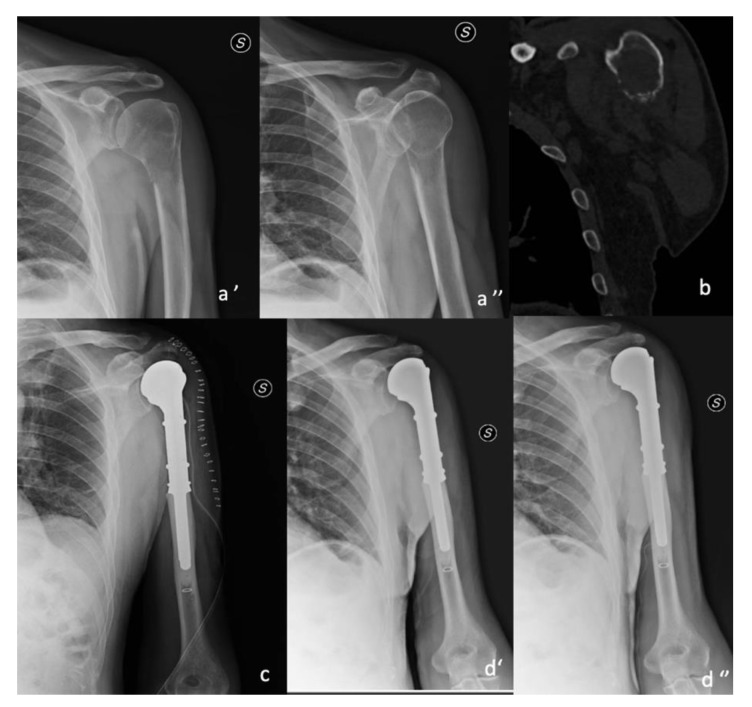
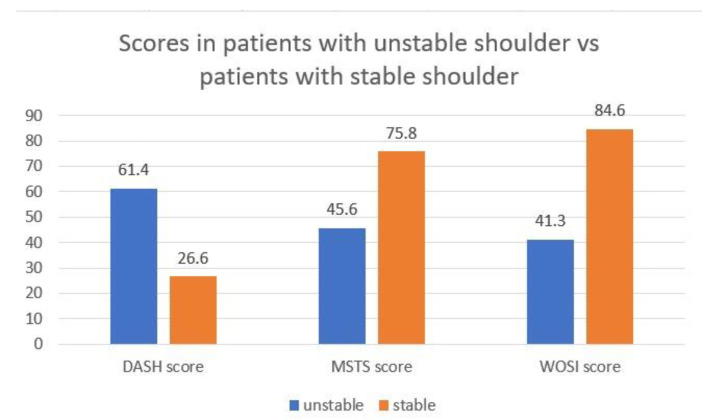
(1) Background: Some of the goals of orthopedic surgical oncology are saving limbs and function. The humerus is the third most frequent site in primary tumors and one of the most involved sites for metastases. Prosthetic replacement with modular megaprosthesis is one of the treatment choices, but there are several types of complications, such as problems with function and pain. The aim of our study is to assess functional outcomes and shoulder instability in the reconstruction of proximal humerus metastases. (2) Methods: This is a retrospective observational study. Twenty-eight patients, with proximal humerus metastases, admitted to the department of Orthopaedics and Traumatology of our University Hospital between 2014 and 2022 were recruited. Each patient underwent resection and prosthetic replacement surgery with modular megaprosthesis. Clinical evaluation was assessed through MSTS score, WOSI index, and DASH score. (3) Results: Twenty patients were included in the study. Fairly good results, especially regarding pain, function, and emotional acceptance, were obtained in all three tests: DASH, MSTS, and WOSI. Patients who reported shoulder instability actually have worse outcomes than those who report having stable shoulders. In addition, patients with a resection >10 cm have worse outcomes than those who had a resection of 10 cm. No significant differences were found between the deltopectoral approach group and the lateral approach group. (4) Conclusions: Reconstructive surgery with megaprosthesis of the proximal humerus in patients with metastases can be considered a treatment option, especially in patients with pathological fractures or injuries with a high risk of fracture and good life expectancy. This study shows how this type of surgery affects instability, but in terms of functionality, pain, and patient satisfaction, it gives satisfactory results.
(1) 背景:骨科肿瘤学的部分目标是保存肢体和功能。肱骨是原发性肿瘤中第三大常见部位,也是转移瘤最常累及的部位之一。带模块的假体置换是治疗选择之一,但存在多种类型的并发症,如功能和疼痛问题。我们的研究目的是评估肱骨近端转移瘤重建的功能结果和肩不稳定。
(2) 方法:这是一项回顾性观察研究。2014 年至 2022 年期间,我们大学医院骨科和创伤科收治了 28 例肱骨近端转移瘤患者。每位患者均接受了切除和带模块的假体置换手术。临床评估通过 MSTS 评分、WOSI 指数和 DASH 评分进行评估。
(3) 结果:20 例患者纳入研究。在所有三个测试中,DASH、MSTS 和 WOSI,都取得了相当好的结果,特别是在疼痛、功能和情绪接受方面。报告肩不稳定的患者实际上比报告肩部稳定的患者结果更差。此外,切除>10cm 的患者比切除 10cm 的患者结果更差。肩胛胸壁入路组和外侧入路组之间无显著差异。
(4) 结论:在转移瘤患者中,肱骨近端假体重建手术可被视为一种治疗选择,尤其是在病理性骨折或骨折风险高且预期寿命良好的患者中。本研究表明了这种手术如何影响不稳定,但在功能、疼痛和患者满意度方面,它给出了令人满意的结果。