Laboratorio de Fisiologia Molecular de Plantas del PIPS de Cereales y Granos Nativos, Facultad de Agronomia, Universidad Nacional Agraria La Molina, Lima, Peru.
Laboratorio de Evaluación Nutricional de Alimentos, Universidad Nacional Agraria La Molina, Lima, Peru.
Sci Rep. 2023 May 15;13(1):7827. doi: 10.1038/s41598-023-35107-6.
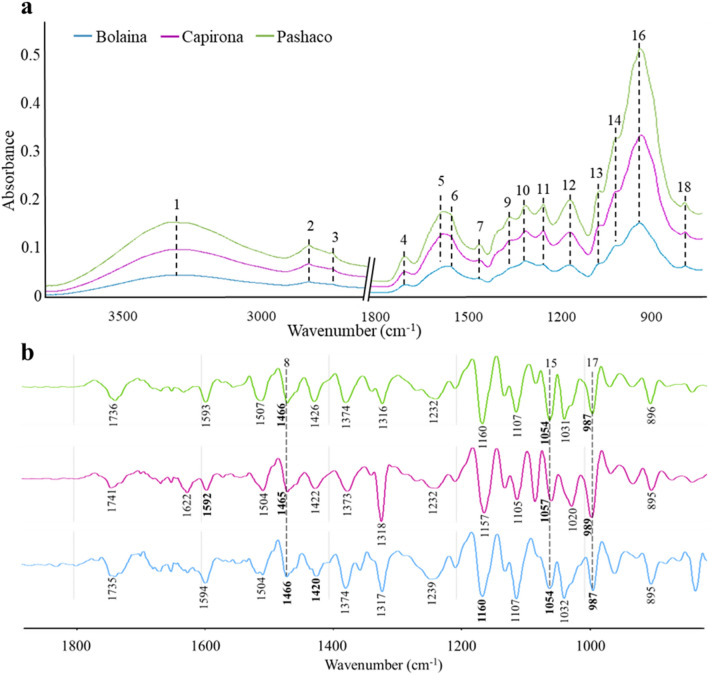
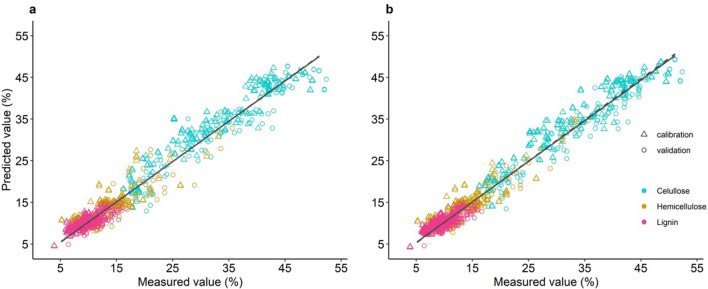
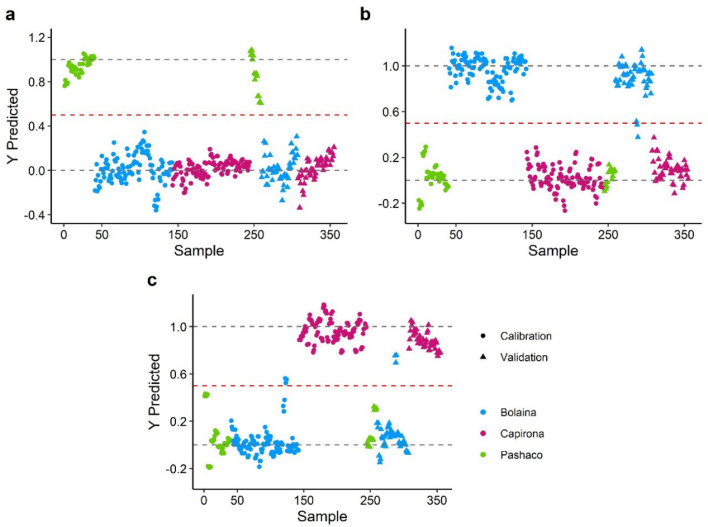
Fast-growing trees like Capirona, Bolaina, and Pashaco have the potential to reduce forest degradation because of their ecological features, the economic importance in the Amazon Forest, and an industry based on wood-polymer composites. Therefore, a practical method to discriminate specie (to avoid illegal logging) and determine chemical composition (tree breeding programs) is needed. This study aimed to validate a model for the classification of wood species and a universal model for the rapid determination of cellulose, hemicellulose, and lignin using FTIR spectroscopy coupled with chemometrics. Our results showed that PLS-DA models for the classification of wood species (0.84 ≤ R ≤ 0.91, 0.12 ≤ RMSEP ≤ 0.20, accuracy, specificity, and sensibility between 95.2 and 100%) were satisfied with the full spectra and the differentiation among these species based on IR peaks related to cellulose, lignin, and hemicellulose. Besides, the full spectra helped build a three-species universal PLS model to quantify the principal wood chemical components. Lignin (RPD = 2.27, [Formula: see text] = 0.84) and hemicellulose (RPD = 2.46, [Formula: see text] = 0.83) models showed a good prediction, while cellulose model (RPD = 3.43, [Formula: see text] = 0.91) classified as efficient. This study showed that FTIR-ATR, together with chemometrics, is a reliable method to discriminate wood species and to determine the wood chemical composition in juvenile trees of Pashaco, Capirona, and Bolaina.
快速生长的树木,如 Capirona、Bolaina 和 Pashaco,由于其生态特征、在亚马逊森林中的经济重要性以及基于木材-聚合物复合材料的产业,有可能减少森林退化。因此,需要一种实用的方法来区分物种(以避免非法采伐)和确定化学成分(树木育种计划)。本研究旨在验证一种用于木材分类的模型和一种用于快速测定纤维素、半纤维素和木质素的通用模型,使用傅里叶变换红外光谱(FTIR)结合化学计量学。我们的结果表明,用于木材分类的 PLS-DA 模型(0.84≤R≤0.91,0.12≤RMSEP≤0.20,准确率、特异性和敏感性在 95.2%至 100%之间)对全光谱和基于与纤维素、木质素和半纤维素相关的 IR 峰对这些物种的区分感到满意。此外,全光谱有助于建立一个三物种通用的 PLS 模型来定量主要木材化学成分。木质素(RPD=2.27,[Formula: see text]=0.84)和半纤维素(RPD=2.46,[Formula: see text]=0.83)模型显示出良好的预测能力,而纤维素模型(RPD=3.43,[Formula: see text]=0.91)则被归类为高效。本研究表明,FTIR-ATR 结合化学计量学是一种可靠的方法,可以区分木材种类,并确定 Pashaco、Capirona 和 Bolaina 幼树的木材化学成分。