Neumann Christopher C M, Schneider François, Hilfenhaus Georg, Vecchione Loredana, Felsenstein Matthäus, Ihlow Jana, Geisel Dominik, Sander Steffen, Pratschke Johann, Stintzing Sebastian, Keilholz Ulrich, Pelzer Uwe
Department of Hematology, Oncology and Tumor Immunology, Charité-Universitätsmedizin Berlin, Freie Universität Berlin, Humboldt-Universität zu Berlin, and Berlin Institute of Health, 10117 Berlin, Germany.
Department of Surgery CCM/CVK, Charité-Universitätsmedizin Berlin, Freie Universität Berlin, Humboldt-Universität zu Berlin, and Berlin Institute of Health, 10117 Berlin, Germany.
Cancers (Basel). 2023 Apr 19;15(8):2367. doi: 10.3390/cancers15082367.
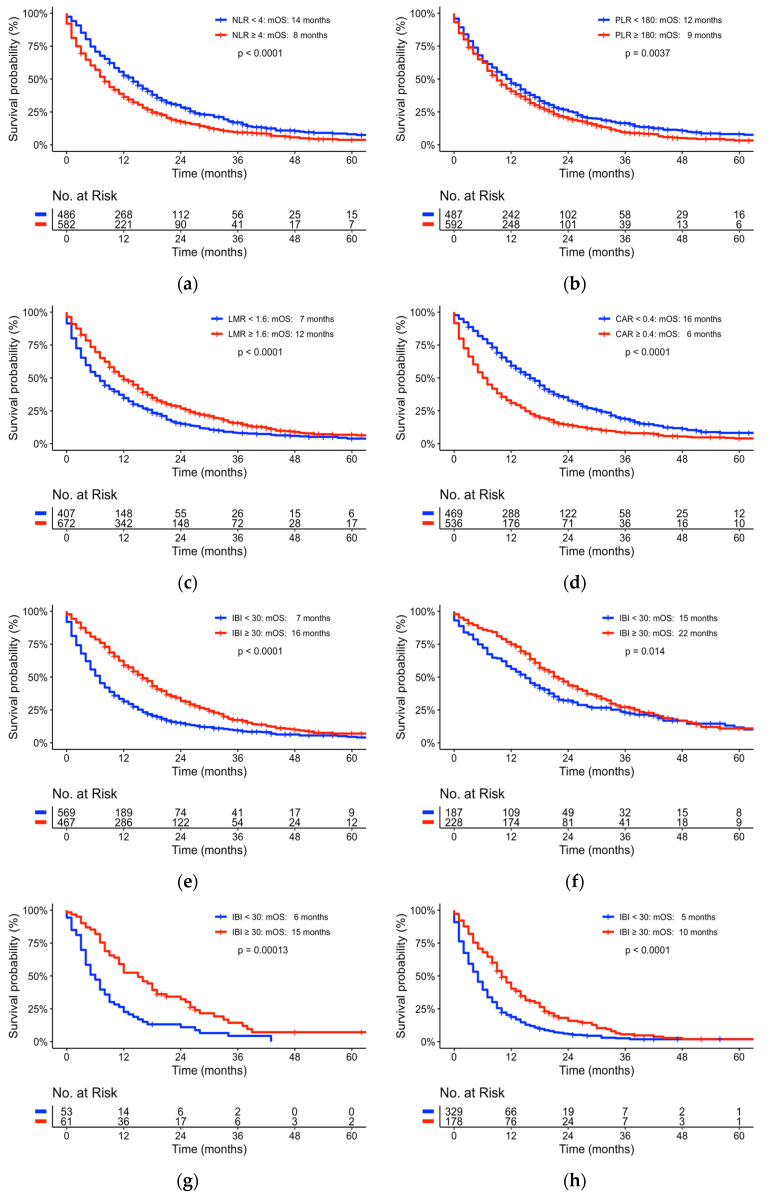
Inflammatory properties are known to promote tumor progression leading to an impaired median overall survival (mOS). Various small studies have focused on a wide range of inflammation-based prognostic indicators. By using sufficient data from 1294 out of 2323 patients diagnosed with pancreatic cancer between 2009 and 2021 at our cancer center, inflammatory markers such as the neutrophil to lymphocyte ratio (NRL), the platelet to lymphocyte ratio (PLR), the lymphocyte to monocyte ratio (LMR) and the CRP to albumin ratio (CAR) were evaluated. We identified a new combined score, termed the inflammatory benchmark index (IBI). We performed univariate and multivariate overall survival analyses and identified optimal prognostic cut-off values for each parameter. In univariate analyses, advanced age ( < 0.001), gender ( < 0.001), tumor stage ( < 0.001), CA19-9 ( = 0.001), NLR ( = 0.001), LMR ( = 0.004), PLR ( = 0.004), CAR ( = 0.001) and IBI ( = 0.001) were identified as prognostic markers. In multivariate analyses advanced age ( < 0.001), gender ( = 0.001), tumor stage ( < 0.001), CA19-9 ( < 0.001), NLR ( = 0.001), LMR ( = 0.038), CAR ( < 0.001) and IBI ( < 0.001) were independent prognostic markers. These findings emphasize the impact of inflammation in pancreatic cancer, provide easily accessible prognostic values for the clinician, and may be useful as stratification parameters for trials aimed at patient inflammation or immune response.
已知炎症特性会促进肿瘤进展,导致中位总生存期(mOS)受损。各种小型研究聚焦于一系列基于炎症的预后指标。通过使用2009年至2021年期间在我们癌症中心诊断出的2323例胰腺癌患者中1294例患者的充分数据,对中性粒细胞与淋巴细胞比值(NRL)、血小板与淋巴细胞比值(PLR)、淋巴细胞与单核细胞比值(LMR)以及C反应蛋白与白蛋白比值(CAR)等炎症标志物进行了评估。我们确定了一个新的综合评分,称为炎症基准指数(IBI)。我们进行了单因素和多因素总生存期分析,并确定了每个参数的最佳预后临界值。在单因素分析中,高龄(<0.001)、性别(<0.001)、肿瘤分期(<0.001)、CA19-9(=0.001)、NLR(=0.001)、LMR(=0.004)、PLR(=0.004)、CAR(=0.001)和IBI(=0.001)被确定为预后标志物。在多因素分析中,高龄(<0.001)、性别(=0.001)、肿瘤分期(<0.001)、CA19-9(<0.001)、NLR(=0.001)、LMR(=0.038)、CAR(<0.001)和IBI(<0.001)是独立的预后标志物。这些发现强调了炎症在胰腺癌中的影响,为临床医生提供了易于获取的预后值,并且可能作为针对患者炎症或免疫反应的试验的分层参数有用。