Department of Cosmetic Health Science, Gifu Pharmaceutical University, Gifu, Japan.
Department of Biochemistry, School of Dentistry, Aichi Gakuin University, Nagoya, Aichi, Japan.
J Biol Chem. 2023 Jun;299(6):104826. doi: 10.1016/j.jbc.2023.104826. Epub 2023 May 16.
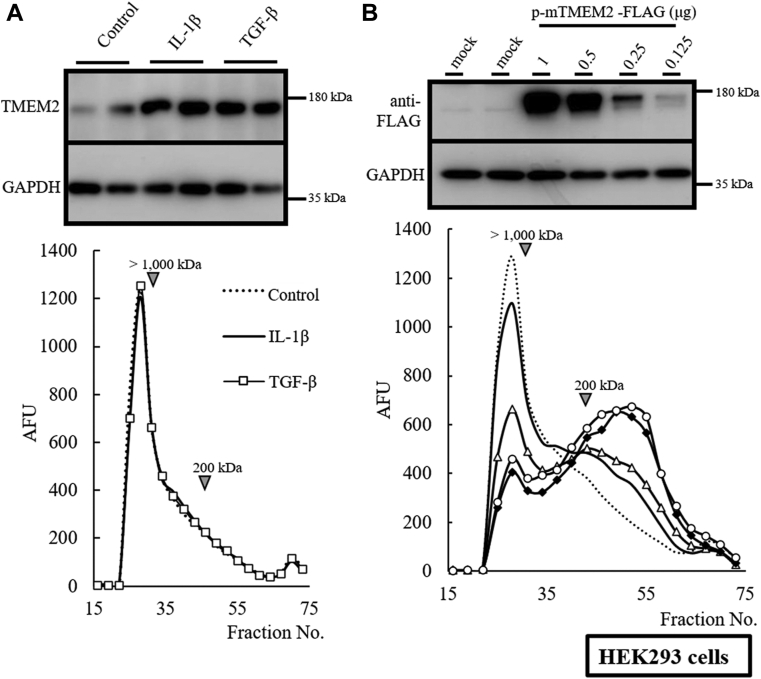
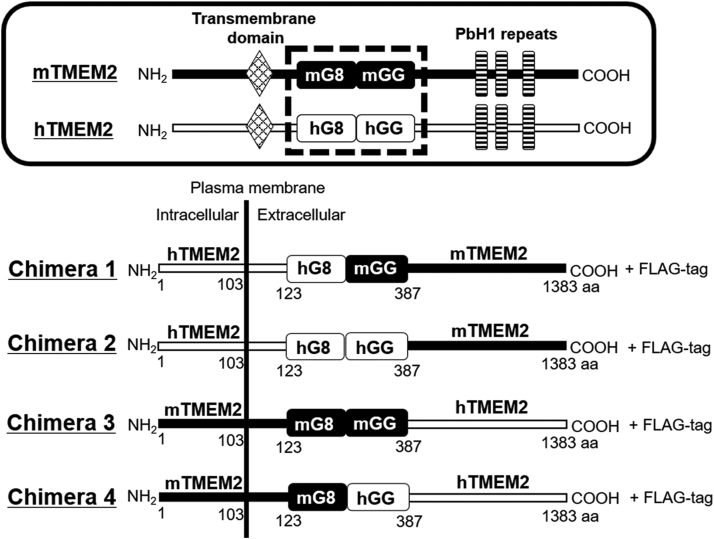
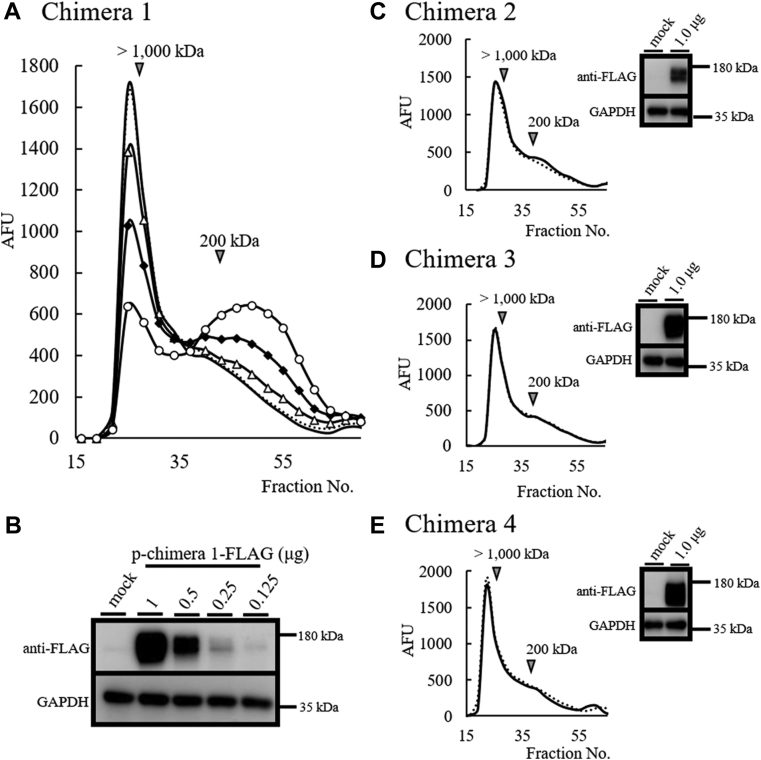
Cutaneous hyaluronan (HA) is depolymerized to intermediate sizes in the extracellular matrix, and further fragmented in the regional lymph nodes. Previously, we showed that the HA-binding protein involved in HA depolymerization (HYBID), also known as KIAA1199/CEMIP, is responsible for the first step of HA depolymerization. Recently, mouse transmembrane 2 (mTMEM2) with high structural similarity to HYBID was proposed to be a membrane-bound hyaluronidase. However, we showed that the knockdown of human TMEM2 (hTMEM2) conversely promoted HA depolymerization in normal human dermal fibroblasts (NHDFs). Therefore, we examined the HA-degrading activity and function of hTMEM2 using HEK293T cells. We found that human HYBID and mTMEM2, but not hTMEM2, degraded extracellular HA, indicating that hTMEM2 does not function as a catalytic hyaluronidase. Analysis of the HA-degrading activity of chimeric TMEM2 in HEK293T cells suggested the importance of the mouse GG domain. Therefore, we focused on the amino acid residues that are conserved in active mouse and human HYBID and mTMEM2 but are substituted in hTMEM2. The HA-degrading activity of mTMEM2 was abolished when its His248 and Ala303 were simultaneously replaced by the corresponding residues of inactive hTMEM2 (Asn248 and Phe303). In NHDFs, enhancement of hTMEM2 expression by proinflammatory cytokines decreased HYBID expression and increased hyaluronan synthase 2-dependent HA production. The effects of proinflammatory cytokines were abrogated by hTMEM2 knockdown. A decreased HYBID expression by interleukin-1β and transforming growth factor-β was canceled by hTMEM2 knockdown. In conclusion, these results indicate that hTMEM2 is not a catalytic hyaluronidase, but a regulator of HA metabolism.
皮肤透明质酸(HA)在细胞外基质中解聚为中间大小的片段,并在局部淋巴结中进一步碎片化。之前,我们表明,参与 HA 解聚的 HA 结合蛋白(HYBID),也称为 KIAA1199/CEMIP,负责 HA 解聚的第一步。最近,与 HYBID 具有高度结构相似性的小鼠跨膜 2(mTMEM2)被提议为膜结合透明质酸酶。然而,我们表明,人 TMEM2(hTMEM2)的敲低反而促进了正常人真皮成纤维细胞(NHDFs)中的 HA 解聚。因此,我们使用 HEK293T 细胞检查了 hTMEM2 的 HA 降解活性和功能。我们发现,人类 HYBID 和 mTMEM2,但不是 hTMEM2,降解细胞外 HA,表明 hTMEM2 不作为催化透明质酸酶发挥作用。HEK293T 细胞中嵌合 TMEM2 的 HA 降解活性分析表明了鼠标 GG 结构域的重要性。因此,我们专注于在活性小鼠和人类 HYBID 和 mTMEM2 中保守但在 hTMEM2 中取代的氨基酸残基。当 mTMEM2 的 His248 和 Ala303 同时被无活性的 hTMEM2 的相应残基(Asn248 和 Phe303)取代时,mTMEM2 的 HA 降解活性被消除。在 NHDFs 中,促炎细胞因子增强 hTMEM2 表达会降低 HYBID 表达并增加透明质酸合酶 2 依赖性 HA 产生。hTMEM2 敲低可消除促炎细胞因子的作用。白细胞介素-1β和转化生长因子-β对 HYBID 表达的降低作用被 hTMEM2 敲低取消。总之,这些结果表明 hTMEM2 不是催化透明质酸酶,而是 HA 代谢的调节剂。