Department of Radiation Oncology, The University of Texas MD Anderson Cancer Center, Houston, Texas, USA.
Department of Population Health Sciences, Department of Pediatrics, Center for Health Measurement, Duke University School of Medicine, Durham, North Carolina, USA.
Cancer Med. 2023 Jul;12(13):14157-14170. doi: 10.1002/cam4.6082. Epub 2023 May 18.
Radiation therapy (RT) is a common treatment for adolescents and young adults (AYAs, 15-39 years old) with cancer; however, it may cause toxicities that affect health-related quality-of-life (HRQOL). Thus, we assessed HRQOL in AYAs before, during, and after RT.
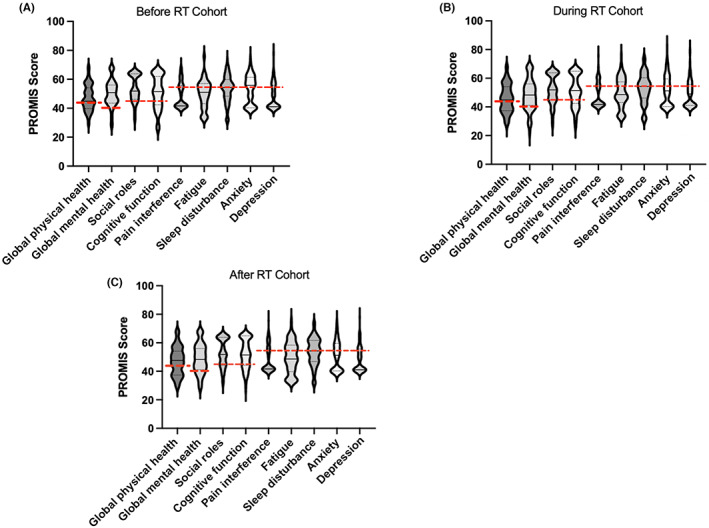
We identified 265 AYAs who completed HRQOL PROMIS® surveys before (n = 87), during (n = 84), or after (n = 94) RT. Higher PROMIS® score represents more of the concept. Mean scores were compared to the general US population and minimally important differences (MIDs) were used to evaluate the impact of cancer on HRQOL. Linear regression modeling was used to evaluate the effect of clinical and demographic factors on PROMIS scores.
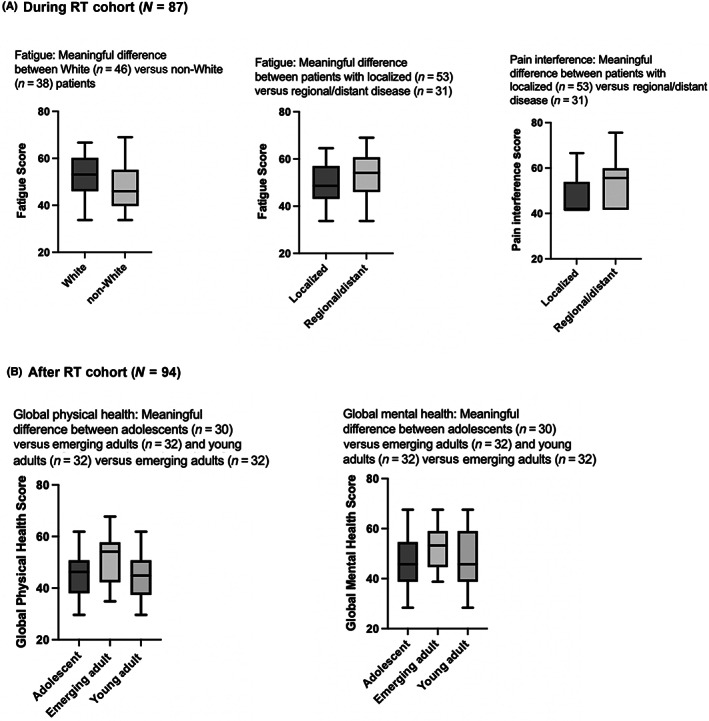
Median [IQR] age was 26 [20-31] years. Cancer types varied; most had sarcoma (26%) or CNS malignancy (23%). Compared to the general US population, the before RT cohort had worse anxiety (mean score 55.2 vs. 50, MID 3, p < 0.001) and the during RT cohort had worse global physical health (mean score 44.9 vs. 50, MID 5, p < 0.001). In the during RT cohort, patients with regional/distant disease had significantly worse pain (B = 15.94, p < 0.01) and fatigue (B = 14.20, p = 0.01) than patients with localized disease. In the after RT cohort, adolescents (15-18 years) and young adults (26-39 years) had worse global physical health (B = -6.87, p < 0.01, and B = -7.87, p < 0.01, respectively) and global mental health (B = -6.74, p < 0.01, and B = -5.67, p = 0.01, respectively) than emerging adults (19-25 years).
AYAs with cancer receiving RT experience impairments in various domains of HRQOL. Advanced cancer stage may contribute to poorer short-term HRQOL and developmental stage may contribute to differing long-term HRQOL.
放射治疗(RT)是治疗青少年和年轻成年人(15-39 岁)癌症的常用方法;然而,它可能会导致影响健康相关生活质量(HRQOL)的毒性。因此,我们在 RT 之前、期间和之后评估了 AYA 的 HRQOL。
我们确定了 265 名完成了 HRQOL PROMIS®调查的 AYA,他们在 RT 之前(n=87)、期间(n=84)或之后(n=94)完成了调查。更高的 PROMIS®分数表示更能代表该概念。比较了平均分数与一般美国人群,并使用最小重要差异(MID)来评估癌症对 HRQOL 的影响。线性回归模型用于评估临床和人口统计学因素对 PROMIS 分数的影响。
中位[IQR]年龄为 26[20-31]岁。癌症类型多种多样;大多数是肉瘤(26%)或中枢神经系统恶性肿瘤(23%)。与一般美国人群相比,RT 前队列的焦虑评分更差(平均评分 55.2 比 50,MID3,p<0.001),RT 期间队列的整体身体健康评分更差(平均评分 44.9 比 50,MID5,p<0.001)。在 RT 期间队列中,局部/远处疾病患者的疼痛(B=15.94,p<0.01)和疲劳(B=14.20,p=0.01)明显更差。在 RT 后队列中,青少年(15-18 岁)和年轻成年人(26-39 岁)的整体身体健康(B=-6.87,p<0.01,和 B=-7.87,p<0.01)和整体心理健康(B=-6.74,p<0.01,和 B=-5.67,p=0.01)评分明显低于成年早期(19-25 岁)。
接受 RT 的癌症青少年和年轻成年人在 HRQOL 的各个领域都存在障碍。晚期癌症可能导致短期 HRQOL 较差,而发育阶段可能导致长期 HRQOL 不同。