Department of Translational Hematology, Instituto de Investigación Hospital 12 de Octubre (i+12), Hematological Malignancies Clinical Research Unit H120-CNIO, CIBERONC, ES 28041, Madrid.
Nantes Université, INSERM, Immunology and New Concepts in ImmunoTherapy, INCIT, UMR 1302, F-44000 Nantes.
Haematologica. 2024 Jan 1;109(1):272-282. doi: 10.3324/haematol.2023.283096.
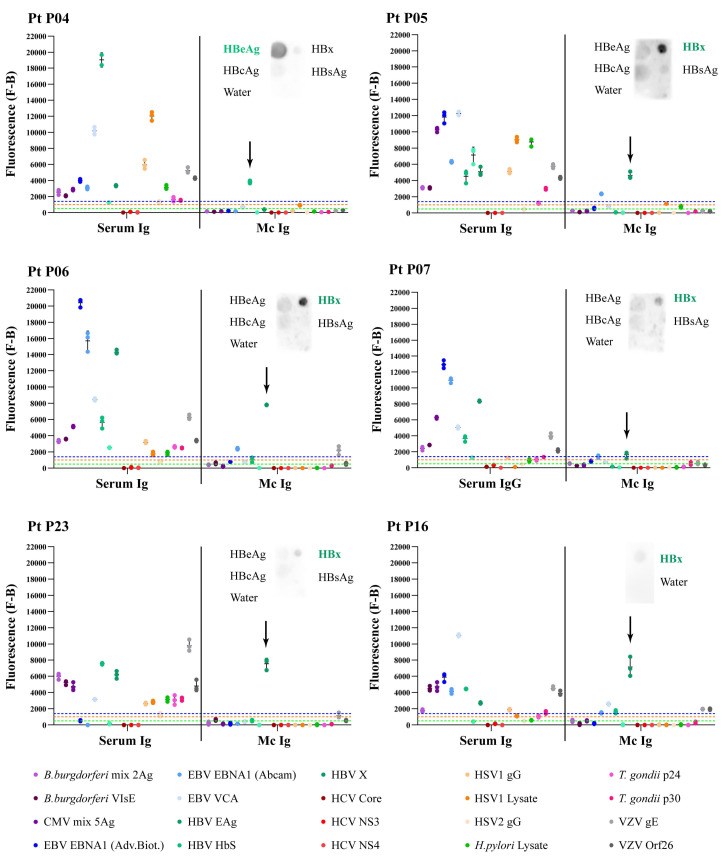
Subsets of multiple myeloma (MM) and monoclonal gammopathies of undetermined significance (MGUS) present with a monoclonal immunoglobulin specific for hepatitis C virus (HCV), thus are presumably HCV-driven, and antiviral treatment can lead to the disappearance of antigen stimulation and improved control of clonal plasma cells. Here we studied the role of hepatitis B virus (HBV) in the pathogenesis of MGUS and MM in 45 HBV-infected patients with monoclonal gammopathy. We analyzed the specificity of recognition of the monoclonal immunoglobulin of these patients and validated the efficacy of antiviral treatment (AVT). For 18 of 45 (40%) HBV-infected patients, the target of the monoclonal immunoglobulin was identified: the most frequent target was HBV (n=11), followed by other infectious pathogens (n=6) and glucosylsphingosine (n=1). Two patients whose monoclonal immunoglobulin targeted HBV (HBx and HBcAg), implying that their gammopathy was HBV-driven, received AVT and the gammopathy did not progress. AVT efficacy was then investigated in a large cohort of HBV-infected MM patients (n=1367) who received or did not receive anti-HBV treatments and compared to a cohort of HCV-infected MM patients (n=1220). AVT significantly improved patient probability of overall survival (P=0.016 for the HBV-positive cohort, P=0.005 for the HCV-positive cohort). Altogether, MGUS and MM disease can be HBV- or HCV-driven in infected patients, and the study demonstrates the importance of AVT in such patients.
多发性骨髓瘤 (MM) 和意义未明的单克隆丙种球蛋白血症 (MGUS) 的亚组表现为针对丙型肝炎病毒 (HCV) 的单克隆免疫球蛋白,因此推测为 HCV 驱动,抗病毒治疗可导致抗原刺激的消失和克隆性浆细胞的更好控制。在这里,我们研究了乙型肝炎病毒 (HBV) 在 45 例伴有单克隆丙种球蛋白的 HBV 感染患者的 MGUS 和 MM 发病机制中的作用。我们分析了这些患者的单克隆免疫球蛋白的识别特异性,并验证了抗病毒治疗 (AVT) 的疗效。在 45 例 HBV 感染患者中,有 18 例(40%)的单克隆免疫球蛋白的靶标被鉴定出来:最常见的靶标是 HBV(n=11),其次是其他传染性病原体(n=6)和葡萄糖鞘氨醇(n=1)。有两名患者的单克隆免疫球蛋白针对 HBV(HBx 和 HBcAg),这表明他们的丙种球蛋白血症是 HBV 驱动的,他们接受了 AVT 治疗,丙种球蛋白血症没有进展。然后在接受或未接受抗 HBV 治疗的大量 HBV 感染 MM 患者队列(n=1367)中研究了 AVT 的疗效,并与 HCV 感染 MM 患者队列(n=1220)进行了比较。AVT 显著提高了患者的总生存率(HBV 阳性队列 P=0.016,HCV 阳性队列 P=0.005)。总之,感染患者的 MGUS 和 MM 疾病可以是 HBV 或 HCV 驱动的,该研究证明了 AVT 在这些患者中的重要性。