Key Laboratory of Neuropharmacology and Translational Medicine of Zhejiang Province, School of Pharmaceutical Sciences, Zhejiang Chinese Medical University, Hangzhou, Zhejiang, China.
Aging Dis. 2023 Dec 1;14(6):2127-2152. doi: 10.14336/AD.2023.0310-2.
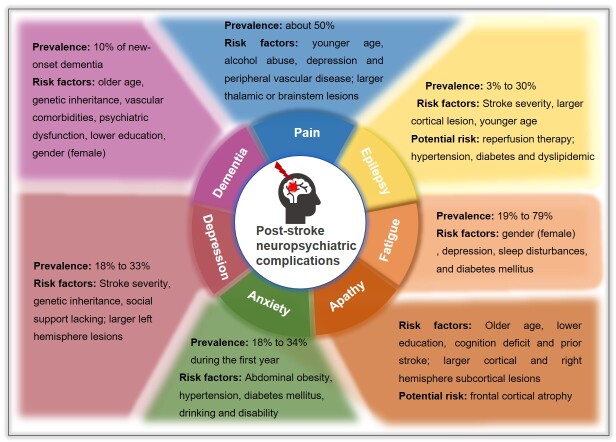
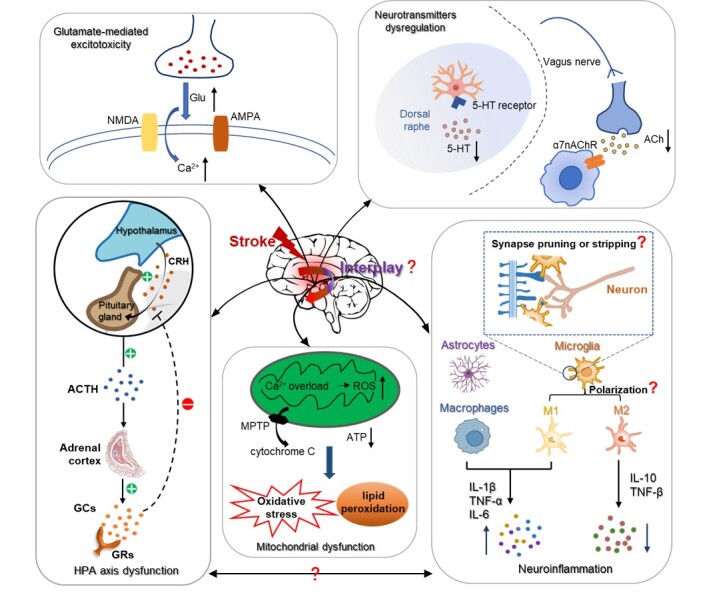
Almost all stroke survivors suffer physical disabilities and neuropsychiatric disturbances, which can be briefly divided into post-stroke neurological diseases and post-stroke psychiatric disorders. The former type mainly includes post-stroke pain, post-stroke epilepsy, and post-stroke dementia while the latter one includes post-stroke depression, post-stroke anxiety, post-stroke apathy and post-stroke fatigue. Multiple risk factors are related to these post-stroke neuropsychiatric complications, such as age, gender, lifestyle, stroke type, medication, lesion location, and comorbidities. Recent studies have revealed several critical mechanisms underlying these complications, namely inflammatory response, dysregulation of the hypothalamic pituitary adrenal axis, cholinergic dysfunction, reduced level of 5-hydroxytryptamine, glutamate-mediated excitotoxicity and mitochondrial dysfunction. Moreover, clinical efforts have successfully given birth to many practical pharmaceutic strategies, such as anti-inflammatory medications, acetylcholinesterase inhibitors, and selective serotonin reuptake inhibitors, as well as diverse rehabilitative modalities to help patients physically and mentally. However, the efficacy of these interventions is still under debate. Further investigations into these post-stroke neuropsychiatric complications, from both basic and clinical perspectives, are urgent for the development of effective treatment strategies.
几乎所有中风幸存者都患有身体残疾和神经精神障碍,可以简要地分为中风后神经系统疾病和中风后精神障碍。前者主要包括中风后疼痛、中风后癫痫和中风后痴呆,而后者包括中风后抑郁、中风后焦虑、中风后冷漠和中风后疲劳。多种风险因素与这些中风后神经精神并发症有关,如年龄、性别、生活方式、中风类型、药物、病变部位和合并症。最近的研究揭示了这些并发症的几个关键机制,即炎症反应、下丘脑-垂体-肾上腺轴失调、胆碱能功能障碍、5-羟色胺水平降低、谷氨酸介导的兴奋毒性和线粒体功能障碍。此外,临床努力成功地产生了许多实用的药物治疗策略,如抗炎药物、乙酰胆碱酯酶抑制剂和选择性 5-羟色胺再摄取抑制剂,以及各种康复模式,以帮助患者身心。然而,这些干预措施的疗效仍存在争议。从基础和临床角度进一步研究这些中风后神经精神并发症,对于开发有效的治疗策略是紧迫的。