Semple Robert K, Patel Kashyap A, Auh Sungyoung, Brown Rebecca J
Centre for Cardiovascular Science, University of Edinburgh, Edinburgh, UK.
MRC Human Genetics Unit, Institute of Genetics and Cancer, University of Edinburgh, Edinburgh, UK.
medRxiv. 2023 Apr 21:2023.04.17.23288671. doi: 10.1101/2023.04.17.23288671.
To assess the effects of pharmacologic and/or surgical interventions in monogenic insulin resistance (IR), stratified by genetic aetiology.
Systematic review.
PubMed, MEDLINE and Embase, from 1 January 1987 to 23 June 2021.
Studies reporting individual-level effects of pharmacologic and/or surgical interventions in monogenic IR were eligible. Individual subject data were extracted and duplicate data removed. Outcomes were analyzed for each affected gene and intervention, and in aggregate for partial, generalised and all lipodystrophy.
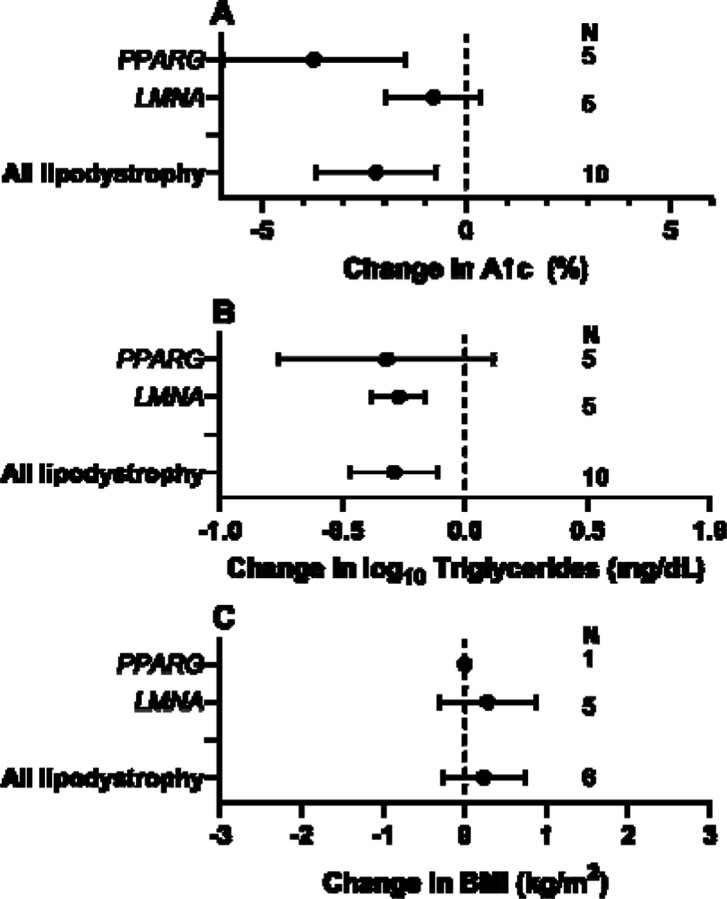
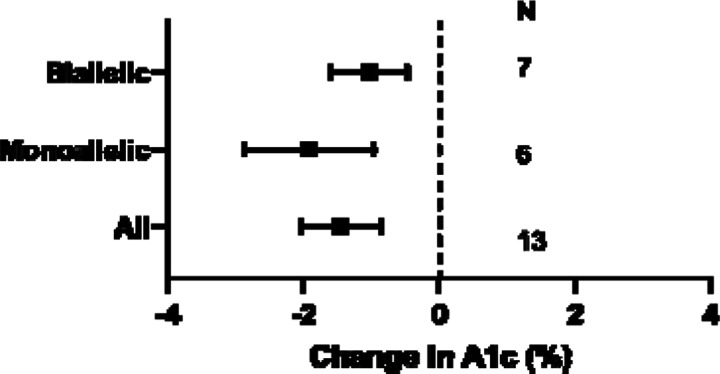
10 non-randomised experimental studies, 8 case series, and 21 single case reports met inclusion criteria, all rated as having moderate or serious risk of bias. Metreleptin was associated with lower triglycerides and hemoglobin A1c in aggregated lipodystrophy (n=111), in partial lipodystrophy (n=71) and generalised lipodystrophy (n=41)), and in , , or subgroups (n=72,13,21 and 21 respectively). Body Mass Index (BMI) was lower after treatment in partial and generalised lipodystrophy overall, and in , but not or subgroups. Thiazolidinedione use was associated with improved hemoglobin A1c and triglycerides in aggregated lipodystrophy (n=13), improved hemoglobin A1c only in the subgroup (n=5), and improved triglycerides only in the subgroup (n=7). In -related IR, use of rhIGF-1, alone or with IGFBP3, was associated with improved hemoglobin A1c (n=15). The small size or absence of all other genotype-treatment combinations precluded firm conclusions.
The evidence guiding genotype-specific treatment of monogenic IR is of low to very low quality. Metreleptin and Thiazolidinediones appear to have beneficial metabolic effects in lipodystrophy, and rhIGF-1 appears to lower hemoglobin A1c in INSR-related IR. For other interventions there is insufficient evidence to assess efficacy and risks either in aggregated lipodystrophy or in genetic subgroups. There is a pressing need to improve the evidence base for management of monogenic IR.
评估按遗传病因分层的单基因胰岛素抵抗(IR)的药物和/或手术干预效果。
系统评价。
1987年1月1日至2021年6月23日的PubMed、MEDLINE和Embase。
报告单基因IR药物和/或手术干预个体水平效果的研究符合要求。提取个体受试者数据并去除重复数据。对每个受影响基因和干预措施的结果进行分析,并对部分、全身性和所有脂肪营养不良进行汇总分析。
10项非随机实验研究、8个病例系列和21篇单病例报告符合纳入标准,所有研究均被评为具有中度或严重偏倚风险。在汇总脂肪营养不良(n = 111)、部分脂肪营养不良(n = 71)和全身性脂肪营养不良(n = 41)以及在 、 、 或 亚组(分别为n = 72、13、21和21)中,米泊美生与较低的甘油三酯和糖化血红蛋白相关。总体而言,在部分和全身性脂肪营养不良以及在 亚组中,治疗后体重指数(BMI)较低,但在 或 亚组中并非如此。噻唑烷二酮类药物的使用与汇总脂肪营养不良(n = 13)中糖化血红蛋白和甘油三酯的改善有关,仅在 亚组(n = 5)中糖化血红蛋白有所改善,仅在 亚组(n = 7)中甘油三酯有所改善。在与 相关的IR中,单独使用重组人胰岛素样生长因子-1(rhIGF-1)或与胰岛素样生长因子结合蛋白3(IGFBP3)联合使用与糖化血红蛋白改善相关(n = 15)。所有其他基因型-治疗组合样本量小或缺乏,无法得出确切结论。
指导单基因IR基因型特异性治疗的证据质量低至极低。米泊美生和噻唑烷二酮类药物似乎对脂肪营养不良有有益的代谢作用,rhIGF-1似乎能降低与胰岛素受体底物(INSR)相关的IR中的糖化血红蛋白。对于其他干预措施,没有足够的证据评估其在汇总脂肪营养不良或遗传亚组中的疗效和风险。迫切需要改善单基因IR管理的证据基础。