Khan Sarosh, Fawaz Samer, Simpson Rupert, Robertson Craig, Kelly Paul, Mohdnazri Shah, Tang Kare, Cook Christopher M, Gallagher Sean, O'Kane Peter, Spratt James, Brilakis Emmanouil S, Karamasis Grigoris V, Al-Lamee Rasha, Keeble Thomas R, Davies John R
Department of Interventional Cardiology, Essex Cardiothoracic Centre, Basildon, United Kingdom.
Department of Interventional Cardiology, Anglia Ruskin University, Chelmsford, United Kingdom.
Front Cardiovasc Med. 2023 May 3;10:1172763. doi: 10.3389/fcvm.2023.1172763. eCollection 2023.
Percutaneous coronary intervention (PCI) for coronary chronic total occlusion (CTO) has been performed for the improvement of symptoms and quality of life in patients with stable angina. The ORBITA study demonstrated the role of the placebo effect in contemporary PCI in non-CTO chronic coronary syndromes. However, the benefit of CTO PCI beyond that of a placebo has not been demonstrated.
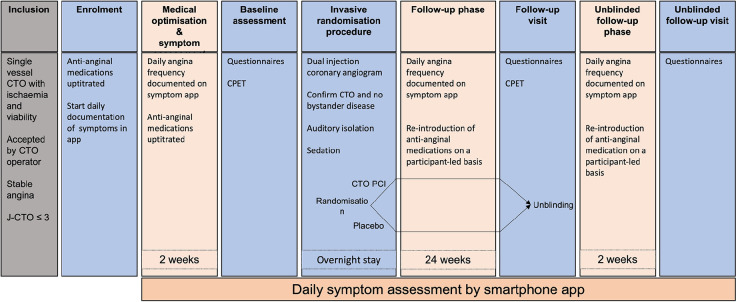
The ORBITA-CTO pilot study will be a double-blind, placebo-controlled study of CTO PCI randomising patients who have: (1) been accepted by a CTO operator for PCI; (2) experienced symptoms due to a CTO; (3) evidence of ischaemia; (4) evidence of viability within the CTO territory; and (5) a J-CTO score ≤3.
Patients will undergo medication optimisation that will ensure they are on at least a minimum amount of anti-anginals and complete questionnaires. Patients will record their symptoms on an app daily throughout the study. Patients will undergo randomisation procedures, including an overnight stay, and be discharged the following day. All anti-anginals will be stopped after randomisation and re-initiated on a patient-led basis during the 6-month follow-up period. At follow-up, patients will undergo repeat questionnaires and unblinding, with a further 2-week unblinded follow-up.
The co-primary outcomes are feasibility (blinding) in this cohort and angina symptom score using an ordinal clinical outcome scale for angina. Secondary outcomes include changes in quality-of-life measures, Seattle Angina Questionnaire (SAQ), peak VO2, and anaerobic threshold on the cardiopulmonary exercise test.
The feasibility of a placebo-controlled CTO PCI study will lead to future studies assessing efficacy. The impact of CTO PCI on angina measured using a novel daily symptom app may provide improved fidelity in assessing symptoms in patients with CTO's.
经皮冠状动脉介入治疗(PCI)用于冠状动脉慢性完全闭塞(CTO),旨在改善稳定型心绞痛患者的症状和生活质量。ORBITA研究证明了安慰剂效应在当代非CTO慢性冠状动脉综合征PCI中的作用。然而,CTO PCI超出安慰剂的益处尚未得到证实。
ORBITA-CTO试点研究将是一项双盲、安慰剂对照的CTO PCI研究,将符合以下条件的患者随机分组:(1)已被CTO介入医生接受PCI治疗;(2)因CTO出现症状;(3)有缺血证据;(4)CTO区域内存活心肌证据;(5)J-CTO评分≤3。
患者将接受药物优化,确保至少服用最低剂量的抗心绞痛药物,并完成问卷调查。在整个研究过程中,患者将每天通过应用程序记录症状。患者将接受随机分组程序,包括过夜留观,并于次日出院。随机分组后将停用所有抗心绞痛药物,并在6个月随访期内由患者自主决定重新开始用药。随访时,患者将接受重复问卷调查和揭盲,并进行为期2周的揭盲后随访。
共同主要结局是该队列中的可行性(盲法)以及使用心绞痛序贯临床结局量表的心绞痛症状评分。次要结局包括生活质量指标、西雅图心绞痛问卷(SAQ)、峰值VO2以及心肺运动试验中的无氧阈值的变化。
安慰剂对照CTO PCI研究的可行性将为未来评估疗效的研究奠定基础。使用新型每日症状应用程序测量CTO PCI对心绞痛的影响,可能会提高评估CTO患者症状的准确性。