Ferrena Alexander, Wang Jichuan, Zhang Ranxin, Karadal-Ferrena Burcu, Al-Hardan Waleed, Singh Swapnil, Borjihan Hasibagan, Schwartz Edward, Zhao Hongling, Yang Rui, Geller David, Hoang Bang, Zheng Deyou
Institute for Clinical and Translational Research, Albert Einstein College of Medicine, Bronx, NY, USA.
Department of Genetics, Albert Einstein College of Medicine, Bronx, NY, USA.
bioRxiv. 2023 May 12:2023.05.09.540053. doi: 10.1101/2023.05.09.540053.
Osteosarcoma (OS) is an aggressive bone malignancy with a poor prognosis. One putative proto-oncogene in OS is , encoding a substrate recognition factor of the SCF E3 ubiquitin ligase. We previously demonstrated that knockout in murine OS improved survival and delayed tumorigenesis. Here we aim to define the SKP2 drives transcriptional program and its clinical implication in OS.
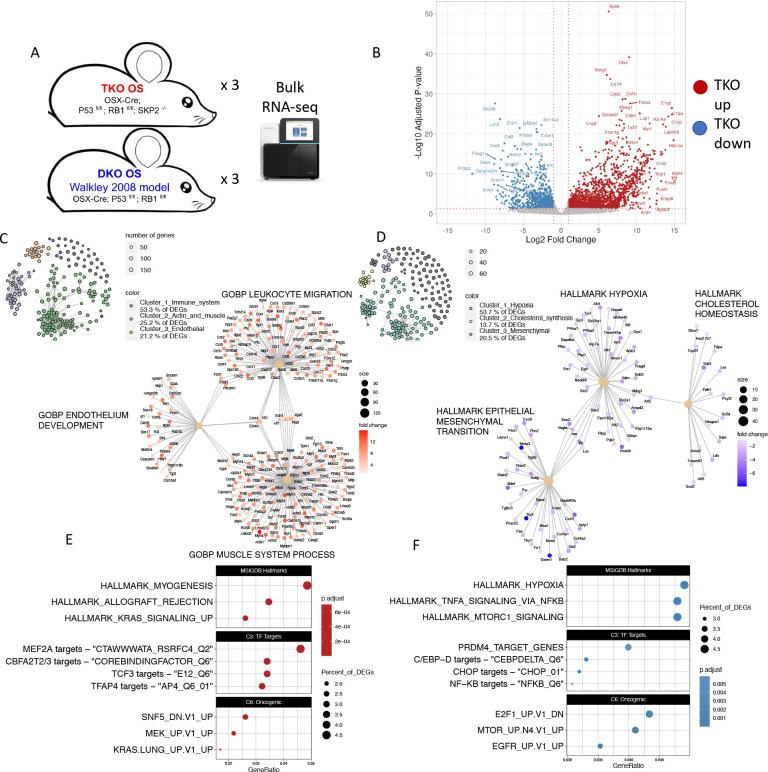
We performed RNA-sequencing (RNA-seq) on tumors from a transgenic OS mouse model with conditional and knockouts in the osteoblast lineage ("DKO": Osx1-Cre;Rb1;p53) and a triple-knockout model with additional germline knockout ("TKO": Osx1-Cre;Rb1;p53;SKP2). We validated our RNA-seq findings using qPCR and immunohistochemistry. To investigate the clinical implications of our results, we analyzed a human OS patient cohort ("NCI-TARGET OS") with RNA-seq and clinical data.
We found large differences in gene expression after SKP2 knockout. Strikingly, we observed increased expression of genes related to immune microenvironment infiltration in TKO tumors. We observed significant increases in signature genes for macrophages and to a lesser extent, T cells, B cells and vascular cells. We also uncovered a set of relevant transcription factors that may mediate the changes. In OS patient cohorts, high expression of genes upregulated in TKO was correlated with favorable overall survival, which was largely explained by the macrophage gene signatures. This relationship was further supported by our finding that SKP2 expression was negatively correlated with macrophage infiltration in the NCI-TARGET OS and the TCGA Sarcoma cohort.
Our findings indicate that SKP2 may mediate immune exclusion from the OS tumor microenvironment, suggesting that SKP2 modulation in OS may induce anti-tumor immune activation.
骨肉瘤(OS)是一种侵袭性骨恶性肿瘤,预后较差。骨肉瘤中的一个假定原癌基因是 ,其编码SCF E3泛素连接酶的底物识别因子。我们之前证明,在小鼠骨肉瘤中敲除 可提高生存率并延迟肿瘤发生。在此,我们旨在确定SKP2驱动的转录程序及其在骨肉瘤中的临床意义。
我们对来自成骨细胞谱系中条件性敲除 和 (“DKO”:Osx1-Cre;Rb1;p53)的转基因骨肉瘤小鼠模型的肿瘤以及额外敲除 种系的三敲除模型(“TKO”:Osx1-Cre;Rb1;p53;SKP2)进行了RNA测序(RNA-seq)。我们使用qPCR和免疫组织化学验证了RNA-seq结果。为了研究我们结果的临床意义,我们分析了一个具有RNA-seq和临床数据的人类骨肉瘤患者队列(“NCI-TARGET OS”)。
我们发现SKP2敲除后基因表达存在巨大差异。令人惊讶的是,我们观察到TKO肿瘤中与免疫微环境浸润相关的基因表达增加。我们观察到巨噬细胞特征基因显著增加,T细胞、B细胞和血管细胞特征基因也有较小程度的增加。我们还发现了一组可能介导这些变化的相关转录因子。在骨肉瘤患者队列中,TKO中上调基因的高表达与良好的总生存率相关,这在很大程度上由巨噬细胞基因特征所解释。我们发现SKP2表达与NCI-TARGET OS和TCGA肉瘤队列中的巨噬细胞浸润呈负相关,这一关系进一步支持了上述结论。
我们的研究结果表明,SKP2可能介导骨肉瘤肿瘤微环境中的免疫排斥,这表明在骨肉瘤中调节SKP2可能诱导抗肿瘤免疫激活。