
翅膀和腿部神经肌肉系统对不同的轴前多指畸形的独特模式反应。
Distinct patterning responses of wing and leg neuromuscular systems to different preaxial polydactylies.
作者信息
Luxey Maëva, Stieger Gabriela, Berki Bianka, Tschopp Patrick
机构信息
DUW Zoology, University of Basel, Basel, Switzerland.
出版信息
Front Cell Dev Biol. 2023 May 4;11:1154205. doi: 10.3389/fcell.2023.1154205. eCollection 2023.
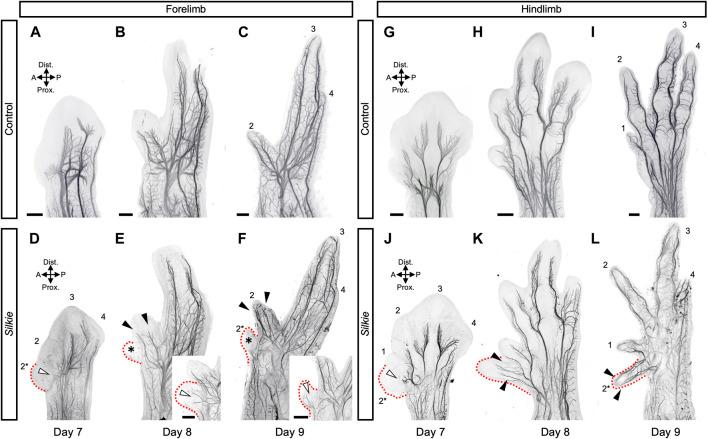
The tetrapod limb has long served as a paradigm to study vertebrate pattern formation and evolutionary diversification. The distal part of the limb, the so-called autopod, is of particular interest in this regard, given the numerous modifications in both its morphology and behavioral motor output. While the underlying alterations in skeletal form have received considerable attention, much less is known about the accompanying changes in the neuromuscular system. However, modifications in the skeleton need to be properly integrated with both muscle and nerve patterns, to result in a fully functional limb. This task is further complicated by the distinct embryonic origins of the three main tissue types involved-skeleton, muscles and nerves-and, accordingly, how they are patterned and connected with one another during development. To evaluate the degree of regulative crosstalk in this complex limb patterning process, here we analyze the developing limb neuromuscular system of breed chicken. These animals display a preaxial polydactyly, due to a polymorphism in the limb regulatory region of the gene. Using lightsheet microscopy and 3D-reconstructions, we investigate the neuromuscular patterns of extra digits in wings and legs, and compare our results to Retinoic Acid-induced polydactylies. Contrary to previous findings, autopod muscle patterns do not adjust to alterations in the underlying skeletal topology, while nerves show partial responsiveness. We discuss the implications of tissue-specific sensitivities to global limb patterning cues for our understanding of the evolution of novel forms and functions in the distal tetrapod limb.
四足动物的肢体长期以来一直是研究脊椎动物模式形成和进化多样化的范例。鉴于肢体远端(即所谓的 autopod)在形态和行为运动输出方面有众多变化,因此在这方面特别受关注。虽然骨骼形态的潜在改变已受到相当多的关注,但对于神经肌肉系统伴随的变化却知之甚少。然而,骨骼的改变需要与肌肉和神经模式适当整合,才能形成功能完整的肢体。由于涉及的三种主要组织类型(骨骼、肌肉和神经)具有不同的胚胎起源,以及它们在发育过程中如何形成模式并相互连接,这一任务变得更加复杂。为了评估这一复杂肢体模式形成过程中的调节性串扰程度,我们在此分析了特定品种鸡发育中的肢体神经肌肉系统。这些动物由于基因肢体调节区域的多态性而表现出前轴多指畸形。利用光片显微镜和三维重建技术,我们研究了特定品种鸡翅膀和腿部额外脚趾的神经肌肉模式,并将我们的结果与视黄酸诱导的多指畸形进行比较。与之前的研究结果相反,autopod 肌肉模式不会根据潜在骨骼拓扑结构的改变进行调整,而神经则表现出部分反应性。我们讨论了组织对整体肢体模式形成线索的特异性敏感性对于我们理解四足动物肢体远端新形式和功能进化的意义。


 Zotero 插件