Department of Obstetrics and Gynecology, Rambam Health Care Campus, Haifa, Israel.
Ruth and Bruce Rappaport Faculty of Medicine, Israel Institute of Technology - Technion, Haifa, Israel.
Sci Rep. 2023 May 22;13(1):8241. doi: 10.1038/s41598-023-35019-5.
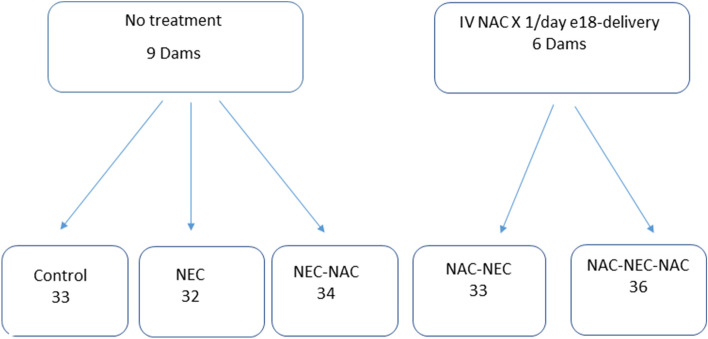
Necrotizing enterocolitis (NEC) brain injury is mediated through Toll-like receptor 4 (TLR4) on the intestinal epithelium and brain microglia. Our aim was to determine whether postnatal and/or prenatal NAC can modify NEC associated intestinal and brain TLR4 expression and brain glutathione levels in a rat model of NEC. Newborn Sprague-Dawley rats were randomized into three groups: Control (n = 33); NEC (n = 32)-hypoxia and formula feeding; and NEC-NAC (n = 34)-received NAC (300 mg/kg IP) in addition to NEC conditions. Two additional groups included pups of dams treated once daily with NAC (300 mg/kg IV) for the last 3 days of pregnancy: NAC-NEC (n = 33) or NAC-NEC-NAC (n = 36) with additional postnatal NAC. Pups were sacrificed on the fifth day, and ileum and brains harvested for TLR-4 and glutathione protein levels. Brain and ileum TLR-4 protein levels were significantly increased in NEC offspring as compared to control (brain 2.5 ± 0.6 vs. 0.88 ± 0.12 U and ileum 0.24 ± 0.04 vs. 0.09 ± 0.01, p < 0.05). When NAC was administered only to dams (NAC-NEC) a significant decrease in TLR-4 levels was demonstrated in both offspring brain (1.53 ± 0.41 vs. 2.5 ± 0.6 U, p < 0.05) and ileum (0.12 ± 0.03 vs. 0.24 ± 0.04 U, p < 0.05) as compared to NEC. The same pattern was demonstrated when NAC was administered only or postnatally. The decrease in brain and ileum glutathione levels observed in NEC offspring was reversed with all NAC treatment groups. NAC reverses the increase in ileum and brain TLR-4 levels and the decrease in brain and ileum glutathione levels associated with NEC in a rat model, and thus may protect from NEC associated brain injury.
坏死性小肠结肠炎 (NEC) 脑损伤是通过肠道上皮细胞和脑小胶质细胞上的 Toll 样受体 4 (TLR4) 介导的。我们的目的是确定在 NEC 大鼠模型中,出生后和/或产前 NAC 是否可以改变 NEC 相关的肠道和大脑 TLR4 表达以及大脑谷胱甘肽水平。新生 Sprague-Dawley 大鼠随机分为三组:对照组 (n = 33);NEC 组 (n = 32)-缺氧和配方喂养;NEC-NAC 组 (n = 34)-除了 NEC 条件外,还接受 NAC (300 mg/kg IP)。另外两组包括在妊娠最后 3 天每天接受一次 NAC (300 mg/kg IV) 治疗的母鼠的幼仔:NAC-NEC 组 (n = 33) 或 NAC-NEC-NAC 组 (n = 36),出生后接受额外的 NAC。第五天处死幼仔,采集回肠和大脑用于 TLR-4 和谷胱甘肽蛋白水平检测。与对照组相比,NEC 后代的大脑和回肠 TLR-4 蛋白水平显著升高 (大脑 2.5 ± 0.6 与 0.88 ± 0.12 U,回肠 0.24 ± 0.04 与 0.09 ± 0.01,p < 0.05)。当 NAC 仅给予母鼠时 (NAC-NEC),与 NEC 相比,后代大脑 (1.53 ± 0.41 与 2.5 ± 0.6 U,p < 0.05) 和回肠 (0.12 ± 0.03 与 0.24 ± 0.04 U,p < 0.05) 的 TLR-4 水平均显著降低。当 NAC 仅或出生后给予时,也出现了相同的模式。NEC 后代大脑和回肠谷胱甘肽水平的降低在所有 NAC 治疗组中均得到逆转。NAC 逆转了 NEC 大鼠模型中回肠和大脑 TLR-4 水平的升高以及大脑和回肠谷胱甘肽水平的降低,从而可能预防 NEC 相关的脑损伤。