National Nanotechnology Center (NANOTEC), National Science and Technology Development Agency (NSTDA), Pathum Thani 12120, Thailand.
Leibniz-Institut für Katalyse e.V. (LIKAT Rostock), Albert-Einstein-Straße 29a, 18059 Rostock, Germany.
ACS Appl Mater Interfaces. 2023 Jun 7;15(22):26700-26709. doi: 10.1021/acsami.3c03310. Epub 2023 May 23.
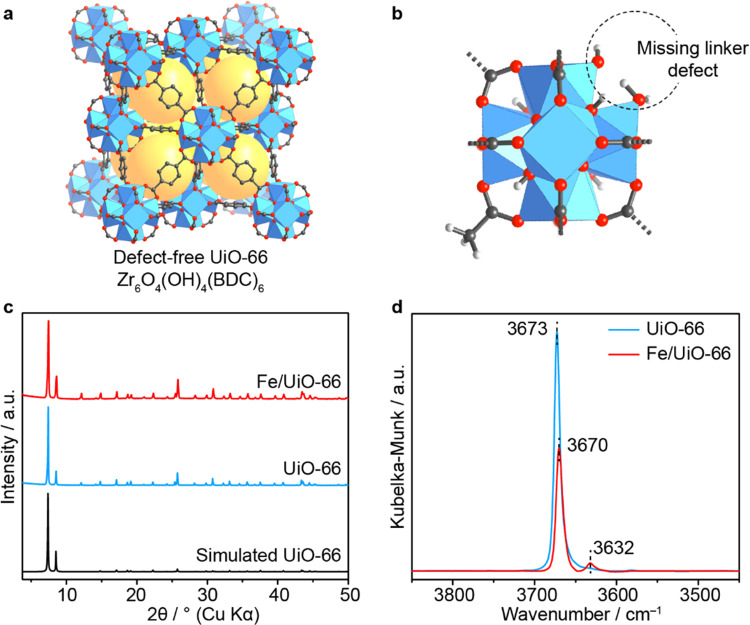
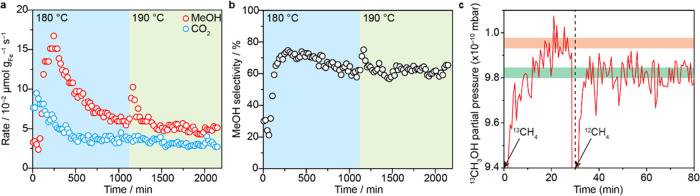
Catalytic partial oxidation of methane presents a promising route to convert the abundant but environmentally undesired methane gas to liquid methanol with applications as an energy carrier and a platform chemical. However, an outstanding challenge for this process remains in developing a catalyst that can oxidize methane selectively to methanol with good activity under continuous flow conditions in the gas phase using O as an oxidant. Here, we report a Fe catalyst supported by a metal-organic framework (MOF), Fe/UiO-66, for the selective and on-stream partial oxidation of methane to methanol. Kinetic studies indicate the continuous production of methanol at a superior reaction rate of 5.9 × 10 μmol g s at 180 °C and high selectivity toward methanol, with the catalytic turnover verified by transient methane isotopic measurements. Through an array of spectroscopic characterizations, electron-deficient Fe species rendered by the MOF support is identified as the probable active site for the reaction.
甲烷的催化部分氧化提供了一种很有前途的途径,可以将丰富但环境不理想的甲烷气体转化为液体甲醇,甲醇可用作能源载体和平台化学品。然而,对于这一过程,一个突出的挑战仍然是开发一种催化剂,该催化剂可以在气相中使用 O 作为氧化剂,在连续流动条件下将甲烷选择性氧化成甲醇,同时具有良好的活性。在这里,我们报告了一种由金属有机骨架(MOF)支撑的 Fe 催化剂,Fe/UiO-66,用于甲烷的选择性在线部分氧化生成甲醇。动力学研究表明,在 180°C 时以 5.9×10μmol g s 的优异反应速率连续生产甲醇,且甲醇具有高选择性,通过瞬态甲烷同位素测量验证了催化周转数。通过一系列光谱表征,确定 MOF 载体赋予的缺电子 Fe 物种是反应的可能活性中心。