Bernal-Chávez Sergio A, Romero-Montero Alejandra, Hernández-Parra Héctor, Peña-Corona Sheila I, Del Prado-Audelo María L, Alcalá-Alcalá Sergio, Cortés Hernán, Kiyekbayeva Lashyn, Sharifi-Rad Javad, Leyva-Gómez Gerardo
Departamento de Farmacia, Facultad de Química, Universidad Nacional Autónoma de México, Ciudad de México, 04510, Mexico.
Departamento de Farmacología, Centro de Investigación y de Estudios Avanzados del Instituto Politécnico Nacional, Ciudad de México, México.
J Biol Eng. 2023 May 23;17(1):35. doi: 10.1186/s13036-023-00353-9.
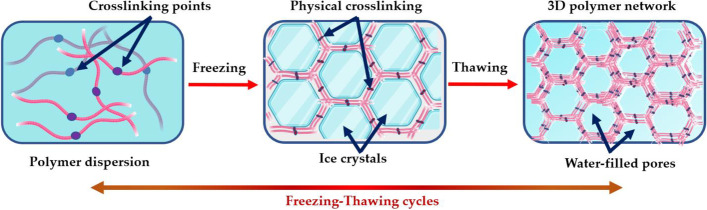
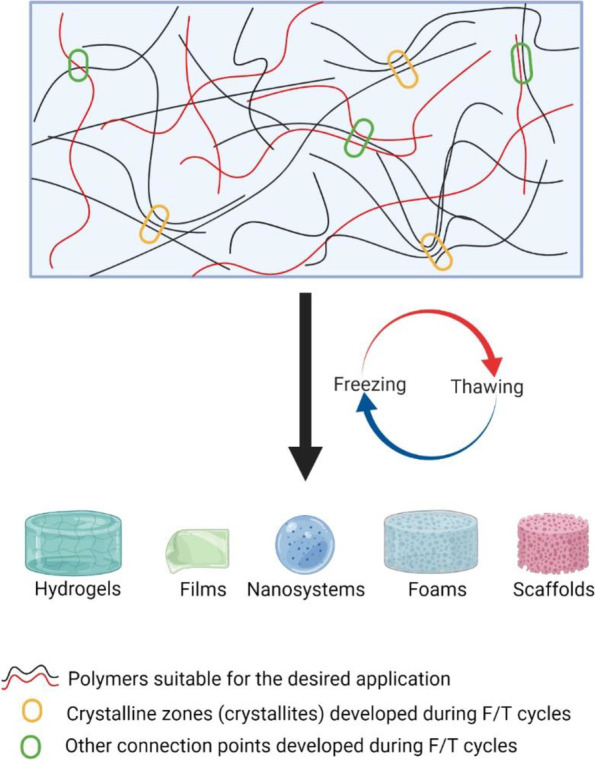
The freeze-thaw (F/T) method is commonly employed during the processing and handling of drug substances to enhance their chemical and physical stability and obtain pharmaceutical applications such as hydrogels, emulsions, and nanosystems (e.g., supramolecular complexes of cyclodextrins and liposomes). Using F/T in manufacturing hydrogels successfully prevents the need for toxic cross-linking agents; moreover, their use promotes a concentrated product and better stability in emulsions. However, the use of F/T in these applications is limited by their characteristics (e.g., porosity, flexibility, swelling capacity, drug loading, and drug release capacity), which depend on the optimization of process conditions and the kind and ratio of polymers, temperature, time, and the number of cycles that involve high physical stress that could change properties associated to quality attributes. Therefore, is necessary the optimization of F/T conditions and variables. The current research regarding F/T is focused on enhancing the formulations, the process, and the use of this method in pharmaceutical, clinical, and biological areas. The present review aims to discuss different studies related to the impact and effects of the F/T process on the physical, mechanical, and chemical properties (porosity, swelling capacity) of diverse pharmaceutical applications with an emphasis on their formulation properties, the method and variables used, as well as challenges and opportunities in developing. Finally, we review the experimental approach for choosing the standard variables studied in the F/T method applying the systematic methodology of quality by design.
冻融(F/T)法常用于药物物质的加工和处理过程中,以增强其化学和物理稳定性,并获得诸如水凝胶、乳液和纳米系统(例如环糊精和脂质体的超分子复合物)等药物应用。在制造水凝胶时使用冻融法成功避免了对有毒交联剂的需求;此外,其使用促进了浓缩产品的形成,并提高了乳液的稳定性。然而,在这些应用中使用冻融法受到其特性(例如孔隙率、柔韧性、溶胀能力、载药量和药物释放能力)的限制,这些特性取决于工艺条件的优化以及聚合物的种类和比例、温度、时间以及涉及高物理应力的循环次数,而高物理应力可能会改变与质量属性相关的性质。因此,优化冻融条件和变量是必要的。目前关于冻融的研究集中在改进配方、工艺以及该方法在制药、临床和生物领域的应用。本综述旨在讨论与冻融过程对各种药物应用的物理、机械和化学性质(孔隙率、溶胀能力)的影响相关的不同研究,重点关注其配方性质、所使用的方法和变量,以及开发中的挑战和机遇。最后,我们回顾了采用设计质量系统方法来选择冻融法中研究的标准变量的实验方法。