Zhou Hecheng, Wang Zili, Chen Chuanshun, Hu Hai, Jiang Binbin, Yin Yuesong, Zhang Kexiang, Shen Minren, Wu Song
Department of Orthopaedic Surgery, The Third Xiangya Hospital of Central South University, Changsha, Hunan Province, China.
Clinical Medicine Eight-Year Program, Xiangya Medical School of Central South University, Changsha, Hunan, China.
Orthop J Sports Med. 2023 May 19;11(5):23259671231170192. doi: 10.1177/23259671231170192. eCollection 2023 May.
Fatty infiltration (FI) of the rotator cuff muscles is correlated with shoulder function and retear rates after rotator cuff repair. High-intensity interval training (HIIT) induces beige adipose tissue to express more uncoupling protein 1 (UCP1) to consume lipids. The beta-3 adrenergic receptor (β3AR) is located on adipocyte membrane and induces thermogenesis.
To test the role of HIIT in improving muscle quality and contractility in a delayed rotator cuff repair mouse model via β3AR.
Controlled laboratory study.
Three-month-old C57BL/6J mice underwent a unilateral supraspinatus (SS) tendon transection with a 6-week delayed tendon repair. Mice ran on a treadmill with the HIIT program for 6 weeks after tendon transection or after delayed repair. To study the role of β3AR, SR59230A, a selective β3AR antagonist, was administered to mice 10 minutes before each exercise through intraperitoneal injection. The SS, interscapular brown adipose tissue (iBAT), and subcutaneous inguinal white adipose tissue (ingWAT) were harvested at the end of the 12th week after tendon transection and were analyzed by histology and Western blotting. Tests were performed to assess muscle contractility of the SS.
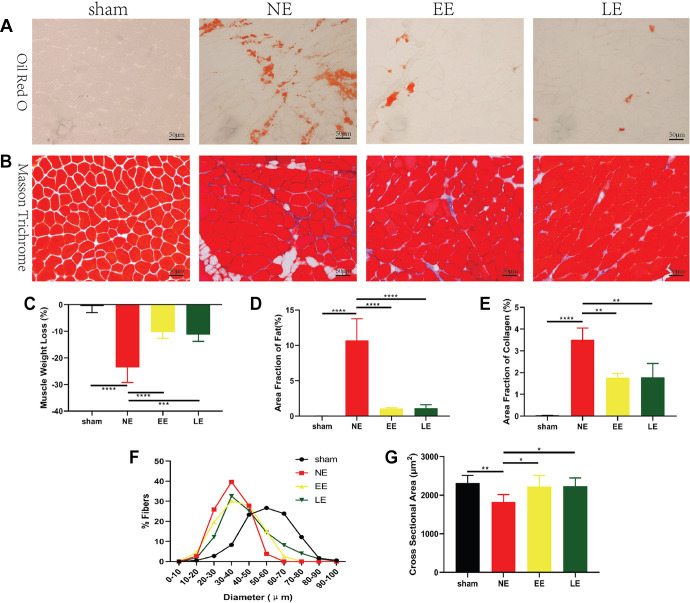
Histologic analysis of SS showed that HIIT prevented and reversed muscle atrophy and FI. The contractile tests showed higher contractility of the SS in the HIIT groups than in the no-exercise group. In the HIIT groups, SS, iBAT, and ingWAT all showed increased expression of tyrosine hydroxylase, UCP1, and upregulated β3AR thermogenesis pathway. However, SR59230A inhibited HIIT, suggesting that the effect of HIIT depends on β3AR.
HIIT improved SS quality and function after delayed rotator cuff repair through a β3AR-dependent mechanism.
HIIT may serve as a new rehabilitation method for patients with rotator cuff muscle atrophy and FI after rotator cuff repair to improve postoperative clinical outcomes.
肩袖肌群的脂肪浸润(FI)与肩袖修复后的肩部功能及再撕裂率相关。高强度间歇训练(HIIT)可诱导米色脂肪组织表达更多解偶联蛋白1(UCP1)以消耗脂质。β-3肾上腺素能受体(β3AR)位于脂肪细胞膜上并诱导产热。
通过β3AR测试HIIT在延迟肩袖修复小鼠模型中改善肌肉质量和收缩力的作用。
对照实验室研究。
对3月龄C57BL/6J小鼠进行单侧冈上肌(SS)肌腱横断,并延迟6周进行肌腱修复。小鼠在肌腱横断后或延迟修复后按照HIIT方案在跑步机上跑步6周。为研究β3AR的作用,在每次运动前10分钟通过腹腔注射向小鼠给予选择性β3AR拮抗剂SR59230A。在肌腱横断后第12周结束时采集SS、肩胛间棕色脂肪组织(iBAT)和腹股沟皮下白色脂肪组织(ingWAT),并进行组织学和蛋白质印迹分析。进行测试以评估SS的肌肉收缩力。
SS的组织学分析显示,HIIT可预防并逆转肌肉萎缩和FI。收缩力测试显示,HIIT组的SS收缩力高于无运动组。在HIIT组中,SS、iBAT和ingWAT均显示酪氨酸羟化酶、UCP1表达增加,且β3AR产热途径上调。然而,SR59230A抑制了HIIT,表明HIIT的作用依赖于β3AR。
HIIT通过β3AR依赖性机制改善延迟肩袖修复后的SS质量和功能。
HIIT可能作为一种新的康复方法,用于肩袖修复后肩袖肌群萎缩和FI的患者,以改善术后临床结局。