LEO Pharma A/S, Ballerup, Denmark.
Department of Chemical and Biochemical Engineering, Technical University of Denmark, Lyngby, Denmark.
Biotechnol Lett. 2023 Aug;45(8):931-938. doi: 10.1007/s10529-023-03384-w. Epub 2023 May 25.
Dielectric spectroscopy is commonly used for online monitoring of biomass growth. It is however not utilized for biomass concentration measurements due to poor correlation with Cell Dry Weight (CDW). A calibration methodology is developed that can directly measure viable biomass concentration in a commercial filamentous process using dielectric values, without recourse to independent and challenging viability determinations.
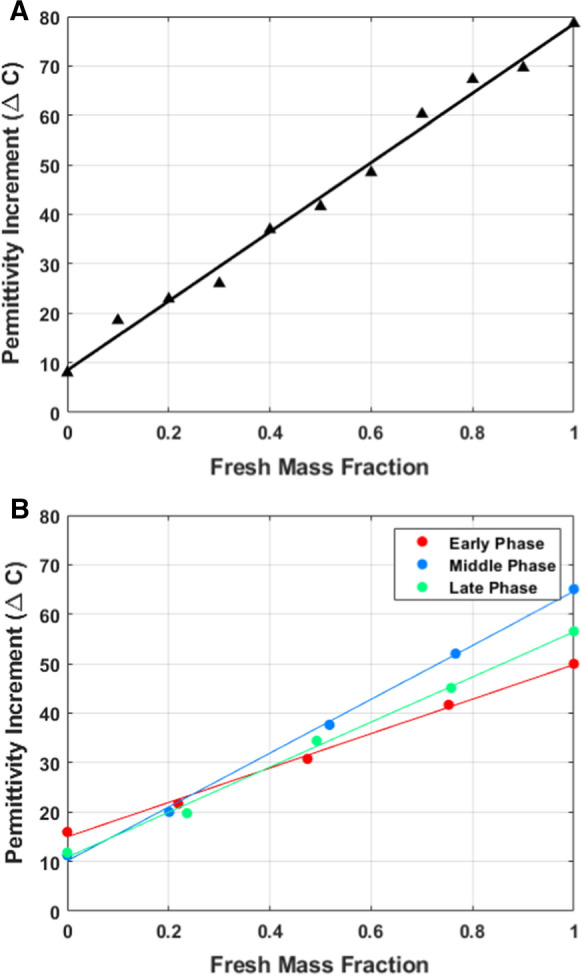
The methodology is applied to samples from the industrial scale fermentation of a filamentous fungus, Acremonium fusidioides. By mixing fresh and heat-killed samples, linear responses were verified and sample viability could be fitted with the dielectric [Formula: see text] values and total solids concentration. The study included a total of 26 samples across 21 different cultivations, with a legacy at-line viable cell analyzer requiring 2 ml samples, and a modern on-line probe operated at-line with 2 different sample presentation volumes, one compatible with the legacy analyzer, a larger sample volume of 100 ml being compatible with calibration for on-line operation. The linear model provided an [Formula: see text] value of 0.99 between [Formula: see text] and viable biomass across the sample set using either instrument. The difference in ∆C when analyzing 100 mL and 2 mL samples with an in-line probe can be adjusted by a scalar factor of 1.33 within the microbial system used in this study, preserving the linear relation with [Formula: see text] of 0.97.
It is possible to directly estimate viable biomass concentrations utilizing dielectric spectroscopy without recourse to extensive and difficult to execute independent viability studies. The same method can be applied to calibrate different instruments to measure viable biomass concentration. Small sample volumes are appropriate as long as the sample volumes are kept consistent.
介电谱常用于在线监测生物量的生长。然而,由于与细胞干重(CDW)相关性差,因此未将其用于生物量浓度测量。开发了一种校准方法,该方法可以使用介电值直接测量商业丝状过程中的活生物量浓度,而无需进行独立且具有挑战性的活力测定。
该方法应用于丝状真菌,节丛孢菌的工业规模发酵的样品。通过混合新鲜和热灭活的样品,验证了线性响应,并且可以根据介电常数[Formula: see text]值和总固体浓度拟合样品的活力。该研究共包括 21 个不同培养物的 26 个样本,使用需要 2 ml 样品的传统在线活细胞分析仪,以及在线探头,该探头在线运行,具有两种不同的样品呈现体积,一种与传统分析仪兼容,另一种更大的样品体积 100 ml 与在线操作的校准兼容。使用两种仪器,在整个样本集中,[Formula: see text]和活生物量之间的线性模型提供了 0.99 的[Formula: see text]值。在本研究中使用的微生物系统中,通过在线探头分析 100 ml 和 2 ml 样品时的 ∆C 差异可以通过 1.33 的标量因子进行调整,保持与[Formula: see text]的 0.97 的线性关系。
无需进行广泛且难以执行的独立活力研究,就可以利用介电光谱直接估计活生物量浓度。相同的方法可以应用于校准不同的仪器以测量活生物量浓度。只要保持样品体积一致,小的样品体积即可。