Tsybulin Semyon V, Filatova Ekaterina A, Pozharskii Alexander F, Ozeryanskii Valery A, Gulevskaya Anna V
Department of Chemistry, Southern Federal University, Zorge str. 7, Rostov-on-Don 344090, Russian Federation.
Beilstein J Org Chem. 2023 May 15;19:674-686. doi: 10.3762/bjoc.19.49. eCollection 2023.
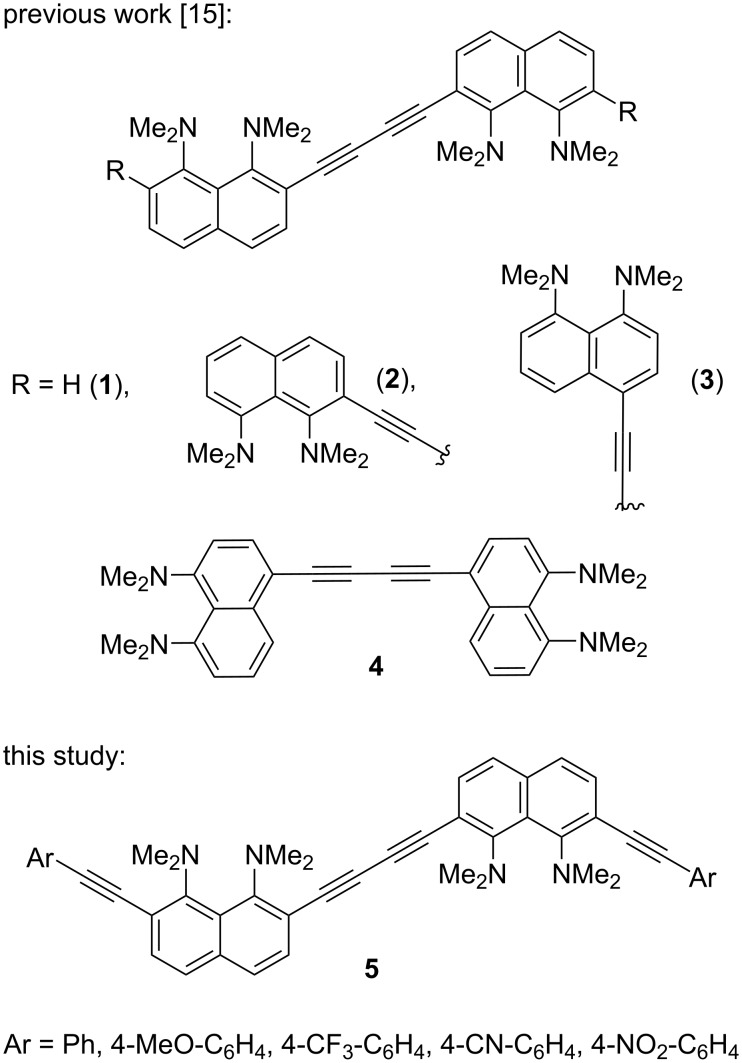
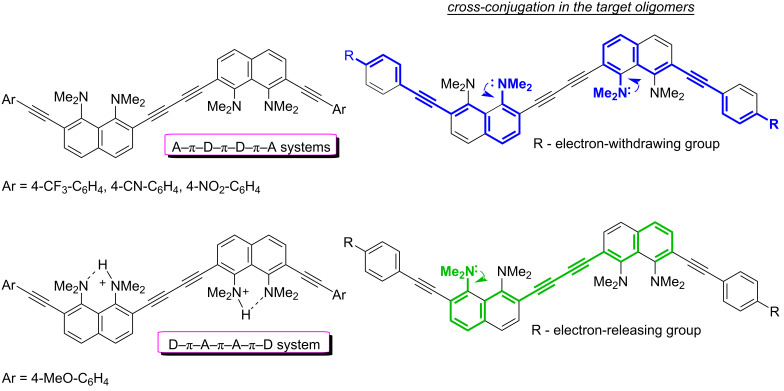
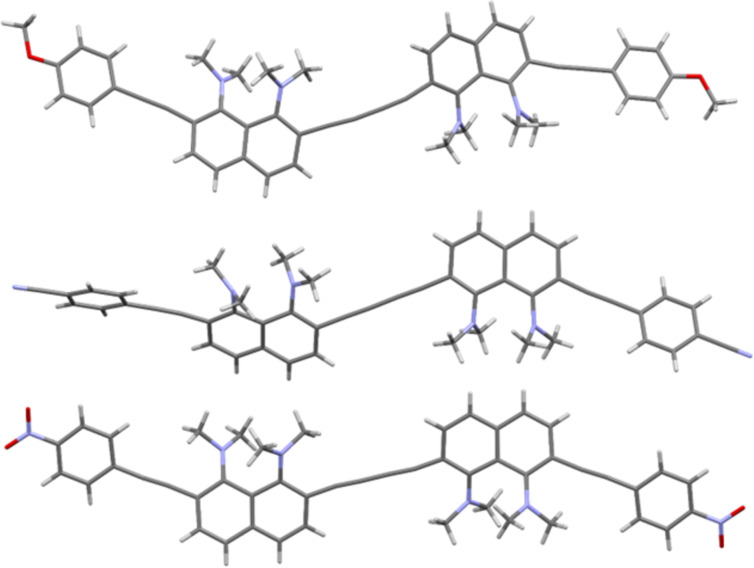
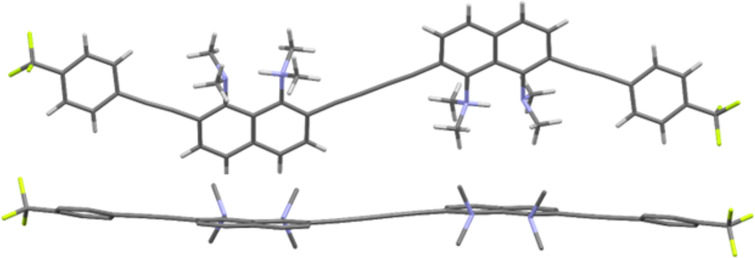
A set of novel 1,4-diaryl-1,3-butadiynes terminated by two 7-(arylethynyl)-1,8-bis(dimethylamino)naphthalene fragments was prepared via the Glaser-Hay oxidative dimerization of 2-ethynyl-7-(arylethynyl)-1,8-bis(dimethylamino)naphthalenes. The oligomers synthesized in this way are cross-conjugated systems, in which two conjugation pathways are possible: π-conjugation of 1,8-bis(dimethylamino)naphthalene (DMAN) fragments through a butadiyne linker and a donor-acceptor aryl-C≡C-DMAN conjugation path. The conjugation path can be "switched" simply by protonation of DMAN fragments. X-ray diffraction, UV-vis spectroscopy and cyclic voltammetry are applied to analyze the extent of π-conjugation and the efficiency of particular donor-acceptor conjugation path in these new compounds. X-ray structures and absorption spectra of doubly protonated tetrafluoroborate salts of the oligomers are also discussed.
通过2-乙炔基-7-(芳基乙炔基)-1,8-双(二甲氨基)萘的格拉泽-海氧化偶联反应,制备了一组由两个7-(芳基乙炔基)-1,8-双(二甲氨基)萘片段封端的新型1,4-二芳基-1,3-丁二炔。以这种方式合成的低聚物是交叉共轭体系,其中存在两种共轭途径:通过丁二炔连接基的1,8-双(二甲氨基)萘(DMAN)片段的π共轭以及供体-受体芳基-C≡C-DMAN共轭途径。共轭途径可以通过DMAN片段的质子化简单地“切换”。应用X射线衍射、紫外-可见光谱和循环伏安法来分析这些新化合物中π共轭的程度以及特定供体-受体共轭途径的效率。还讨论了低聚物的双质子化四氟硼酸盐的X射线结构和吸收光谱。