Park Ji-Young, Hewawaduge Chamith, Sivasankar Chandran, Lloren Khristine Kaith S, Oh Byungkwan, So Mi Young, Lee John Hwa
Department of Veterinary Public Health, College of Veterinary Medicine, Jeonbuk National University, Iksan 54596, Republic of Korea.
Department of Veterinary Pathology, College of Veterinary Medicine, Jeonbuk National University, Iksan 54596, Republic of Korea.
Pharmaceutics. 2023 Apr 26;15(5):1339. doi: 10.3390/pharmaceutics15051339.
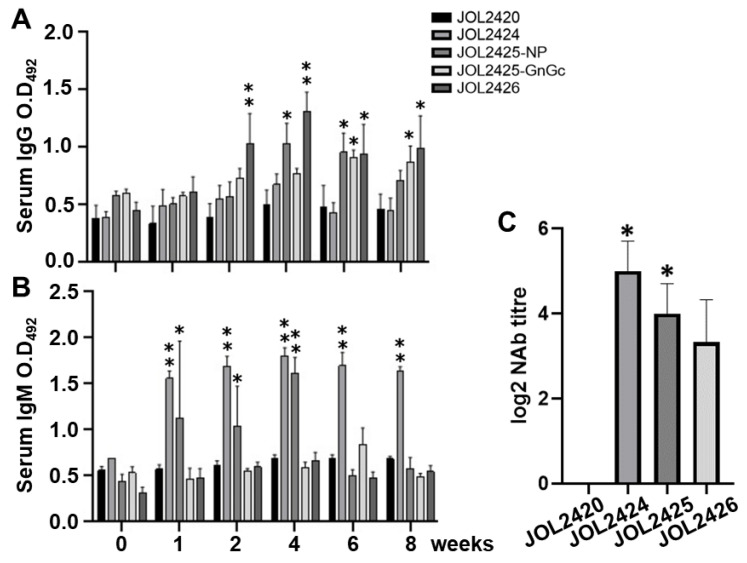
Currently, there are no commercial vaccines or therapeutics against severe fever with thrombocytopenia syndrome (SFTS) virus. This study explored an engineered Salmonella as a vaccine carrier to deliver a eukaryotic self-mRNA replicating vector, pJHL204. This vector expresses multiple SFTS virus antigenic genes for the nucleocapsid protein (NP), glycoprotein precursor (Gn/Gc), and nonstructural protein (NS) to induce host immune responses. The engineered constructs were designed and validated through 3D structure modeling. Western blot and qRT-PCR analyses of transformed HEK293T cells confirmed the delivery and expression of the vaccine antigens. Significantly, mice immunized with these constructs demonstrated a cell-mediated and humoral response as balanced Th1/Th2 immunity. The JOL2424 and JOL2425 delivering NP and Gn/Gc generated strong immunoglobulin IgG and IgM antibodies and high neutralizing titers. To further examine the immunogenicity and protection, we utilized a human DC-SIGN receptor transduced mouse model for SFTS virus infection by an adeno-associated viral vector system. Among the SFTSV antigen constructs, the construct with full-length NP and Gn/Gc and the construct with NP and selected Gn/Gc epitopes induced robust cellular and humoral immune responses. These were followed by adequate protection based on viral titer reduction and reduced histopathological lesions in the spleen and liver. In conclusion, these data indicate that recombinant attenuated Salmonella JOL2424 and JOL2425 delivering NP and Gn/Gc antigens of SFTSV are promising vaccine candidates that induce strong humoral and cellular immune responses and protection against SFTSV. Moreover, the data proved that the hDC-SIGN transduced mice as a worthy tool for immunogenicity study for SFTSV.
目前,尚无针对严重发热伴血小板减少综合征(SFTS)病毒的商用疫苗或治疗方法。本研究探索了一种工程化沙门氏菌作为疫苗载体,以递送真核自我mRNA复制载体pJHL204。该载体表达用于核衣壳蛋白(NP)、糖蛋白前体(Gn/Gc)和非结构蛋白(NS)的多个SFTS病毒抗原基因,以诱导宿主免疫反应。通过3D结构建模设计并验证了工程构建体。对转化的HEK293T细胞进行的蛋白质免疫印迹和定量逆转录聚合酶链反应分析证实了疫苗抗原的递送和表达。值得注意的是,用这些构建体免疫的小鼠表现出细胞介导的和体液反应,作为平衡的Th1/Th2免疫。递送NP和Gn/Gc的JOL2424和JOL2425产生了强大的免疫球蛋白IgG和IgM抗体以及高中和效价。为了进一步研究免疫原性和保护作用,我们利用腺相关病毒载体系统转导人DC-SIGN受体的小鼠模型进行SFTS病毒感染。在SFTSV抗原构建体中,具有全长NP和Gn/Gc的构建体以及具有NP和选定Gn/Gc表位的构建体诱导了强大的细胞和体液免疫反应。随后基于病毒滴度降低以及脾脏和肝脏中组织病理学损伤减少而提供了充分的保护。总之,这些数据表明,递送SFTSV的NP和Gn/Gc抗原的重组减毒沙门氏菌JOL2424和JOL2425是有前景的疫苗候选物,可诱导强烈的体液和细胞免疫反应并提供针对SFTSV的保护。此外,数据证明转导hDC-SIGN的小鼠是用于SFTSV免疫原性研究的有价值工具。