Department of Orthopaedics, Second Affiliated Hospital of Chongqing Medical University.
Department of Orthopaedics, Center for Musculoskeletal Research, University of Rochester Medical Center, Rochester, NY.
Int J Surg. 2023 Sep 1;109(9):2721-2731. doi: 10.1097/JS9.0000000000000502.
Post-traumatic related limb osteomyelitis (PTRLO) is a complex bone infection. Currently, there are no available microbial data on a national scale that can guide appropriate antibiotic selection, and explore the dynamic changes in dominant pathogens over time. This study aimed to conduct a comprehensive epidemiological analysis of PTRLO in China.
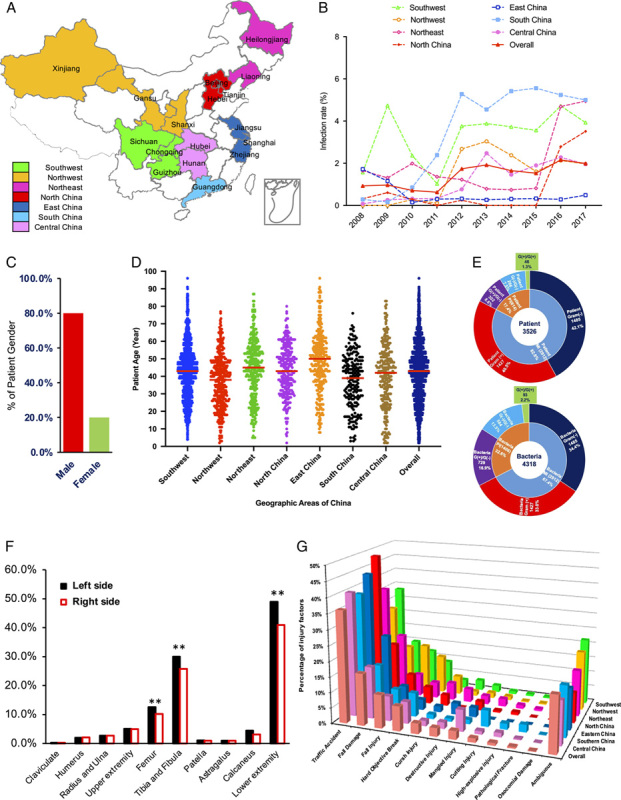
The study was approved by the Institutional Research Board (IRB), and 3526 PTRLO patients were identified from 212 394 traumatic limb fracture patients at 21 hospitals between 1 January 2008 and 31 December 2017. A retrospective analysis was conducted to investigate the epidemiology of PTRLO, including changes in infection rate (IR), pathogens, infection risk factors and antibiotic resistance and sensitivity.
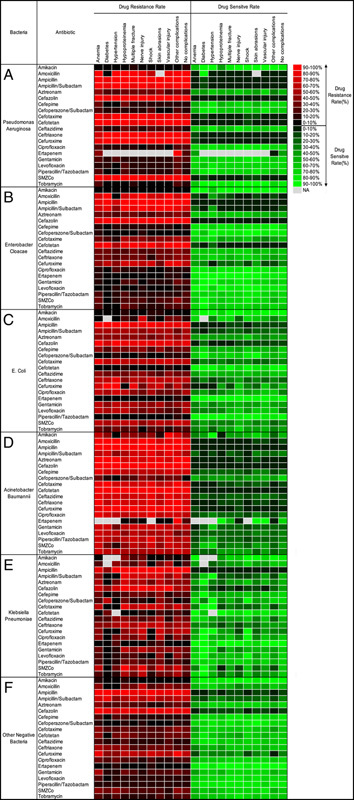
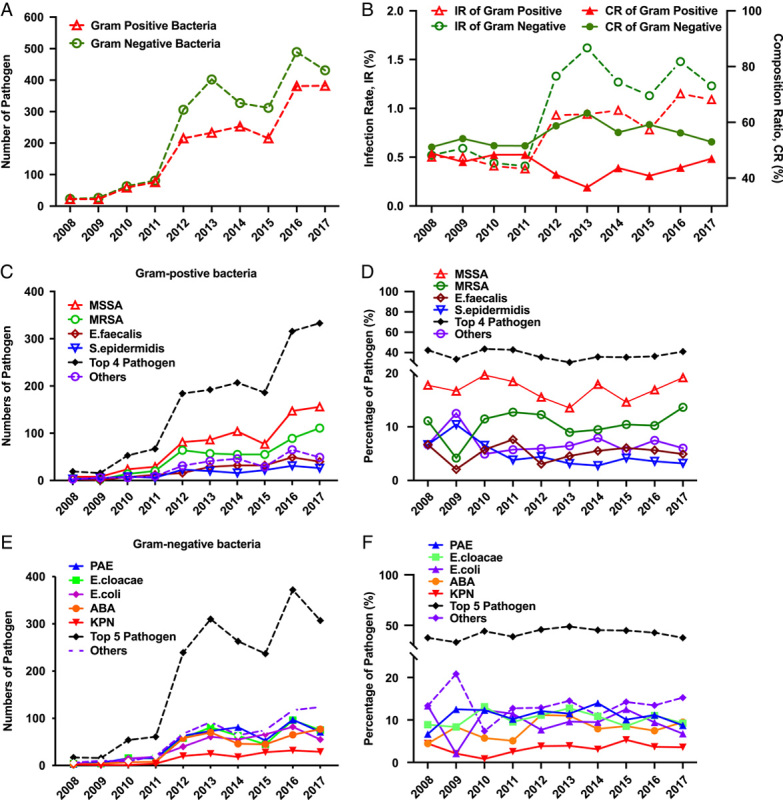
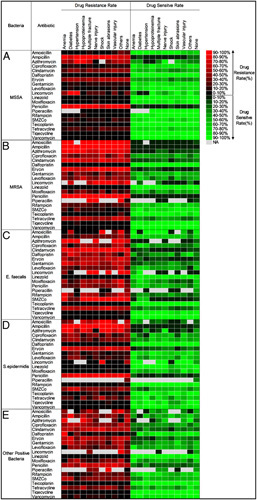
The IR of PTRLO increased gradually from 0.93 to 2.16% (Z=14.392, P <0.001). Monomicrobial infection (82.6%) was significantly higher than polymicrobial infection (17.4%) ( P <0.001). The IR of Gram-positive (GP) and Gram-negative (GN) pathogens showed a significant increase from the lowest 0.41% to the highest 1.15% (GP) or 1.62% (GN), respectively. However, the longitudinal trend of GP vs. GN's composition did not show any significance (Z=±1.1918, P >0.05). The most prevalent GP strains were Methicillin-sensitive Staphylococcus aureus (MSSA) (17.03%), Methicillin-resistant Staphylococcus aureus (MRSA) (10.46%), E. faecalis (5.19%) and S. epidermidis (4.87%). In contrast, the dominant strains GN strains were Pseudomonas Aeruginosa (10.92%), E. cloacae (10.34%), E. coli (9.47%), Acinetobacter Baumannii (7.92%) and Klebsiella Pneumoniae (3.33%). In general, the high-risk factors for polymicrobial infection include opened-fracture (odds ratio, 2.223), hypoproteinemia (odds ratio, 2.328), and multiple fractures (odds ratio, 1.465). It is important to note that the antibiotics resistance and sensitivity analysis of the pathogens may be influenced by complications or comorbidities.
This study provides the latest data of PTRLO in China and offers trustworthy guidelines for clinical practice. (China Clinical Trials.gov number, ChiCTR1800017597).
创伤后相关肢体骨髓炎(PTRLO)是一种复杂的骨感染。目前,在全国范围内,没有可用于指导抗生素选择的微生物数据,也无法了解优势病原体随时间的动态变化。本研究旨在对中国的 PTRLO 进行全面的流行病学分析。
该研究得到了机构审查委员会(IRB)的批准,对 2008 年 1 月 1 日至 2017 年 12 月 31 日期间,21 家医院的 212394 例创伤性肢体骨折患者中,确定了 3526 例 PTRLO 患者。对 PTRLO 的流行病学进行回顾性分析,包括感染率(IR)、病原体、感染危险因素和抗生素耐药性及敏感性的变化。
PTRLO 的 IR 从 0.93%逐渐升高到 2.16%(Z=14.392,P<0.001)。单一致病菌感染(82.6%)明显高于多致病菌感染(17.4%)(P<0.001)。革兰氏阳性菌(GP)和革兰氏阴性菌(GN)病原体的 IR 分别从最低的 0.41%增加到最高的 1.15%(GP)或 1.62%(GN)。然而,GP 与 GN 的组成纵向趋势没有显示出任何显著差异(Z=±1.1918,P>0.05)。最常见的 GP 菌株是甲氧西林敏感金黄色葡萄球菌(MSSA)(17.03%)、耐甲氧西林金黄色葡萄球菌(MRSA)(10.46%)、粪肠球菌(5.19%)和表皮葡萄球菌(4.87%)。相比之下,主要 GN 菌株为铜绿假单胞菌(10.92%)、阴沟肠杆菌(10.34%)、大肠杆菌(9.47%)、鲍曼不动杆菌(7.92%)和肺炎克雷伯菌(3.33%)。一般来说,多致病菌感染的高危因素包括开放性骨折(优势比,2.223)、低蛋白血症(优势比,2.328)和多发性骨折(优势比,1.465)。值得注意的是,病原体的抗生素耐药性和敏感性分析可能会受到并发症或合并症的影响。
本研究提供了中国 PTRLO 的最新数据,为临床实践提供了可靠的指导。(中国临床试验注册中心编号:ChiCTR1800017597)。