Department of Oncology, Hospital de Santa Maria, Centro Hospitalar Lisboa Norte, Lisbon, Portugal.
Instituto de Medicina Molecular-João Lobo Antunes, Faculdade de Medicina da Universidade de Lisboa, Lisbon, Portugal.
Front Public Health. 2023 May 12;11:1133959. doi: 10.3389/fpubh.2023.1133959. eCollection 2023.
PD-[L]1 inhibitors revolutionized cancer treatment but challenge the affordability of health systems. This policy-focused model aimed to estimate the health and budget impact of anti-PD-(L)1s in Portugal and inform current discussions.
The Health Impact Projection (HIP) model estimates clinical (life years, progression-free survival [PFS] years, and quality-adjusted life years [QALY] gained and adverse events [AEs] incurred) and economic (direct and indirect costs) outcomes in a world where cancer patients are initiating treatment with standard-of-care (SOC) versus SOC plus anti-PD-(L)1s over a 3-year time horizon. Indications included adjuvant and metastatic melanoma, non-small cell lung cancer (first and second line), metastatic triple-negative breast cancer, head and neck cancer, urothelial carcinoma, and renal cell carcinoma. Model inputs were based on publicly available literature data and expert opinion.
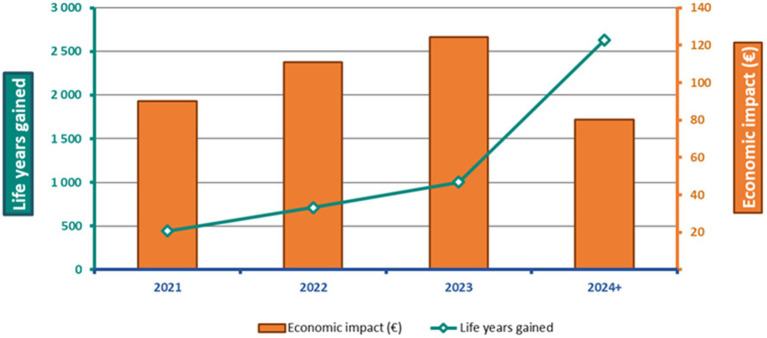
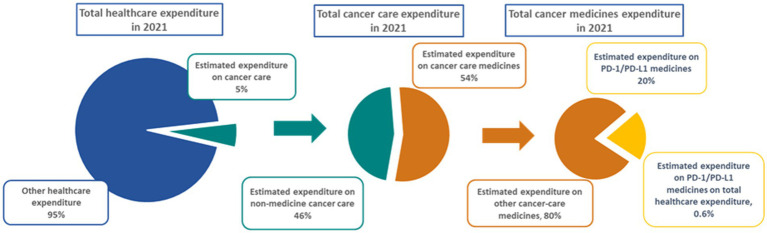
The model estimated that, over 3 years, 7,773 patients would be treated with anti-PD-(L)1s, realizing a gain of 4,787 life years, 6,901 PFS years, and 4,214 QALYs and avoiding 399 AEs. The introduction of anti-PD-(L)1s had a projected average annual impact of ≈ €108 million and a share of 20% of total cancer medicines expenditure and 0.6% of total healthcare expenditure in 2021. Although higher disease management costs are expected for patients living longer with anti-PD-(L)1s and drug acquisition costs are considerable, that is partially offset by a reduction in end-of-life costs (€611,092/year) and costs associated with patient productivity lost to cancer (€9,128,142/year).
This model highlights the significant survival and QoL benefit of anti-PD-(L)1s for cancer patients in Portugal, with a relatively low increased cost in total healthcare expenditure.
PD-[L]1 抑制剂彻底改变了癌症治疗,但给医疗体系的负担能力带来了挑战。本项以政策为重点的模型旨在评估葡萄牙使用抗 PD-(L)1 药物的健康和预算影响,并为当前的讨论提供信息。
健康影响预测 (HIP) 模型在 3 年的时间范围内,在癌症患者接受标准治疗(SOC)与 SOC 加抗 PD-(L)1 治疗的情况下,估计了临床(生命年、无进展生存期[PFS]年、质量调整生命年[QALY]和不良事件[AE])和经济(直接和间接成本)结果。纳入的适应证包括辅助和转移性黑色素瘤、非小细胞肺癌(一线和二线)、转移性三阴性乳腺癌、头颈部癌、尿路上皮癌和肾细胞癌。模型输入基于公开的文献数据和专家意见。
该模型估计,在 3 年内,将有 7773 名患者接受抗 PD-(L)1 治疗,实现 4787 个生命年、6901 个 PFS 年和 4214 个 QALY 的获益,并避免 399 例 AE。抗 PD-(L)1 的引入预计将对 2021 年的年平均影响约为 1.08 亿欧元,占癌症药物总支出的 20%和总医疗保健支出的 0.6%。尽管接受抗 PD-(L)1 治疗的患者寿命延长,导致疾病管理成本预计会增加,且药物获取成本较高,但这部分被终末期成本的降低(每年 611092 欧元)和因癌症导致的患者生产力损失成本(每年 9128142 欧元)所抵消。
该模型突出了抗 PD-(L)1 药物为葡萄牙癌症患者带来的显著生存和 QoL 获益,同时对总医疗保健支出的增加成本相对较低。