
封锁措施对学生成绩的影响:意大利、瑞典和土耳其之间的比较研究。
The effect of lockdown on students' performance: A comparative study between Italy, Sweden and Turkey.
作者信息
Casalone Giorgia, Michelangeli Alessandra, Östh John, Türk Umut
机构信息
Department of Economics and Business, University of Piemonte Orientale, Vercelli, Italy.
Dondena Centre for Research on Social Dynamics and Public Policy, Italy.
出版信息
Heliyon. 2023 Jun;9(6):e16464. doi: 10.1016/j.heliyon.2023.e16464. Epub 2023 May 23.
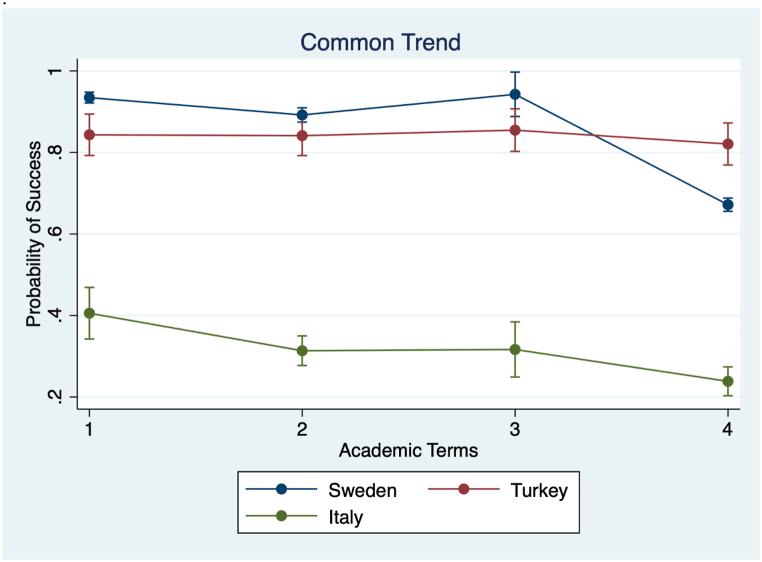
During the first months of the COVID-19 outbreak, countries adopted different strategies in order to mitigate the effects of the pandemic, ranging from recommendations to limit individual movement to severe lockdown measures. Regarding higher education, university studies were shifted to digital solutions in most countries. The sudden move to online teaching affected students differently, depending on the overall mitigation strategies applied. Severe lockdown and closure measures caused a disruption of their academic and social interactions. In contrast, recommendations to limit activities probably did not change students' life to a great extent. The heterogeneity of the policies adopted in three countries (Italy, Sweden and Turkey) gives us an opportunity to assess the effects of lockdown measures due to the COVID-19 pandemic on university students' performance. We employ a difference-in-differences approach by exploiting the fact that Italy and Turkey experienced national lockdowns, while Sweden never applied nationwide mandatory restrictive policies. We use administrative data from universities in the three countries to estimate the probability to pass exams after the spread of COVID-19 pandemic (and the shift to distance education), with respect to the previous comparable period. We find that the pass rate decreased with the shift to online teaching. However, lockdown measures, especially if very restrictive as those applied in Italy, helped to compensate such negative effect. A possible explanation is that students took advantage of the huge increase in the time available for their studies, given the impossibility to carry out any activity outside the home.
在新冠疫情爆发的最初几个月,各国采取了不同策略来减轻疫情影响,从限制个人流动的建议到严格的封锁措施不等。在高等教育方面,大多数国家的大学课程转向了数字化解决方案。突然转向在线教学对学生的影响各异,这取决于所采用的总体缓解策略。严格的封锁和关闭措施导致学生的学术和社交互动中断。相比之下,限制活动的建议可能在很大程度上并未改变学生的生活。三个国家(意大利、瑞典和土耳其)所采取政策的异质性,让我们有机会评估新冠疫情封锁措施对大学生学业表现的影响。我们采用双重差分法,利用意大利和土耳其经历了全国性封锁,而瑞典从未实施全国性强制限制政策这一事实。我们使用这三个国家大学的行政数据,来估计新冠疫情蔓延(以及转向远程教育)后相对于之前可比时期的考试通过率。我们发现,转向在线教学后通过率下降了。然而,封锁措施,尤其是像意大利实施的那种非常严格的措施,有助于弥补这种负面影响。一个可能的解释是,由于无法在家外进行任何活动,学生利用了可用于学习的时间大幅增加这一情况。



 Zotero 插件