Charité - Universitätsmedizin Berlin, Corporate Member of Freie Universität Berlin and Humboldt-Universität zu Berlin, Department of Neurology, Charitéplatz 1, 10117 Berlin, Germany; Charité - Universitätsmedizin Berlin, Corporate Member of Freie Universität Berlin and Humboldt-Universität zu Berlin, NCRC - Neuroscience Clinical Research Center, Charitéplatz 1, 10117 Berlin, Germany.
Charité - Universitätsmedizin Berlin, Corporate Member of Freie Universität Berlin and Humboldt-Universität zu Berlin, Department of Neurology, Charitéplatz 1, 10117 Berlin, Germany; Charité - Universitätsmedizin Berlin, Corporate Member of Freie Universität Berlin and Humboldt-Universität zu Berlin, NCRC - Neuroscience Clinical Research Center, Charitéplatz 1, 10117 Berlin, Germany.
Neuroimage Clin. 2023;38:103439. doi: 10.1016/j.nicl.2023.103439. Epub 2023 May 24.
The hippocampus is the most prominent single region of interest (ROI) for the diagnosis and prediction of Alzheimer's disease (AD). However, its suitability in the earliest stages of cognitive decline, i.e., subjective cognitive decline (SCD), remains uncertain which warrants the pursuit of alternative or complementary regions. The amygdala might be a promising candidate, given its implication in memory as well as other psychiatric disorders, e.g. depression and anxiety, which are prevalent in SCD. In this 7 tesla (T) magnetic resonance imaging (MRI) study, we aimed to compare the contribution of volumetric measurements of the hippocampus, the amygdala, and their respective subfields, for early diagnosis and prediction in an AD-related study population.
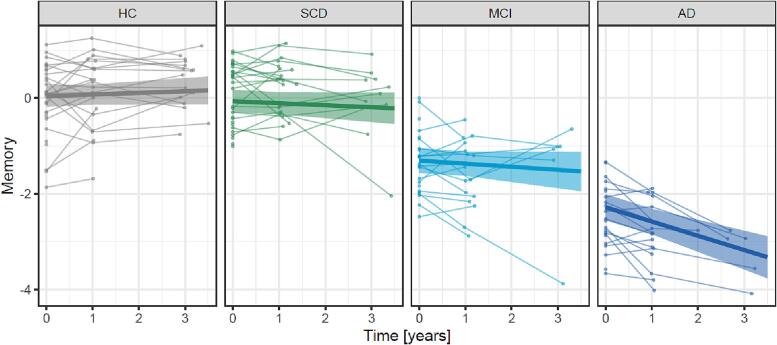
Participants from a longitudinal study were grouped into SCD (n = 29), mild cognitive impairment (MCI, n = 23), AD (n = 22) and healthy control (HC, n = 31). All participants underwent 7T MRI at baseline and extensive neuropsychological testing at up to three visits (baseline n = 105, 1-year n = 78, 3-year n = 39). Analysis of covariance (ANCOVA) was used to assess group differences of baseline volumes of the amygdala and the hippocampus and their subfields. Linear mixed models were used to estimate the effects of baseline volumes on yearly changes of a z-scaled memory score. All models were adjusted to age, sex and education.
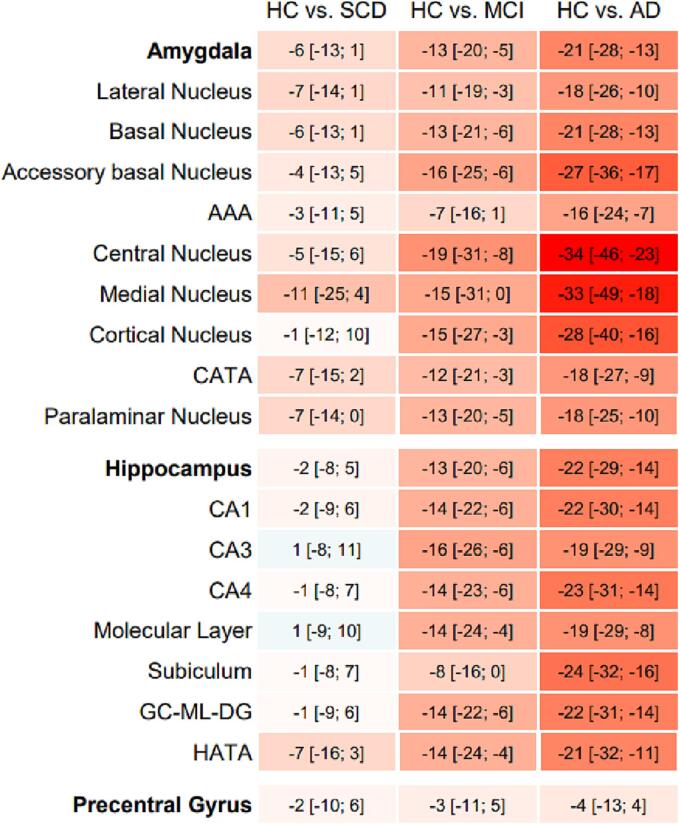
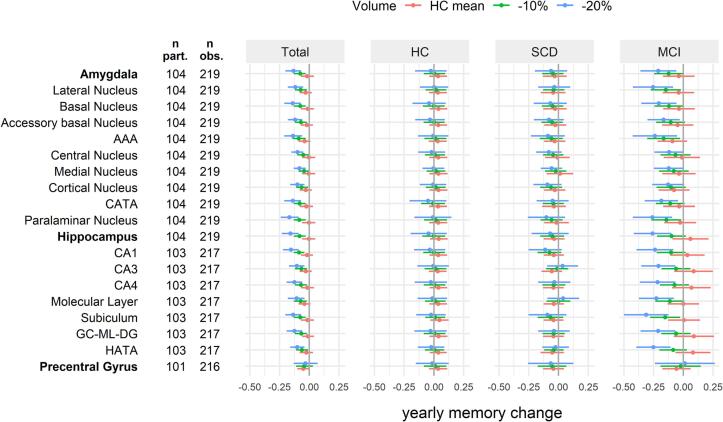
Compared to the HC group, individuals with SCD showed smaller amygdala ROI volumes (range across subfields -11% to -1%), but not hippocampus ROI volumes (-2% to 1%) except for the hippocampus-amygdala-transition-area (-7%). However, cross-sectional associations between baseline memory and volumes were smaller for amygdala ROIs (std. ß [95% CI] ranging between 0.16 [0.08; 0.25] and 0.46 [0.31; 0.60]) than hippocampus ROIs (between 0.32 [0.19; 0.44] and 0.53 [0.40; 0.67]). Further, the association of baseline volumes with yearly memory change in the HC and SCD groups was similarly weak for amygdala ROIs and hippocampus ROIs. In the MCI group, volumes of amygdala ROIs were associated with a relevant yearly memory decline [95% CI] ranging between -0.12 [-0.24; 0.00] and -0.26 [-0.42; -0.09] for individuals with 20% smaller volumes than the HC group. However, effects were stronger for hippocampus ROIs with a corresponding yearly memory decline ranging between -0.21 [-0.35; -0.07] and -0.31 [-0.50; -0.13].
Volumes of amygdala ROIs, as determined by 7T MRI, might contribute to objectively and non-invasively identify patients with SCD, and thus aid early diagnosis and treatment of individuals at risk to develop dementia due to AD, however associations with other psychiatric disorders should be evaluated in further studies. The amygdala's value in the prediction of longitudinal memory changes in the SCD group remains questionable. Primarily in patients with MCI, memory decline over 3 years appears to be more strongly associated with volumes of hippocampus ROIs than amygdala ROIs.
海马体是诊断和预测阿尔茨海默病(AD)最突出的单一感兴趣区(ROI)。然而,它在认知能力下降的早期阶段,即主观认知下降(SCD)的适用性尚不确定,这需要寻找替代或补充的区域。杏仁核可能是一个很有前途的候选者,因为它在记忆以及其他精神疾病,如抑郁症和焦虑症,都有一定的关联,而这些疾病在 SCD 中很常见。在这项 7 特斯拉(T)磁共振成像(MRI)研究中,我们旨在比较海马体、杏仁核及其各自的亚区的容积测量在 AD 相关研究人群中的早期诊断和预测中的贡献。
来自一项纵向研究的参与者被分为 SCD(n=29)、轻度认知障碍(MCI,n=23)、AD(n=22)和健康对照组(HC,n=31)。所有参与者在基线时进行 7T MRI 检查,并在最多三次访视时进行广泛的神经心理学测试(基线 n=105,1 年 n=78,3 年 n=39)。协方差分析(ANCOVA)用于评估基线时杏仁核和海马体及其亚区的组间体积差异。线性混合模型用于估计基线体积对 z 标准化记忆评分的年度变化的影响。所有模型均调整为年龄、性别和教育程度。
与 HC 组相比,SCD 患者的杏仁核 ROI 体积较小(各亚区范围为-11%至-1%),但海马体 ROI 体积无差异(-2%至 1%),除了海马体-杏仁核过渡区(-7%)。然而,与海马体 ROI 相比,基线记忆与体积之间的横断面相关性较小(标准β[95%CI]范围在 0.16[0.08;0.25]和 0.46[0.31;0.60]之间)。进一步的,在 HC 和 SCD 组中,基线体积与每年记忆变化的相关性对于杏仁核 ROI 和海马体 ROI 同样较弱。在 MCI 组中,杏仁核 ROI 的体积与相关的每年记忆下降相关[95%CI]范围在-0.12[-0.24;0.00]和-0.26[-0.42;0.09],与 HC 组相比,个体的体积减少了 20%。然而,对于海马体 ROI 来说,其影响更强,相应的每年记忆下降范围在-0.21[-0.35;0.07]和-0.31[-0.50;0.13]之间。
7T MRI 确定的杏仁核 ROI 体积可能有助于客观、无创地识别 SCD 患者,从而有助于早期诊断和治疗 AD 风险人群,但应在进一步研究中评估与其他精神疾病的关联。杏仁核在 SCD 组的纵向记忆变化预测中的价值仍存在疑问。主要在 MCI 患者中,3 年内的记忆下降与海马体 ROI 体积的相关性明显强于杏仁核 ROI 体积。