From the Centers for Disease Control and Prevention, Surveillance and Data Science Branch, Division of STD Prevention (NCHHSTP), Atlanta, GA.
Johns Hopkins University School of Medicine and Baltimore City Health Department, Baltimore, MD.
Sex Transm Dis. 2023 Oct 1;50(10):692-698. doi: 10.1097/OLQ.0000000000001837. Epub 2023 May 28.
The initial years of the COVID-19 pandemic disrupted sexual health care clinic's services. We describe use patterns by patient characteristics, and the use of telehealth (TH) services among a network of sexually transmitted disease (STD) clinics.
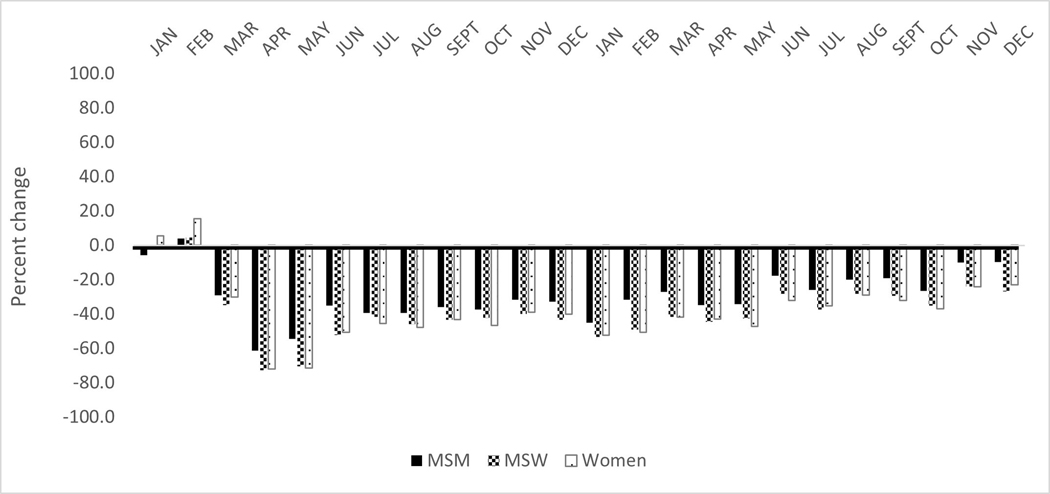
Data were collected using a survey to assess the impact of COVID-19 from March to December 2020 among 7 jurisdictions who contribute STD visit-level data as part of the STD Surveillance Network. As a complement to the survey, retrospective data from January 2019 to December 2021 from these 7 STD clinics in the same 7 jurisdictions were examined for monthly utilization trends by overall visits, patient characteristics, and TH visits.
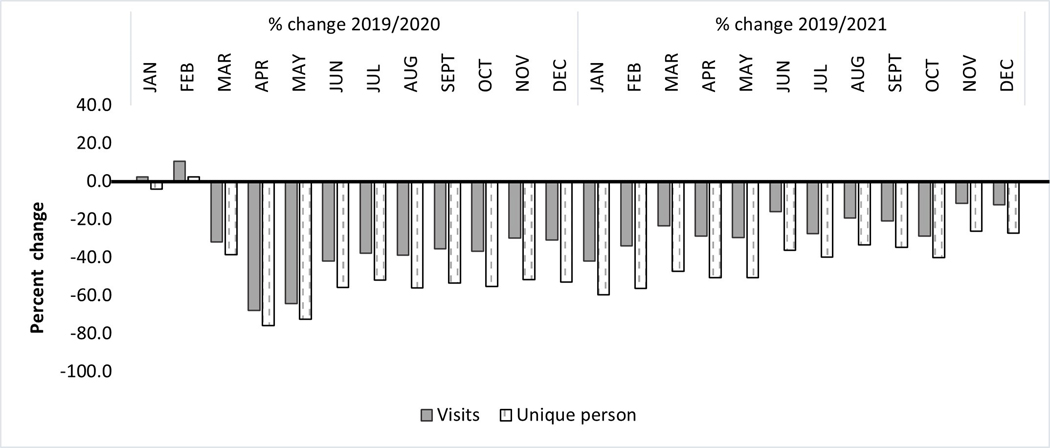
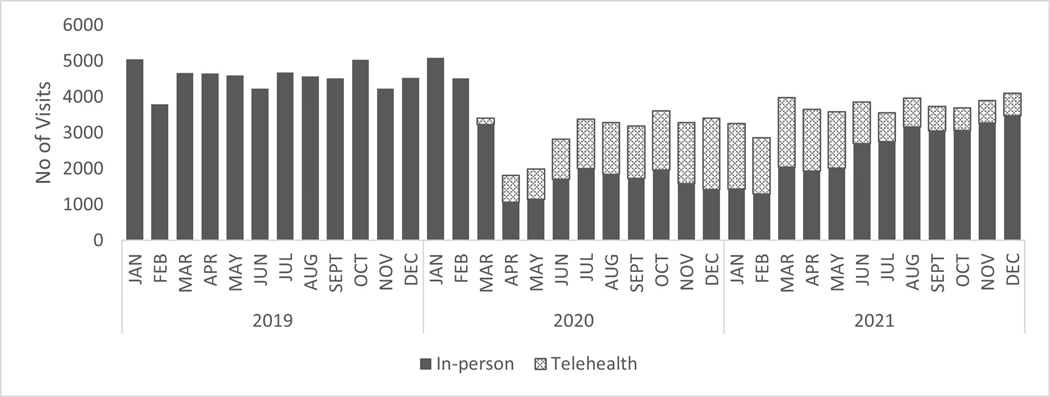
Survey results indicated 7 clinics prioritized patients for in-person visits and 4 jurisdictions reported urgent care centers were the most common referral location. In April 2020 (relative to April 2019) clinic visits and unique patients decreased by 68.0% and 75.8%, respectively. Telehealth were documented in 4 clinics, beginning in March 2020, peaking in December 2020, and tapering until December 2021. We observed the number of clinic visits (-12.2%) and unique patients presenting for care (-27.2%) in December 2021 had yet to return to levels to that seen in December 2019.
Sexually transmitted disease clinics showed fragility and resiliency in their adjustment to the pandemic; allowing for the continuation of services. Overall patient census has been slow to return to prepandemic levels, and many patients may still not be seeking timely care. This could result in missed opportunities to screen and treat STIs and increasing the possibility of harmful sequelae.
COVID-19 大流行的最初几年扰乱了性健康护理诊所的服务。我们描述了按患者特征的使用模式,以及在性传播疾病(STD)诊所网络中使用远程医疗(TH)服务的情况。
从 2020 年 3 月至 12 月,使用一项调查收集了 COVID-19 对 7 个司法管辖区的影响数据,这些司法管辖区作为 STD 监测网络的一部分,提供 STD 就诊级别的数据。作为调查的补充,对来自这 7 个 STD 诊所的 2019 年 1 月至 2021 年 12 月的回顾性数据进行了检查,以了解总体就诊量、患者特征和 TH 就诊量的月度变化趋势。
调查结果表明,7 家诊所优先为患者安排了面对面就诊,4 个司法管辖区报告说,紧急护理中心是最常见的转诊地点。与 2019 年 4 月相比,2020 年 4 月诊所就诊和就诊的患者分别减少了 68.0%和 75.8%。2020 年 3 月,4 家诊所开始记录远程医疗,2020 年 12 月达到峰值,并一直持续到 2021 年 12 月。我们观察到,2021 年 12 月的诊所就诊次数(减少了 12.2%)和就诊的独特患者(减少了 27.2%)尚未恢复到 2019 年 12 月的水平。
性传播疾病诊所表现出脆弱性和对大流行的适应能力;允许继续提供服务。总的患者普查人数仍缓慢恢复到大流行前的水平,许多患者可能仍未寻求及时的护理。这可能导致错失筛查和治疗性传播感染的机会,并增加产生有害后果的可能性。