Department of Physiology and Anatomy, University of North Texas Health Science Center, 3500 Camp Bowie Blvd, Fort Worth, TX, USA.
Department of Health and Exercise Science, The College of New Jersey, 2000 Pennington Rd, Ewing, NJ, USA.
Sci Rep. 2023 May 31;13(1):8838. doi: 10.1038/s41598-023-34773-w.
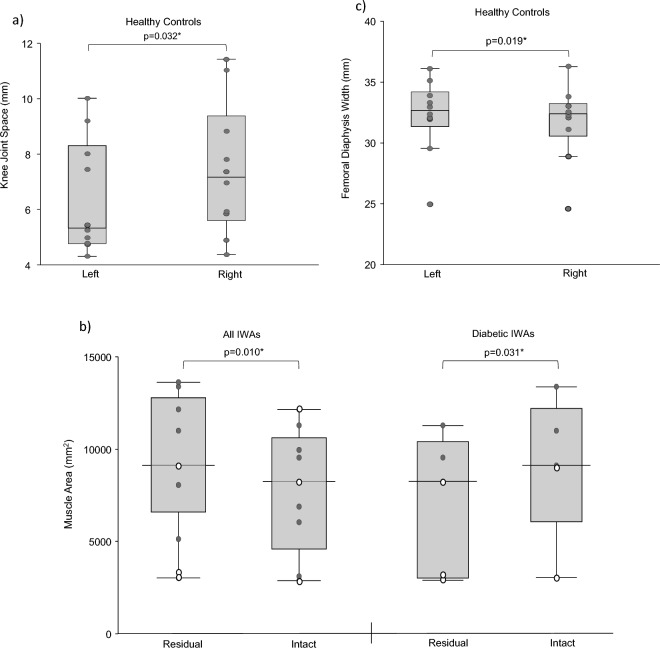
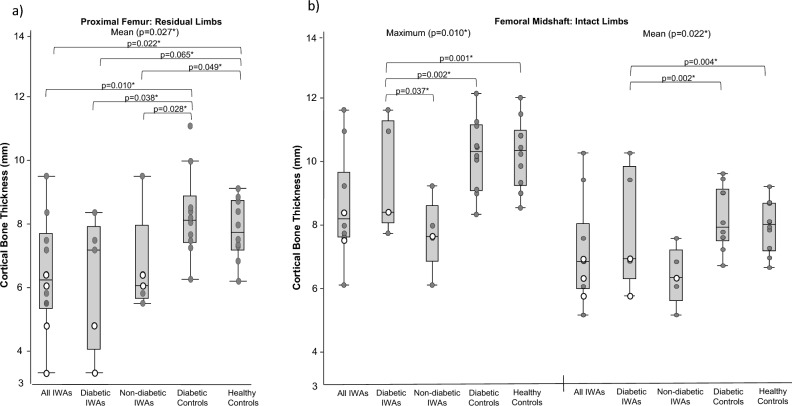
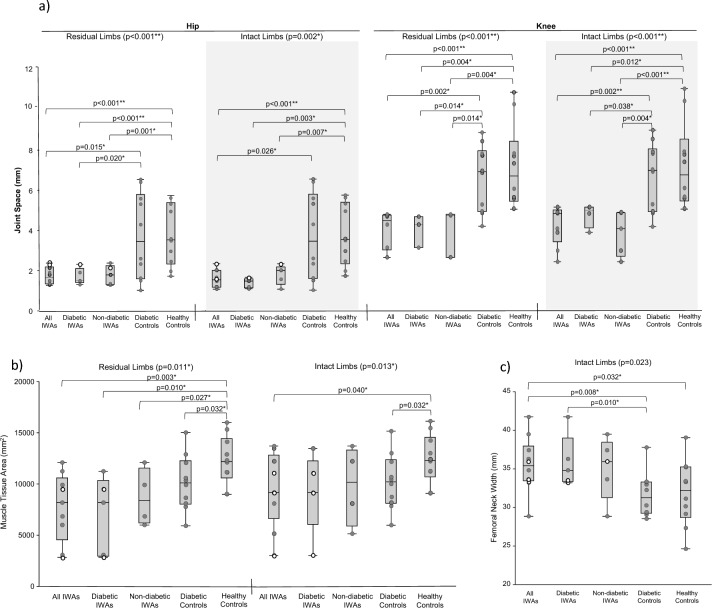
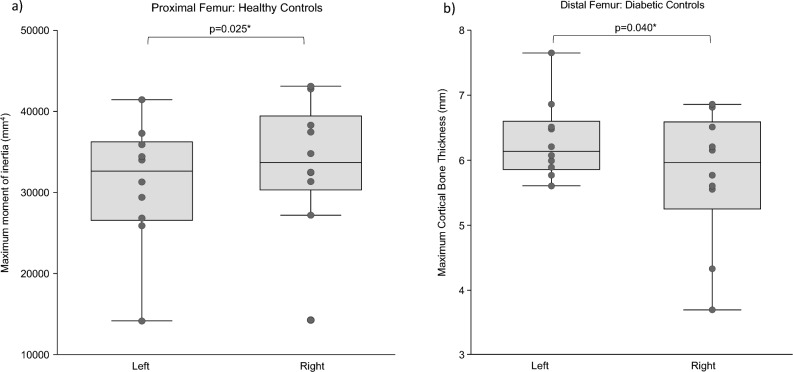
Individuals with lower-limb amputations, many of whom have type 2 diabetes, experience impaired musculoskeletal health. This study: (1) compared residual and intact limbs of diabetic and non-diabetic post-mortem individuals with amputation to identify structures vulnerable to injury, and (2) compared findings to diabetic and healthy control groups to differentiate influences of amputation and diabetes on musculoskeletal health. Postmortem CT scans of three groups, ten individuals each, were included: (1) individuals with transtibial or transfemoral amputations, half with diabetes (2) diabetic controls, and (3) healthy controls. Hip and knee joint spaces, cross-sectional thigh muscle and fat areas, and cross-sectional bone properties (e.g. area, thickness, geometry) were measured. Wilcoxon Signed-Rank and Kruskal-Wallis tests assessed statistical significance. Asymmetry percentages between limbs assessed clinical significance. Residual limbs of individuals with amputation, particularly those with diabetes, had significantly less thigh muscle area and thinner distal femoral cortical bone compared to intact limbs. Compared to control groups, individuals with amputation had significantly narrower joint spaces, less thigh muscle area bilaterally, and thinner proximal femoral cortical bone in the residual limb. Diabetic individuals with amputation had the most clinically significant asymmetry. Findings tended to align with those of living individuals. However, lack of available medical information and small sample sizes reduced the anticipated clinical utility. Larger sample sizes of living individuals are needed to assess generalizability of findings. Quantifying musculoskeletal properties and differentiating influences of amputation and diabetes could eventually help direct rehabilitation techniques.
下肢截肢者(其中许多人患有 2 型糖尿病)的肌肉骨骼健康受损。本研究:(1)比较了糖尿病和非糖尿病截肢者的残肢和完整肢体,以确定易受伤的结构;(2)将结果与糖尿病和健康对照组进行比较,以区分截肢和糖尿病对肌肉骨骼健康的影响。纳入了三组共 30 名尸检个体的 CT 扫描:(1)经胫骨或股骨截肢者,其中一半患有糖尿病;(2)糖尿病对照组;(3)健康对照组。测量了髋关节和膝关节间隙、大腿肌肉和脂肪的横截面积,以及骨的横截面积(如面积、厚度、几何形状)。采用 Wilcoxon 符号秩检验和 Kruskal-Wallis 检验评估统计学意义。评估了肢体之间的不对称百分比的临床意义。与完整肢体相比,截肢者的残肢(尤其是糖尿病患者)的大腿肌肉面积更小,股骨远端皮质骨更薄。与对照组相比,截肢者的关节间隙更窄,双侧大腿肌肉面积更小,残肢的股骨近端皮质骨更薄。截肢的糖尿病患者的不对称程度最具临床意义。研究结果与活体研究结果一致。然而,由于缺乏可用的医疗信息和样本量小,降低了预期的临床应用价值。需要更大样本量的活体个体来评估研究结果的普遍性。量化肌肉骨骼特性并区分截肢和糖尿病的影响,最终有助于指导康复技术。