Institute of Environment and Sustainable Development in Agriculture, Chinese Academy of Agricultural Sciences, Beijing, 100081, China.
Key Laboratory of Intergraded Management of Harmful Crop Vermin of China Northwestern Oasis, Ministry of Agriculture and Rural Affairs/Institute of Plant Protection, Xinjiang Academy of Agricultural Sciences, Urumqi, 830091, China.
Sci Data. 2023 Jun 1;10(1):341. doi: 10.1038/s41597-023-02247-3.
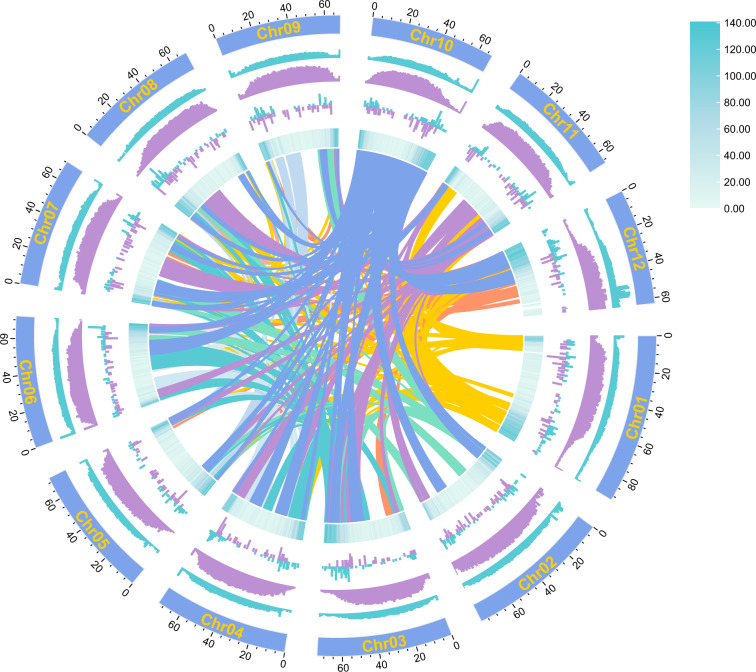
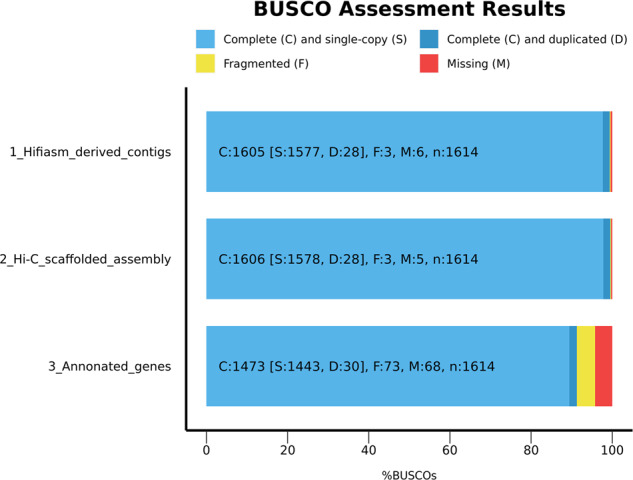
The prickly nightshade Solanum rostratum, an annual malignant weed, is native to North America and has globally invaded 34 countries, causing serious threats to ecosystems, agriculture, animal husbandry, and human health. In this study, we constructed a chromosome-level genome assembly and annotation of S. rostratum. The contig-level genome was initially assembled in 898.42 Mb with a contig N50 of 62.00 Mb from PacBio high-fidelity reads. With Hi-C sequencing data scaffolding, 96.80% of the initially assembled sequences were anchored and orientated onto 12 pseudo-chromosomes, generating a genome of 869.69 Mb with a contig N50 of 72.15 Mb. We identified 649.92 Mb (72.26%) of repetitive sequences and 3,588 non-coding RNAs in the genome. A total of 29,694 protein-coding genes were predicted, with 28,154 (94.81%) functionally annotated genes. We found 99.5% and 91.3% complete embryophyta_odb10 genes in the pseudo-chromosomes genome and predicted gene datasets by BUSCO assessment. The present genomic resource provides essential information for subsequent research on the mechanisms of environmental adaptation of S. rostratum and host shift in Colorado potato beetles.
刺茄 Solanum rostratum,一种一年生恶性杂草,原产于北美洲,现已在全球 34 个国家入侵,对生态系统、农业、畜牧业和人类健康造成严重威胁。本研究构建了刺茄的染色体水平基因组组装和注释。使用 PacBio 高保真reads 初步组装的 Contig 级基因组大小为 898.42 Mb,Contig N50 为 62.00 Mb。通过 Hi-C 测序数据支架,96.80%的初始组装序列锚定并定向到 12 个假染色体上,生成了一个 869.69 Mb 的基因组,Contig N50 为 72.15 Mb。我们在基因组中鉴定出 649.92 Mb(72.26%)的重复序列和 3588 个非编码 RNA。总共预测了 29694 个蛋白质编码基因,其中 28154 个(94.81%)具有功能注释基因。通过 BUSCO 评估,在假染色体基因组和预测的基因数据集上,我们发现 99.5%和 91.3%的完整 embryophyta_odb10 基因。本研究提供的基因组资源为后续研究刺茄的环境适应机制和科罗拉多马铃薯甲虫的宿主转移提供了重要信息。